- by Daily Talkin Staff
- July 8, 2026
-

-
-
Loading
Loading
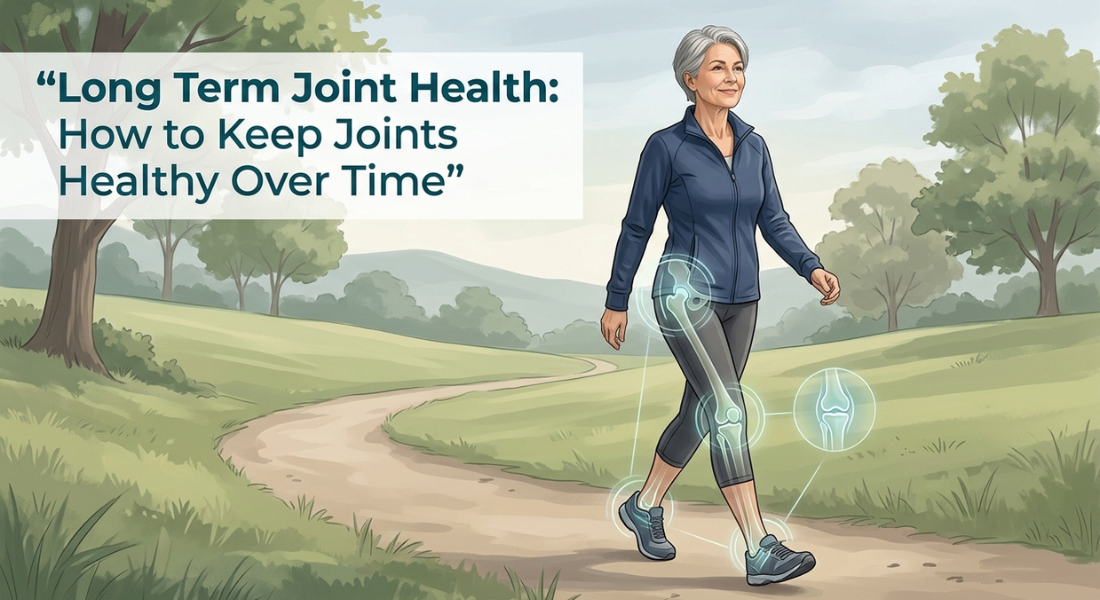
Long term joint health is supported by habits you repeat over months and years, not occasional bursts of effort. Regular movement, strength and mobility can help maintain everyday physical function.
Building sustainable routines around activity, appropriate loading, recovery and general health can support joint function over time. It also means adapting your habits as your needs change.
Long term maintenance focuses on useful movement and everyday physical function.
Consistent activity is more sustainable than occasional intensive efforts.
Strength, mobility, loading and recovery should be adjusted as capacity changes.
Weight and balanced nutrition provide wider support rather than a single joint health solution.
Monitor meaningful changes in function and seek assessment when persistent changes interfere with normal activity.

Long term joint health is about maintaining useful joint movement, physical capacity and everyday function over months and years. The aim is not to keep joints completely unchanged, eliminate every sensation or guarantee that disease will never develop.
Instead the focus is maintaining the capacity to walk, climb stairs, exercise, work, participate in hobbies and manage ordinary physical demands. That requires habits that remain realistic as your schedule, fitness and physical capacity change.
Long term maintenance is different from repairing damaged joints or pursuing a single intervention that promises “joint repair”. It is also not a requirement to feel completely symptom free at every stage of life.
Useful movement and physical capability are practical long term targets. Ageing can bring changes in strength, mobility, recovery and physical capacity without meaning that useful function has to disappear.
A sustainable approach therefore asks whether you can continue doing the activities that matter to you rather than whether your joints remain identical to those of a younger person.
A years long objective depends more on repeatable behaviour than occasional bursts of activity. A demanding routine followed for two weeks and then abandoned provides a weaker foundation for long term maintenance than manageable activity that remains part of ordinary life.
The same principle applies to restrictive diets and unverified “joint repair” claims. A useful routine should survive busy periods, changing responsibilities, ageing and temporary reductions in capacity.
Long term joint health is one part of the wider topic of Joint Health, which covers the broader foundations of healthy joint structure, movement and function. This is part of our complete guide on Joint Health → see the full guide here.
Long term preservation works best as a connected maintenance framework rather than a search for one protective measure. Regular movement, muscle capacity, useful mobility, appropriate loading, recovery and general health all contribute to maintaining physical function.
The objective is not to maximise every category. It is to maintain enough capacity across them to support the activities you need and want to continue doing.
Avoid making inactivity the default and intense activity the occasional correction. Walking, changing position during the day and other regular physical activities can provide a practical baseline that is easier to maintain than sporadic demanding sessions.
For broader adult activity guidance, the World Health Organization recommends 150 to 300 minutes of moderate aerobic activity or 75 to 150 minutes of vigorous activity each week alongside muscle strengthening activity on at least two days.
Muscle capacity and mobility serve different but complementary purposes. Stronger muscles can help you control physical demands while useful mobility allows joints and surrounding tissues to move through the ranges needed for everyday tasks.
Flexibility should therefore not become an isolated target.
The practical question is whether you can move sufficiently well and produce enough controlled force for your usual activities.
The strongest long term routine is one you can actually repeat. That means choosing realistic activities, setting a manageable frequency and allowing the routine to evolve instead of treating every change in circumstances as a reason to stop.
Sustainability also depends on progression. A routine should provide enough challenge to maintain physical capacity without repeatedly exceeding what your current body can tolerate.
Choose movement that fits your schedule, preferences and current ability. An activity that requires extensive preparation may become difficult during busy periods, whereas walking, planned exercise sessions or simple strength work may be easier to maintain.
Scheduling activity can help turn intention into routine. You can also combine everyday movement with planned exercise reducing the need to create a completely separate block of time for every form of activity.
Long term progression means increasing activity, resistance or physical demands gradually rather than repeatedly making large jumps. The goal is to build capacity without turning every session into a test of maximum tolerance.
NIAMS advises starting exercise programmes slowly and allowing the body time to adjust to increased activity. This principle is useful even when your goal is simply maintaining function rather than following a formal training programme.
Consistency does not mean performing the same activities at the same intensity forever. Work demands, injuries, ageing, mobility and recovery can all change what is appropriate.
If a familiar activity becomes harder, modify its intensity, duration, frequency or format. Preserving the habit of supporting physical function matters more than preserving one specific exercise or routine.

Ageing makes adaptation increasingly relevant to maintaining physical capability. The aim is not to stop normal age related change, but to preserve enough strength, mobility, balance, recovery capacity and activity to continue performing useful tasks.
A long term approach therefore needs periodic reassessment. What worked easily at one stage of life may need different loading, more recovery or a modified activity later.
Supporting physical function is different from trying to prevent every physical change associated with getting older. The useful target is continued capability: being able to move, perform everyday activities and remain appropriately active.
This approach also avoids treating ageing itself as a reason to become progressively inactive. Maintaining capacity requires continued participation in suitable physical activity as circumstances permit.
Pay attention when an activity that was previously manageable becomes unusually demanding, recovery takes longer or mobility changes. These observations can help you decide whether the routine needs adjustment.
You may need less volume, different resistance, another activity or additional recovery time. Adaptation protects the long term habit from becoming an all or nothing cycle.
Everyday joint protection is largely about managing repeated physical demands over time. Occupational tasks, sport, household work and exercise can all create recurring loads, so sensible management matters more than trying to avoid normal movement.
The practical goal is to distribute demanding activity appropriately, use suitable technique and equipment where relevant, and leave enough capacity for recovery.
Repeated bending, lifting, gripping, climbing or sporting movements can become demanding when performed frequently without variation or adequate recovery. The answer is not necessarily to stop the activity.
Instead consider how workload is distributed. Vary demanding tasks where possible, use appropriate technique and avoid repeatedly increasing physical demands simply because you managed the previous level.
Recovery supports consistency because the body needs time to adapt between demanding periods. Alternating harder and easier activity can prevent every day from becoming another high demand session.
Sleep also forms part of general recovery. If repeated activity leaves you consistently unable to perform normally that may indicate that current loading is exceeding your available capacity.
Weight and nutrition can support the broader goal of maintaining physical function but neither should become the sole definition of joint health. Their relevance is mainly through overall health, physical capacity and, for weight bearing joints, mechanical demands.
A long term approach therefore treats these factors as background support rather than as a standalone diet or supplement programme.
Body weight can influence the mechanical demands placed on weight bearing joints. The CDC states that people with overweight or obesity are more likely to develop knee osteoarthritis and notes that extra weight places greater stress on joints.
That does not make weight a universal solution or a complete measure of joint function. Long term physical capability depends on several interacting factors.
A balanced eating pattern can support the general health and physical capacity needed to remain active over time. It does not need to become a restrictive “joint diet”.
Avoid claims that a particular food can repair cartilage or lubricate joints. NIAMS includes balanced nutrition and maintaining a healthy weight among broader measures for supporting healthy joints.
Monitoring long term joint health means paying attention to changes in function rather than waiting until everyday activity becomes severely limited. Useful observations include how easily you walk, climb stairs, exercise, work and manage familiar physical tasks.
This is not self diagnosis. It is a way to notice meaningful changes early enough to decide whether your routine needs adjustment or whether professional assessment is appropriate.
Notice whether familiar activities gradually become harder whether your useful mobility declines or whether you are doing less because ordinary physical demands feel increasingly difficult.
A sustained reduction in activity can itself be useful information. Rather than focusing only on isolated sensations look at what your body can consistently do across weeks and months.
Not every persistent change should simply be dismissed as normal ageing. If function continues to decline changes become increasingly limiting or ordinary activities become substantially harder appropriate assessment can help clarify what is happening.
The purpose of monitoring is therefore recognition not diagnosis. A long term maintenance routine should remain flexible enough to respond when your physical function changes.

Professional input becomes particularly relevant when persistent or worsening symptoms, declining function, significant injury or unexplained changes begin interfering with normal activity.
A GP, physiotherapist or physical therapist, rheumatologist or another appropriate clinician can assess an individual situation and determine whether further evaluation is warranted. The right professional depends on the nature of the change.
A maintenance article cannot determine why joint function has changed, and persistent problems should not automatically be explained by ageing or normal variation.
Seeking assessment is especially sensible when changes continue despite reasonable adjustments to activity or begin restricting ordinary life.
Long term joint health is mainly about preserving useful function through habits that can survive changing circumstances. Regular movement, strength, mobility, sensible loading, recovery and general health work together over time rather than acting as one off solutions.
The most sustainable approach is to maintain what you can adapt when your capacity changes and pay attention to persistent declines in function. That keeps long term maintenance practical without ignoring changes that deserve professional assessment.
It means maintaining movement, strength, mobility and everyday joint function over time.
Stay active, maintain strength and mobility, manage physical demands and allow enough recovery.
Yes Regular activity supports physical function, strength and mobility when matched to your abilities.
Yes A healthy weight can help manage physical demands on weight bearing joints.
Stay active, increase physical demands gradually and allow adequate recovery.
Yes especially if changes persist, worsen or affect everyday activities.


Reader Discussion
Leave a Reply