- by Daily Talkin Staff
- July 8, 2026
-

-
-
Loading
Loading
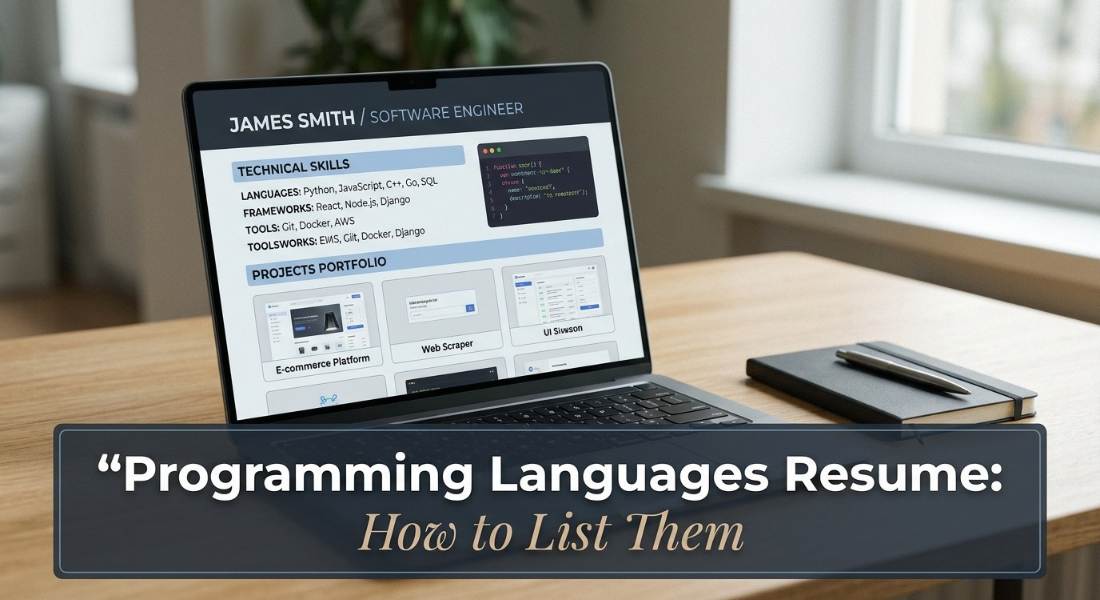
A strong technical resume does more than list coding skills; it shows employers what you can actually build. A well structured Programming Languages Resume helps highlight relevant languages, demonstrate your proficiency and make your technical abilities easier to assess.
Choosing which languages to include is only the first step. You also need to organise your skills clearly, describe your experience honestly and support your claims with practical examples from work, education or personal projects.
This article is part of our complete Programming Languages guide which explores the wider subject, including language concepts, uses and development. See our complete Programming Languages guide →.
Prioritise programming languages that match the job description and your genuine experience.
Use a clear Technical Skills section and group languages separately from frameworks, libraries, databases and tools.
Choose proficiency labels you can support with practical knowledge.
Demonstrate skills through work experience, academic assignments and personal projects.
Use accurate job description keywords and readable formatting without keyword stuffing.
Review every listed skill before submitting your application.

Include programming languages that match the job requirements and reflect skills you can genuinely demonstrate. A focused list helps employers identify relevant technical knowledge quickly while an unnecessarily long list can make it harder to judge your actual ability.
Start by reading the job description and identifying the languages the employer specifically requests. If a vacancy requires Python and SQL for example those skills should be easy to find in your resume.
Put your strongest matching skills first particularly when the role depends on them. Also distinguish between essential requirements and desirable skills. You may include relevant additional languages but they should not distract from the technologies most closely connected to the position.
Avoid selecting languages simply because they appear frequently in industry discussions. A language is worth listing when you have enough knowledge to explain how you have used it whether through employment, coursework or personal projects.
Your resume does not need to contain every language you have studied. Remove technologies that no longer support your target role, especially if you have little practical experience with them.
Keep a separate master list of your technical skills and use it when preparing applications. You can then select the most relevant languages for each vacancy rather than sending the same extensive list to every employer.
This approach keeps the skills section focused and gives greater visibility to the experience that matters for the position.
Programming languages usually belong in a clearly labelled Technical Skills or Programming Languages section.
Place this section according to your experience and the importance of technical knowledge to the role ensuring employers can identify your relevant skills without searching through unrelated information.
Use a straightforward heading such as Technical Skills or Programming Languages. List each language clearly rather than hiding technical details inside a lengthy professional summary.
For example:
TECHNICAL SKILLS
Programming Languages: Python, Java, JavaScript
Databases: PostgreSQL, MySQL
Tools: Git, Docker
This format makes the information easy to scan and gives each category a clear purpose. Include only technologies that are relevant to the position and that you can discuss confidently.
Experienced developers can place technical skills near the top of the resume when programming knowledge is central to the vacancy. This allows recruiters to identify relevant technologies before reviewing employment history.
Students and beginners may place their skills below education or relevant projects. Their coursework and practical assignments can provide useful evidence of technical ability particularly when they have limited employment experience.
The best section order depends on your strongest relevant evidence. A resume should make it easy to understand what you can contribute not follow one rigid layout regardless of experience.
Organise technical skills into clear categories so employers can distinguish programming languages from the other technologies you use.
Separate headings for languages, frameworks, libraries databases and tools can make a skills section easier to understand, provided each category is relevant to the vacancy.
A practical technical skills section may use four categories:
Programming Languages: Python, Java, C++
Frameworks and Libraries: Django, Spring, NumPy
Databases: PostgreSQL, MySQL
Development Tools and Platforms: Git, Docker
You do not need to create every category if you have only a few relevant skills. For example a beginner with experience in Python and SQL may need only a Programming Languages heading and a short project section.
Keep the structure consistent. Avoid placing unrelated technologies under a single heading simply to save space.
Programming languages, libraries and frameworks serve different roles. Listing them under accurate headings prevents confusion and helps employers understand which technologies you actually know.
Category | Examples | Resume section |
Programming languages | Python, Java, C++ | Programming Languages |
Libraries | NumPy, React | Libraries |
Frameworks | Django, Spring | Frameworks |
Databases | PostgreSQL, MySQL | Databases |
Tools | Git, Docker | Development Tools |
For example, Python is a programming language while NumPy is a library commonly used with it. Django is a framework, not a programming language. React is also a library rather than a language.
You can list these technologies together in a technical skills section, but use separate labels when the distinction helps clarify your experience.
Describe proficiency according to what you can actually do with each language. Labels such as basic, intermediate and advanced help employers interpret your skills, but they should reflect practical knowledge rather than confidence alone or the number of years you have studied a technology.
You can use descriptive proficiency labels to communicate your current ability. The following table provides practical guidance, although these terms are not universally standardised certifications.
Level | What it communicates |
Basic | Understands fundamental syntax and concepts |
Intermediate | Can complete practical tasks and build projects with limited support |
Advanced | Can develop, troubleshoot and maintain substantial applications independently |
Expert | Has extensive practical experience and can handle complex technical challenges |
Choose a level you can defend in an interview or technical assessment. For instance, someone who has completed introductory Python exercises may describe their knowledge as basic rather than advanced.
You can also omit proficiency labels when your project descriptions and work history provide stronger evidence. A clear example of what you built may communicate more than a rating beside a language name.
Include years of experience when the figure is accurate and helps explain your background. However, time spent using a language does not automatically establish proficiency.
A developer with two years of substantial project work may have stronger practical ability than someone who has studied the same language for five years but rarely applied it.
Consider the complexity of your work, how independently you completed tasks and whether you can maintain or troubleshoot the code. These details provide better evidence than a duration alone.
Do not describe yourself as an expert unless your experience supports that claim. Listing a language after briefly exploring its syntax can also create unrealistic expectations during recruitment.
Use more precise descriptions when your knowledge is developing:
Basic knowledge of Python.
Academic experience with Java.
Familiarity with JavaScript fundamentals.
These descriptions communicate what you know without suggesting professional level experience you have not gained.

Support each important language on your resume with evidence of how you have used it. Describe the software, feature or process you developed, identify the relevant technology and explain the outcome where you can provide a genuine result.
Connect programming languages to specific responsibilities rather than making unsupported statements about your ability. Explain what you developed, how you used the technology and what changed as a result.
For example:
Developed Python scripts to automate recurring data processing tasks, reducing manual reporting work by 30%.
The 30% figure is illustrative, not a research statistic. Replace it with a result you can verify, or remove the measurement if you did not track one.
A useful experience statement identifies your contribution. Instead of writing “excellent Python developer”, describe the application, process or feature you worked on and the part you were responsible for.
Projects can demonstrate practical knowledge when you have limited professional experience or want to show how you use a particular language.
Include relevant university assignments, personal applications and open source contributions. Give each project a clear name, identify the language used and explain what you developed.
For example:
Personal Expense Tracker
Built an expense tracking application using Python.
Added features to record and organise spending data.
Used Git to manage changes to the project.
Add a GitHub repository or portfolio link when it gives employers access to useful evidence. Make sure the repository is available and that you can explain your contribution rather than relying on the link alone.
A strong resume bullet connects an action, the technology and an outcome. This gives employers a clearer picture of how you applied a language than a list of technical terms.
Use this structure:
Action: What did you build, improve or automate?
Technology: Which programming language or tools did you use?
Outcome: What changed or what did the project achieve?
For example, “Built a Java application to organise student records, allowing users to search and update stored information” identifies the work and its purpose.
Use measurable results when you have reliable figures. Otherwise, describe the completed feature or practical outcome accurately.
Beginners can list programming languages learned through education, training and personal projects. Professional employment is not the only evidence of technical knowledge; relevant coursework, practical assignments and independently developed applications can also show what you can do.
List relevant programming languages covered in your degree, diploma or technical coursework. Include subjects or assignments that demonstrate practical application rather than adding every class you have attended.
For example, a computer science student who completed Java assignments and used SQL in a database project can list both technologies under Technical Skills.
Keep the description accurate. Coursework demonstrates academic experience, but it should not be presented as professional employment.
A project gives employers something concrete to assess. Include its name, the language used and a short explanation of your contribution.
For example:
Student Task Manager
Built a basic task management application using Python.
Used SQL to store and retrieve project data.
Applied programming fundamentals through practical development.
A relevant GitHub repository can provide further evidence. Check that the project contains accessible files and that you understand the code well enough to discuss your decisions.
Students should use clear wording that reflects their actual level of knowledge. Suitable examples include:
Basic knowledge of Python.
Academic experience with Java.
Built a simple web application using JavaScript.
Practised SQL through database coursework.
These descriptions show developing skills without suggesting professional experience. As you complete more substantial projects or gain employment experience, update the wording to reflect your increased responsibilities and ability.
Make relevant skills easy for employers and application systems to identify by using clear headings, readable formatting and accurate terminology. Match the language used in the job description where it genuinely reflects your experience, but do not add unsupported keywords to influence screening results.
Use the correct names of programming languages and technologies requested in the vacancy. If an employer asks for JavaScript, for example, use that recognised name rather than a vague description such as “web coding”.
Include relevant acronyms or variations where they improve clarity. Prioritise the requirements you genuinely meet and avoid copying every technology mentioned in the advertisement.
The University of California, Davis Career Center advises candidates to use exact words or phrases from job descriptions because some employers use applicant tracking systems to scan resumes for keywords. Its guidance also recommends listing only skills candidates can perform with little or no supervision.
Use standard headings such as Technical Skills, Experience, Education and Projects. Choose readable text, consistent spacing and a straightforward layout.
Avoid placing essential technical skills only inside images, decorative graphics or complex visual elements. A text based skills section makes the information easier to locate and review.
Before submitting your document, check that the uploaded or converted version remains readable. Review the spelling of programming languages, dates, headings and technical terms.
Tailoring means adjusting the order and emphasis of relevant information for a particular vacancy. It does not mean claiming experience with a language you have never used or adding skills simply because they appear in the job description.
The University of Florida Career Connections Center recommends tailoring technical resumes to individual jobs and organising programming languages, tools and platforms logically. Its technical resume guide also advises candidates to show accomplishments and measurable results.
No particular format guarantees that an applicant tracking system will select a resume. Clear presentation and accurate information give employers a better opportunity to assess your qualifications.
A useful skills section should reflect the candidate's experience and make relevant technologies easy to identify. The examples below show how experienced developers and beginners can organise their skills followed by a simple template you can adapt.
An experienced developer can combine a categorised skills section with concise employment examples.
TECHNICAL SKILLS
Programming Languages: Python, Java, JavaScript
Frameworks: Django, Spring
Databases: PostgreSQL, MySQL
Tools: Git, Docker
PROFESSIONAL EXPERIENCE
Software Developer | Example Company
Developed Python services for internal applications.
Built Java components supporting business workflows.
Improved application performance through code optimisation.
This example shows how languages can sit alongside related technologies without being mixed into one category. Replace the sample technologies and responsibilities with skills you have actually used.
Where possible, add the purpose of the application the scale of your contribution or a verified result. Do not retain achievements that do not reflect your own work.
Beginners can place their technical skills alongside academic projects to show how they have applied what they learned.
TECHNICAL SKILLS
Programming Languages: Python, Java
Database: SQL
Tools: Git
ACADEMIC PROJECTS
Student Task Manager
Built a basic task management application using Python.
Used SQL to store and retrieve project data.
Applied programming fundamentals through practical development.
This structure gives employers evidence of applied knowledge without suggesting that the candidate has held a professional software development position.
Choose projects that relate to the vacancy. A smaller completed application that you can explain clearly is more useful than a long list of unfinished exercises.
Use this copy ready structure as a starting point. Add only the categories and technologies that match your experience.
PROGRAMMING LANGUAGES
[Language 1] – [Honest proficiency level]
[Language 2] – [Honest proficiency level]
[Language 3] – [Honest proficiency level]
FRAMEWORKS AND LIBRARIES
[Relevant technologies]
TOOLS AND DATABASES
[Relevant tools and databases]
If you have not assessed your proficiency confidently, leave the level out and demonstrate your ability through projects or work experience instead. The template should make your skills clearer not encourage you to fill every available line.

A technical skills section becomes less convincing when it contains irrelevant languages, exaggerated proficiency or claims without supporting evidence. Prioritise accuracy and relevance, and make sure the experience section or projects demonstrate the skills you list.
Avoid these common mistakes:
Listing too many languages without demonstrating practical experience.
Claiming expert proficiency without sufficient evidence.
Mixing programming languages, frameworks and tools into one confusing list.
Including outdated or irrelevant technologies.
Repeating the same language unnecessarily across multiple sections.
Adding performance figures or achievements that cannot be verified.
Stuffing the resume with keywords from the job description.
Review every entry before submitting your application. You should be able to explain what each listed technology does in your work and describe a genuine example of using it.
A strong programming languages resume presents relevant technical skills clearly and supports them with practical evidence. Choose languages that match the role, organise them into understandable categories and describe proficiency honestly.
Work experience, academic assignments and personal projects can all demonstrate applied knowledge. Before submitting your resume, check that every listed skill is accurate, relevant and supported by something you can confidently discuss with an employer.
List the languages relevant to the position and your actual experience. Prioritise skills you can demonstrate rather than including every language you have studied.
Yes when they accurately describe your ability. Use clear terms such as basic, intermediate or advanced, and support important skills with relevant projects or experience.
Yes. Separate programming languages from frameworks, libraries, databases and development tools when doing so makes your technical skills easier to understand.
Include relevant academic coursework, personal projects and practical assignments. Explain which languages you used and what you developed rather than suggesting you have professional experience.
You can include a developing skill when it is relevant to the role but describe your knowledge accurately and avoid implying independent proficiency.
Usually in a Technical Skills or Programming Languages section. Place it higher when technical skills are central to the position or below education and projects when appropriate.


Reader Discussion
Leave a Reply