- by Daily Talkin Staff
- July 8, 2026
-

-
-
Loading
Loading
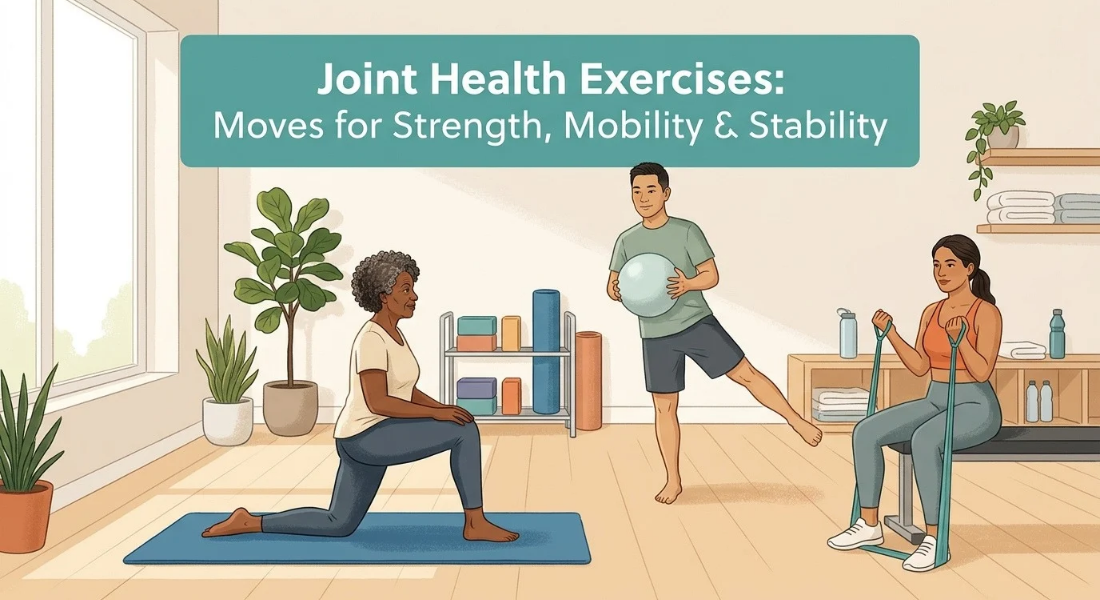
Want to support your joints without turning exercise into a complicated programme? Joint health exercises are movements selected to support strength, mobility, flexibility and stability through controlled activity.
This article covers practical strengthening, mobility, flexibility and stability exercises, along with low impact options and a simple routine. You’ll also learn how to progress each movement gradually.
Combine strengthening, mobility/flexibility, stability and suitable low impact movement.
Start with controlled bodyweight exercises before adding resistance when appropriate.
Use supported balance exercises to practise movement control safely.
Walking, cycling and water based exercise offer different low impact options.
Progress gradually by changing repetitions, resistance, duration or difficulty.
Good technique and consistency matter more than making every exercise difficult.

Choose exercises according to what you want to practise: strength, mobility, flexibility, stability or low impact movement. Your current ability also matters, so a controlled variation that you can perform well is more useful than a harder movement performed poorly.
A balanced selection does not require dozens of exercises. You can combine a few movements that train different qualities and adjust their difficulty as your control improves.
What Should a Balanced Joint Exercise Routine Include?
A practical routine can combine strengthening movements with mobility or flexibility work, stability exercises and suitable low impact activity. Each category serves a different training purpose, so combining them creates more variety than relying only on stretching, walking or resistance work.
Bodyweight movements can provide a simple starting point for learning technique and controlling movement. Once the pattern feels consistent, resistance bands or light weights can add challenge. There is no need to choose a fixed resistance level for everyone.
Strength exercises provide practical ways to challenge the muscles involved in everyday movement. Bodyweight movements, resistance bands and light weights can all be used, depending on your experience and ability.
The aim is controlled movement rather than simply moving the heaviest possible load. Keep the range comfortable, maintain good positioning and avoid rushing through repetitions.
For a squat, stand with your feet roughly hip width apart, keep your chest controlled and bend your hips and knees as you lower. Press through your feet to return to standing.
A sit to stand movement offers a simpler variation. Sit on a stable chair, lean slightly forward and stand without using your hands if comfortable. Lower back down slowly rather than dropping into the seat.
For step ups, place one foot on a stable, low step and push through that foot to rise. Step down with control, then alternate sides when appropriate.
For a band row, secure the resistance band safely, keep your torso controlled and pull the band towards your body while drawing your elbows back. Return slowly instead of allowing the band to snap forward.
For a seated leg extension, sit upright and slowly straighten one knee before lowering the leg under control. Keep the movement smooth rather than kicking the leg.
For a shoulder press, start with light resistance at shoulder level and press upwards without forcing the range. Lower slowly. Bodyweight or light resistance is sufficient for practising control.
Mobility exercises use controlled movement through an available range, while flexibility exercises involve deliberately lengthening muscles. Both can fit into a joint-focused exercise session without requiring aggressive stretching.
Keep these movements smooth and controlled. The objective is to practise useful movement rather than force a joint towards an extreme position.
Shoulder circles can be performed slowly forwards and backwards within a comfortable range. Arm raises provide another simple option: lift the arms gradually, then lower them with control.
You can also use gentle movements for other areas of the body, provided the motion feels comfortable. Avoid bouncing or forcing the final part of a movement.
A hamstring stretch can be performed with one leg positioned forward while you gently shift your body to create a comfortable stretch behind the thigh.
Chest, shoulder and calf stretches are other straightforward choices. Hold each position comfortably rather than pushing aggressively into discomfort. Flexibility work should complement movement, not become a competition to reach a deeper position.

Stability exercises challenge your ability to control body position while standing or moving. They can be simple, requiring only your bodyweight and a stable surface nearby.
Balance work is especially useful when performed with controlled posture. NIAMS includes balance activities and step ups among examples of exercise that can improve balance and coordination.
Stand near a sturdy chair, wall or countertop. Shift your weight onto one foot and lift the other slightly from the floor while keeping your torso upright.
If that feels difficult, keep one hand lightly supported on the stable surface. You can also reduce the challenge by keeping the lifted foot closer to the floor. Focus on steady control rather than holding the position for as long as possible.
A slow step down can challenge control as you lower one foot from a low step towards the floor. Keep the movement deliberate and use a stable support if needed.
Slow step ups provide another option. Instead of rushing through each repetition, pause briefly as you establish your position before stepping back down. The exercise should remain controlled throughout.
Low impact activities provide movement options without requiring repeated high impact actions. Walking, cycling and water based exercise differ in equipment, movement pattern and accessibility, so the most suitable choice depends on what you can perform comfortably and consistently.
Low-impact does not mean effortless. You can still adjust duration or pace to create a useful workout while keeping the movement pattern manageable.
Walking is accessible and requires little equipment. Cycling provides repetitive lower body movement while reducing the need for repeated foot strikes against the ground.
Swimming and water based exercise offer another option, with the water providing resistance while supporting bodyweight. Choose according to comfort, access to equipment or facilities and personal preference rather than assuming one activity suits everyone.
Adjust duration, pace or resistance rather than automatically increasing impact. For example, a walk can become longer or slightly faster, while cycling can be extended gradually or performed with modestly greater resistance.
If you are starting from a low activity level, building up gradually is consistent with U.S. physical-activity guidance. ODPHP recommends starting with small amounts when necessary and increasing activity over time.

A useful routine can be organised around four simple stages: prepare with controlled mobility, strengthen with selected resistance movements, practise movement control through stability work, then add optional low impact activity.
Joint health covers the wider factors that influence how joints function, while this article focuses specifically on exercise selection and movement. For the broader context, see our complete Joint Health guide → see the full guide here.
Start with gentle mobility movements such as shoulder circles and controlled range of motion work. Follow with two or three strengthening movements, such as sit to stands, step ups or band rows.
Add a short balance exercise such as supported single leg standing. Finish with walking, cycling or water based exercise if desired. The sequence can be shortened or extended according to your available time and ability.
Improve control before making an exercise substantially harder. Once the movement feels consistent, you can gradually add repetitions, slightly increase resistance, extend the duration or choose a more challenging variation.
Change one variable at a time where practical. The ODPHP guidelines also support gradually increasing muscle strengthening activity rather than starting at a demanding level.
The NHS similarly recommends starting gradually and building strength over time, with muscle strengthening activity performed on at least two days each week.
Joint health exercises do not need to form a complicated programme. A practical selection can combine controlled strengthening, mobility and flexibility work, stability exercises and suitable low impact movement.
Start with movements you can perform well, then progress gradually by adjusting repetitions, resistance, duration or difficulty. The most useful routine is one that matches your current ability and can be performed consistently.
There is no single best exercise for everyone. Useful options include strengthening movements, mobility and flexibility exercises, stability work and suitable low impact activities such as walking or cycling.
Yes. Resistance exercises can strengthen muscles involved in movement. Bodyweight exercises, resistance bands and weights can be used with controlled technique and gradual progression according to ability.
Low impact exercise involves less repeated impact than higher impact activities. Walking, cycling and water based exercise are practical examples that can be adjusted for duration, pace and personal preference.
For general adult activity, guidance recommends at least 150 minutes of moderate aerobic activity weekly and muscle strengthening activity on at least two days each week.
Gentle movement can prepare you for exercise, while flexibility work can be included as part of or after a session. Avoid treating stretching as a requirement for every exercise or person.
First improve control and technique. Then gradually adjust one variable, such as repetitions, resistance, duration or exercise difficulty, rather than increasing everything at once.


Reader Discussion
Leave a Reply