- by Daily Talkin Staff
- July 8, 2026
-

-
-
Loading
Loading
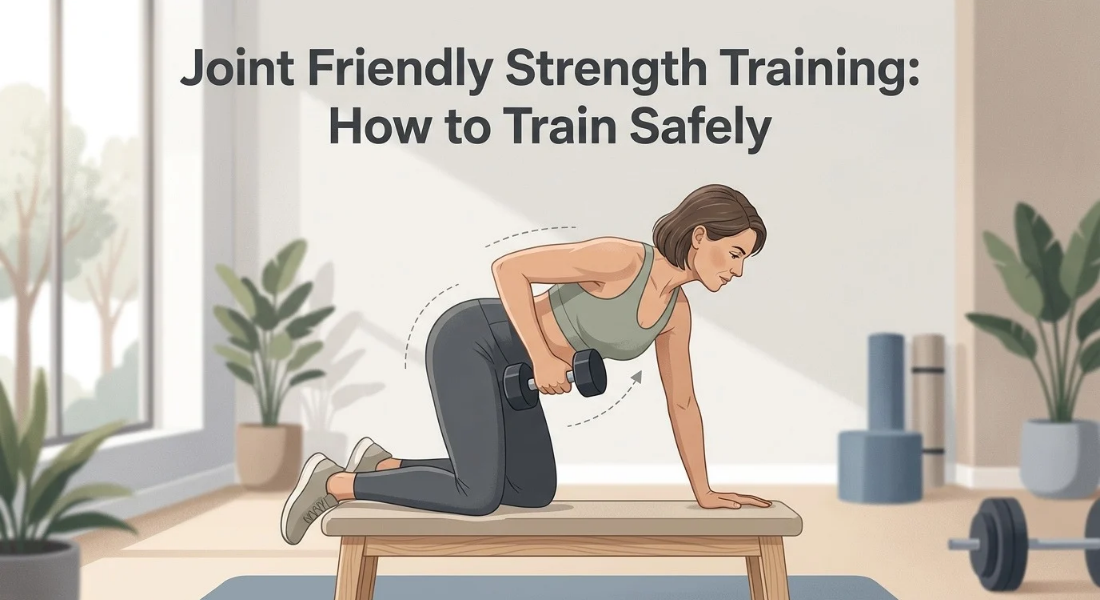
Strength training can build useful strength while a particular movement still feels unnecessarily demanding on a joint. Joint friendly strength training is resistance training organised around controllable movement, manageable demands and sensible progression.
This guide covers exercise selection, control, loading, modification and progression. Joint health covers the wider factors that support normal joint function while this article focuses specifically on structuring strength training around manageable movement and loading.
This is part of our complete guide on Joint Health → see the full guide here.
Joint friendly training focuses on controllable movement and manageable overall training demand.
Low impact and joint friendly are related but not identical.
Choose exercises that allow practical changes to resistance, range, support or repetitions.
Progression can involve resistance, repetitions, sets, range or exercise complexity.
If movement control deteriorates modify the demand rather than automatically pushing through.
Repeat a manageable workload before adding another challenge.

Joint friendly strength training is not defined by one exercise, one weight or avoiding challenge. It means choosing and performing resistance exercises so the movement, range, resistance and workload remain controllable enough to train effectively.
A useful exercise should provide a meaningful strength stimulus without making the movement unnecessarily difficult to manage. The right choice therefore depends on current ability rather than a universal list of “safe” exercises.
A practical test is whether you can set up consistently, control the movement, complete the intended repetitions and adjust the demand when necessary.
No Low impact generally means reduced impact forces or avoiding jumping and other high impact contact.
Joint friendly is broader, considering resistance, position, range, repetitions and total workload. A low impact exercise can still be poorly matched to someone's current capacity.
You should be able to control the starting position, resistance, movement path, useful range, repetitions and workload.
The ability to adjust these variables matters because joint friendly training is an adaptable approach not a fixed list of approved exercises.
Start by asking whether an exercise provides a stable setup, a manageable movement path and resistance you can control repeatedly. The goal is not to identify an exercise that is universally safe but one whose demands fit your current ability.
Look for movements that can be scaled without losing their main training purpose. A resistance band, dumbbell or bodyweight variation may each work, depending on how well you can control its resistance, position and range.
Before increasing load establish whether the basic movement remains repeatable. This gives you a practical basis for choosing an appropriate variation instead of relying on a generic exercise list.
An exercise is easier to modify when you can change resistance, support, position, range or repetitions without losing its main purpose.
That adaptability is valuable because the appropriate training demand can change as your ability changes.
Stable or supported positions can reduce balance demands and let you concentrate on producing and controlling force.
They are not automatically better. If balance is part of the intended task and you can control it removing that demand changes the exercise rather than necessarily improving it.
Multi joint exercises can be useful when several joints and muscle groups can share a controlled movement pattern.
They are not automatically more joint friendly than single joint movements. Choose them when their position, range, resistance and complexity remain manageable.
Movement control means deliberately managing position, direction and force instead of allowing momentum or fatigue to dictate the repetition.
The aim is not to make every repetition extremely slow. It is to keep the intended movement repeatable enough to judge whether the selected resistance, range and workload remain appropriate.
When control deteriorates you have a specific training variable to adjust rather than simply forcing the same movement.
Good control includes consistent positioning, deliberate direction changes and a lowering phase you can manage.
The exact speed varies by exercise. The useful standard is repeatable execution rather than relying on momentum to complete the repetition.
Use a range you can control for the exercise and your current ability. A larger range increases movement demand but more range is not automatically better in every situation.
If control deteriorates at part of the movement reducing the range can make the exercise more manageable before expanding it again later.
No Joint friendly training is not synonymous with extremely slow repetitions. A repetition should be controlled enough to maintain the intended movement but its speed can vary with the exercise and goal.
Slowing down can be useful when it improves control but it is not required for every repetition.
Resistance is only one part of training load. Repetitions, sets, range, exercise variation and training frequency can also change the demand created by an exercise.
This means “lighter is always better” is not a useful rule. A resistance is appropriate when it provides a useful training stimulus while allowing the intended movement to remain controllable.
Two people can therefore use different resistance for the same exercise and both train appropriately. The relevant question is whether the workload matches current capacity.
Choose resistance that allows the planned movement with consistent technique and controllable repetitions. There is no universal weight that makes an exercise joint friendly.
Bands, dumbbells, machines and bodyweight can all be appropriate when the resulting movement demand is manageable.
Change the variable creating the difficulty. You might reduce resistance, shorten the range, reduce repetitions, add support or choose a simpler variation.
These are training adjustments not treatment protocols. If a movement repeatedly produces concerning symptoms avoid repeatedly forcing the same version and seek appropriate professional guidance.
No More weight is one progression option not the definition of effective strength training.
You can increase repetitions, add a set, expand a controllable range, change the exercise variation or increase resistance when appropriate.

Progression means increasing a training demand after the current version becomes appropriately manageable. The increase does not have to come from resistance.
Repetitions, sets, range, exercise variation and movement complexity can also change the challenge. Changing one meaningful variable at a time makes the training response easier to evaluate.
The Physical Activity Guidelines also recommend gradually increasing muscle strengthening activity over time supporting a progression approach based on adaptation rather than abrupt increases.
You can progress resistance, repetitions, sets, range of motion, exercise variation or movement complexity.
For example you might first make a bodyweight movement more repeatable then increase repetitions and later add resistance. One clear progression is easier to evaluate than changing several variables together.
Increase the demand when the current exercise can be performed consistently enough that its existing workload is no longer an appropriate challenge.
There is no universal calendar rule. Control, repeatability and management of the current workload should guide the decision.
Progressive loading means gradually increasing a training demand as the current workload becomes appropriately manageable.
The increase may involve resistance, repetitions, sets, range or exercise variation rather than weight alone. The aim is to build capacity without allowing the new demand to outpace movement control.
First identify what has made the exercise difficult to manage. The limiting factor may be resistance, range, repetitions, position, balance or movement complexity.
Then change that variable while preserving the useful strength stimulus where possible. This is more precise than abandoning resistance training or simply forcing the original movement.
There is no universal first adjustment. If resistance is the issue reducing it may help.
If control deteriorates only at a particular range changing that range may be more useful. Reducing repetitions can help when fatigue is affecting execution.
Support can reduce balance and stabilisation demands while keeping the main resistance task in place. A wall, bench or stable surface may help maintain consistent positioning.
The aim is not to remove challenge completely, but to direct the challenge towards the intended strength task.
Change the variation when the original version remains difficult to control after sensible adjustments to resistance, range, repetitions or support.
A different variation can alter position, balance or loading while still training a similar movement or muscle group.
A practical session starts with movements you can control uses resistance that matches the task and gives you opportunities to reassess execution between sets.
The goal is not to make training unusually easy. It is to make each demand deliberate enough that you can decide whether to maintain, modify or progress it.
Choose manageable movement patterns, establish appropriate resistance and perform controlled sets. After each set assess whether the movement remains consistent.
If it does progression can be considered later. If control deteriorates, modify resistance, range, repetitions, support or exercise variation.
During resistance training, muscles generate and control force around a joint. A well chosen exercise can therefore develop muscular force production while practising controlled movement.
This does not mean strength alone guarantees stability. The relevant point is that resistance exercise can train strength and control within the movement being performed.
Monitor whether you can repeat the movement with similar control as the set progresses and whether the workload remains manageable.
If the exercise increasingly depends on momentum or altered positioning the current demand may need modification rather than more resistance.
Sustainable progression means allowing enough recovery to repeat the current training demand with reasonable quality before adding another challenge.
Resistance, volume and exercise complexity all contribute to workload. Holding a workload steady can therefore be a productive training decision rather than a sign that progress has stopped.
Hold the current level when the exercise remains challenging but controllable, or when movement quality has not yet become consistent enough for another increase.
Progress does not require heavier resistance or more repetitions every session. Repeating a manageable workload can provide the consistency needed before progressing.

Modify the demand when the current version is no longer manageable with the intended technique or movement control.
Depending on the cause, reduce resistance, repetitions, range or complexity, add support or select another variation. Persistent concerns are better assessed professionally than repeatedly testing the same movement.
Joint friendly strength training is not about choosing only light weights or avoiding challenging exercises. It is about selecting controllable movements, matching resistance and workload to current ability, and changing the training demand when control starts to break down.
Progression can come from resistance, repetitions, sets, range or exercise variation. The useful approach is deliberate: choose, control, load, assess, modify and progress.
Joint friendly strength training uses controllable movement, manageable loading, sensible progression and practical exercise modifications.
No Low impact reduces impact forces while joint friendly training also considers resistance, range, position, repetitions and movement control.
Choose adaptable exercises, control movement and range, use manageable resistance, and modify the training demand when needed.
Yes Bands, weights and bodyweight exercises can build strength when they provide an appropriate and progressive resistance challenge.
Gradually increase resistance, repetitions, sets, range or exercise variation when the current workload remains controlled.
Not necessarily. If the movement remains controllable, continue as appropriate; if it becomes unmanageable modify the training demand.


Reader Discussion
Leave a Reply