- by Daily Talkin Staff
- July 8, 2026
-

-
-
Loading
Loading
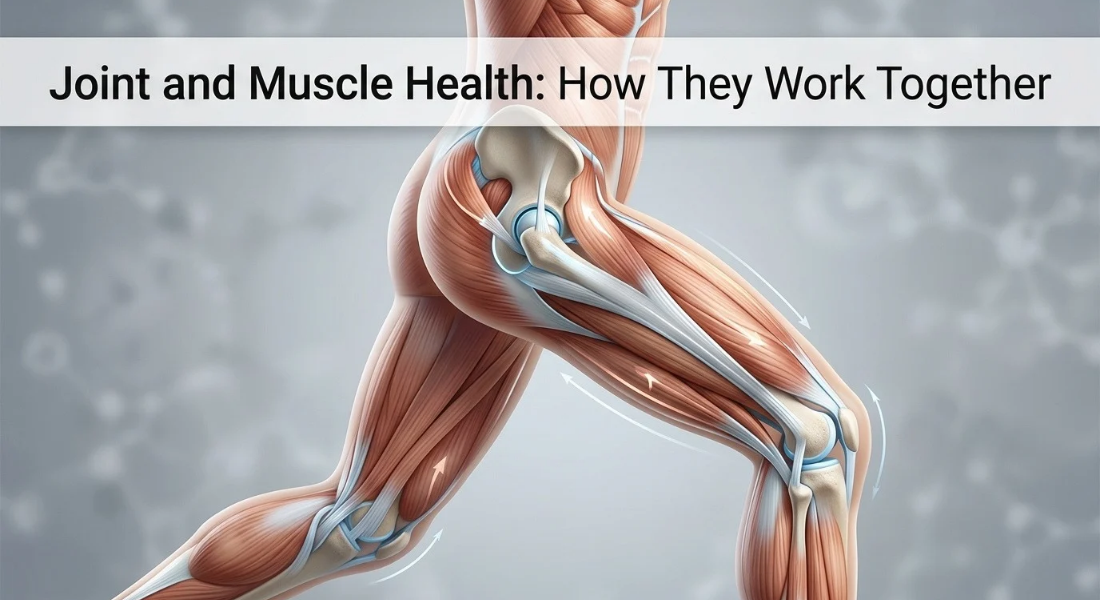
A movement such as walking or climbing stairs depends on more than a healthy joint or strong muscle alone. Joint and muscle health are connected because muscles generate and control movement while joints provide the structures that allow movement to occur.
This relationship affects how the body manages stability, mobility and everyday physical function. Understanding how muscles and joints work together can make the connection between strength, movement and control much clearer.
Muscles generate and regulate force, while joints provide the movement between bones.
Tendons connect muscular force to the bones involved in joint movement.
Muscle strength and muscle control are related but not identical; coordinated control matters for useful movement.
Joint mobility provides the movement range through which muscles can act.
Physical function depends on the combined effect of force, movement and control.
Supporting muscle capacity, usable mobility and recovery helps maintain their functional relationship.
.

Joint and muscle health describe a coordinated movement relationship rather than two completely separate systems. Muscles generate force, tendons transfer that force to bones, and joints provide the moving connection that allows bones to change position.
The result is not simply muscle strength or joint mobility on its own. Effective movement depends on these parts working together so force can be produced, transferred and controlled through an available movement range.
Skeletal muscles contract to create force. Tendons transmit that force from muscles to bones allowing the resulting pull to produce movement around a joint. This also means muscle action is not limited to making a limb move.
Muscles can regulate how quickly and accurately movement occurs. NIAMS explains that skeletal muscles work with bones and joints to provide movement and that tendons connect muscles to bones and control joint movement.
A joint is where bones connect creating the point through which movement can occur. Different joint types permit different amounts and directions of movement so the available movement depends partly on the joint itself.
The muscles therefore act within a movement system rather than in isolation. NIAMS notes that movable joints can allow different patterns of movement, including bending, rotation and movement in several directions depending on the joint type.
Muscle function influences how effectively movement around a joint can be produced and controlled. Adequate force helps move the body while appropriate muscular control helps regulate that movement rather than simply producing maximum force.
This distinction matters because everyday movement requires timing and coordination. A muscle may be strong yet movement can still depend on whether that strength can be applied at the right time and through the available range.
Muscles surrounding a joint can contribute to controlled movement by producing force and responding to changes in position. Their role is therefore functional: they help the body maintain control as a joint moves or bears load.
Strength alone does not guarantee perfect stability but insufficient muscular capacity can make some movements harder to control. NIAMS describes skeletal muscles as working with bones and joints to provide power and strength for movement.
Muscle control is the ability to produce and regulate force according to what a movement requires. Walking, rising from a chair or reaching for an object does not require maximum force; it requires force that is appropriately timed and directed.
This is why movement quality involves more than muscle size or peak strength. The useful outcome is coordinated force that matches the task and the movement available at the joint.
Joint mobility and muscle function have a two way relationship. Muscles need enough usable joint movement to carry out many everyday actions while effective muscular control helps a person manage that available movement.
A restriction in movement can therefore change how an action is performed. Conversely adequate muscular function can help a person use available movement with greater control, making mobility and muscular capacity complementary rather than separate qualities.
Muscles act across joints so the available range of joint movement affects where and how those muscles can contribute to an action. Useful range of motion gives a movement enough space to be performed effectively.
This does not mean maximum flexibility is required for every task. The relevant point is usable movement: enough joint motion for the activity combined with the muscular control needed to use it.
When movement becomes more restricted an activity may require a different movement pattern or become harder to perform. Tasks such as walking, standing or reaching can be affected when the available movement no longer matches the demands of the task.
Reduced movement can also limit physical activity. In conditions such as osteoarthritis NIAMS notes that reduced activity associated with joint pain can contribute to muscle weakness illustrating how changes in one part of the system can influence another.
Physical function depends on more than having strong muscles or mobile joints separately. Everyday activity requires enough muscular force, usable joint movement and coordinated control to turn those capacities into effective movement.
This relationship matters for practical abilities such as walking, standing, reaching and changing position. The goal is not simply to maximise one physical quality but to keep the different parts of movement working together.

Consider rising from a chair. Leg muscles generate force, tendons transfer that force to the bones, and the hip and knee joints allow the legs to change position as the body rises.
Walking follows the same basic principle. Muscles repeatedly generate and regulate force while joints provide the movement between bones. The sequence is coordinated continuously rather than performed by one structure independently.
Physical function combines several abilities. Muscle force provides the capacity to move, joint movement provides the available range, and coordinated control determines how those capacities are used during a task.
That distinction explains why a person can have considerable muscle strength yet still experience difficulty with a movement if joint movement or coordination is limited. Function is the combined result not a single measurement.
Muscle and joint function also depends on tissues that connect and support the movement system. Their relevance here is not their individual anatomy but how they help transfer force, connect bones and allow movement to occur in a controlled way.
NIAMS describes movable joints as involving several tissues, including bones, ligaments, tendons and cartilage. These structures therefore form part of the same functional system rather than acting as unrelated components.
The basic sequence is muscle contraction → tendon force transfer → movement of bones at a joint. Tendons provide the physical connection that allows muscular force to influence the bones involved in movement.
This makes tendons an important link between muscle function and joint movement. NIAMS specifically identifies tendons as tissues that connect muscles to bones and help control joint movement.
Bones provide the structures that meet at joints. Ligaments connect bones and contribute to joint control, while cartilage forms part of movable joints and helps the joint surfaces interact during movement.
The key point is integration. Muscles cannot produce useful joint movement without bones and connecting tissues while joints cannot be used effectively without the muscular forces that drive and control movement.
Supporting this relationship means preserving the capacity to generate force, use available movement and recover between demands. It does not require treating muscle and joint health as two unrelated projects.
Regular physical activity, appropriate muscular loading, usable mobility and recovery all contribute to keeping the movement system active.
WHO recommends at least 150 minutes of moderate activity or 75 minutes of vigorous activity weekly for adults plus muscle strengthening activity on two or more days.
Strength provides capacity, mobility provides usable movement and recovery allows the body to adapt to physical demands. These qualities complement one another rather than replacing one another.
A movement system may therefore benefit from maintaining all three without turning the article into a specific exercise programme. The appropriate balance depends on the person's activities, abilities and circumstances.

Persistent, worsening or significant symptoms that interfere with normal movement or daily function warrant professional assessment. Symptoms alone do not establish their cause, so assessment is more useful than assuming that a muscle or joint is responsible.
Joint and muscle function is one part of the wider Joint Health topic which covers the foundations of healthy joints, mobility, stability and supporting tissues. See our complete Joint Health guide → see the guide here.
Muscles and joints function as a coordinated movement system. Muscles generate and control force, while joints provide movement between bones, with tendons and other supporting tissues helping connect the system.
Understanding this relationship explains why physical function depends on more than strength or mobility alone: useful movement comes from their interaction.
Muscles generate and control force around joints, helping support movement and manage everyday loads.
Mobility gives muscles room to work while muscle control helps manage joint movement during physical tasks.
Yes. Reduced muscle strength or control can make some movements harder or less controlled, although causes can vary.
Muscles generate force while joints allow and guide movement. Tendons transfer muscle force to bones.
Joint function involves movement and stability while muscle function involves generating and controlling force.
Yes. Their interaction supports everyday activities such as walking, standing, reaching and changing position.


Reader Discussion
Leave a Reply