- by Daily Talkin Staff
- July 8, 2026
-

-
-
Loading
Loading
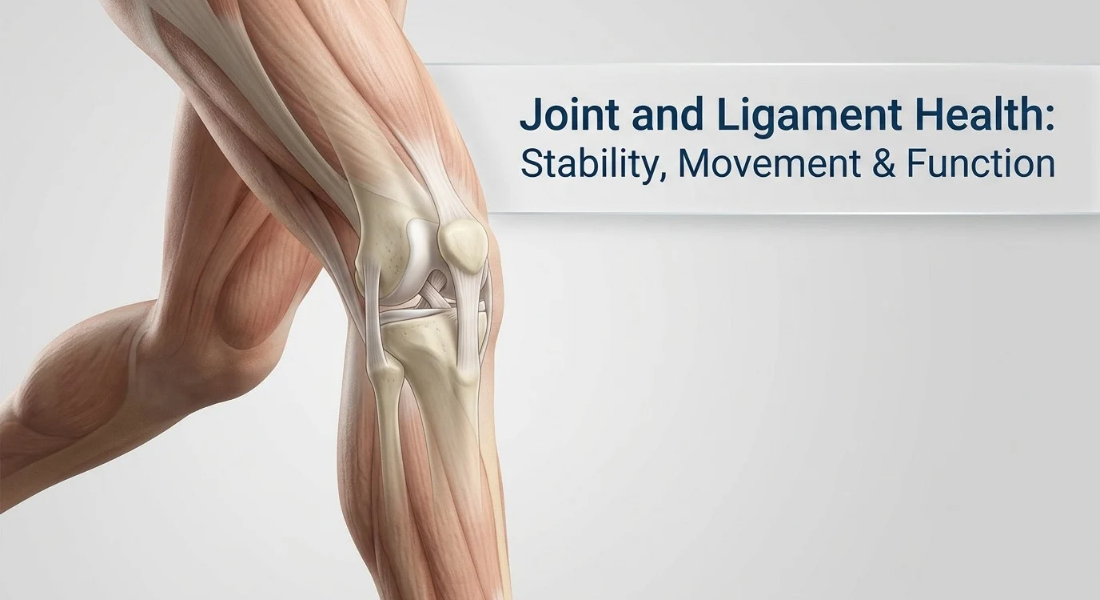
Walking, turning or stepping down shows why Joint and Ligament Health means supporting controlled movement and stability.
Joint Health covers the wider role of joint structure, movement, stability and everyday function while this article focuses specifically on how ligaments contribute to that system. This is part of our complete Joint Health guide → see the full guide here.
Joint health is broader than ligament health and includes the coordinated function of the joint system.
Ligaments provide mechanical restraint that helps limit excessive or unwanted movement.
Ligament mechanoreceptors can contribute sensory information involved in proprioception and functional stability.
Appropriate physical loading, recovery and general health support normal tissue function.
Joint stability is functional when it allows useful movement while controlling unwanted motion.
Persistent or function limiting problems after an injury warrant professional assessment.

Joint and ligament health are connected because useful movement requires both mobility and control. A joint needs enough freedom to move while ligaments and surrounding tissues help limit unwanted motion and support mechanical stability.
The nervous system also coordinates sensory information and muscle responses during movement. This relationship means ligament function is one part of overall joint function rather than a separate system.
MedlinePlus describes ligaments as helping keep joints stable during movement while joints also involve other surrounding tissues.
Ligaments help resist excessive or unwanted movement around a joint. Their mechanical properties provide passive restraint helping keep movement within a functional range rather than allowing unrestricted motion.
That restraint matters during ordinary activities such as changing direction or accepting a load. Stability does not mean preventing movement it means helping control movement while allowing the joint to perform its intended function.
Normal movement depends on more than mechanical restraint. Sensory structures within some ligaments can detect mechanical changes and send information to the nervous system contributing to proprioception and neuromuscular responses.
Research on knee ligaments identifies mechanoreceptors that respond to changes associated with joint position and movement. Evidence supports a contribution to functional stability although the precise role of individual receptors and pathways remains an area of research.
Joint health describes the broader functional condition of a joint and its supporting structures. Ligament health is narrower, focusing on the integrity and normal function of ligament tissue within that system.
The distinction matters because a joint can function through coordinated activity across several tissues whereas ligaments provide one specific form of mechanical and sensory support.
Feature | Joint health | Ligament health |
Main focus | Overall joint function and stability | Ligament integrity and supporting function |
Functional role | Supports useful movement and load management | Helps control excessive movement and contribute to stability |
Relationship | Includes several coordinated tissues | Forms one important part of the joint system |
MedlinePlus similarly explains that joints involve surrounding soft tissues including ligaments which help maintain stability during movement.
Ligament function contributes to joint stability but ligament health should not be treated as another name for overall joint health. Functional stability emerges from several systems working together.
A useful way to think about the relationship is ligament function supports stability and control while the wider joint system provides the conditions for useful movement.
Normal function is supported by sensible physical demands, adequate recovery and general health rather than a single exercise, food or supplement.
The practical focus is maintaining coordinated function without turning this topic into an injury prevention or joint improvement programme.
Ligaments and surrounding tissues are exposed to physical forces during everyday movement and exercise. Completely avoiding movement is therefore different from managing physical demands appropriately.
Sudden increases in load can place unfamiliar demands on tissues whereas gradual progression gives the body an opportunity to adapt to changing physical requirements. The principle is controlled exposure rather than a prescribed training programme.
Repeated physical loading is part of normal activity but tissues also need time between demanding periods. Recovery allows the body to respond to accumulated physical stress rather than treating every session or activity as an isolated event.
The appropriate amount of recovery varies with the activity and individual circumstances. For this reason recovery is best understood as a supporting principle rather than a fixed ligament recovery schedule.
Adequate nutrition contributes to normal tissue function as part of broader health. It is more useful to consider overall dietary adequacy than to search for a specific “ligament food” or product.
This distinction also prevents nutrition from becoming a separate supplement topic. General health supports the body's normal functions but no single nutrient or supplement can be presented here as a guaranteed way to maintain ligament stability.

Ligament health matters because useful stability is not the same as keeping a joint rigid. The aim of normal function is controlled movement: enough freedom for activity with enough restraint and sensory feedback to limit unwanted motion.
This becomes particularly relevant when movement requires rapid changes in position or load. Mechanical restraint, sensory information and neuromuscular control can work together to support functional joint use.
Proprioception refers to the body's ability to sense the position and movement of its parts. Ligament mechanoreceptors can provide sensory information associated with mechanical changes within a joint.
Research on knee ligaments suggests these receptors contribute to proprioceptive signalling and may influence functional joint stability. However proprioception is not supplied by ligaments alone; sensory information from multiple systems contributes to movement control.
Reduced stability can make controlled movement more difficult because the system has less effective control over unwanted motion.
A person may also feel less confident when loading a joint or changing position although the underlying cause cannot be determined from that experience alone. This article does not treat instability as a diagnosis.
Specific injuries, symptoms and rehabilitation require separate clinical assessment rather than assumptions based on general joint function.
Long term thinking about joint and ligament health is mainly about preserving normal function. Appropriate physical loading, movement quality, recovery and attention to persistent problems all fit within that framework.
The goal is not to guarantee that injury or disease will never occur. Instead it is to understand how ligament function contributes to a joint's ability to remain stable while still allowing useful movement.
Healthy function allows a joint to move through useful activities while its stabilising structures help control that movement. The joint should not need to be completely still to be considered stable.
In practical terms, stability and mobility work together. Ligaments provide part of the restraint and sensory input while the wider joint system and neuromuscular control help coordinate functional movement.

Persistent, significant or function limiting problems following an injury or unusual physical event warrant professional assessment rather than self diagnosis.
MedlinePlus notes that ligament sprains can result from events such as falling, twisting or impact. This provides a useful safety boundary: a notable event followed by ongoing functional difficulty should be assessed appropriately.
Ligament health is one component of functional joint stability. Normal ligament function helps control unwanted movement and contributes sensory information while the wider joint system allows useful mobility.
Understanding that relationship keeps the focus on normal function rather than promising to prevent every injury or condition. Good joint function depends on coordinated stability, movement and control.
Ligaments support joint stability and controlled movement making their function an important part of overall joint health.
Yes Ligaments help limit excessive or unwanted movement supporting joint stability while allowing normal movement.
Healthy ligament function supports stability and movement control. Ligament sensory information may also contribute to proprioception.
Joint health covers overall joint function while ligament health focuses on ligament integrity and its role in stability and movement.
Yes Research suggests ligament mechanoreceptors provide sensory information related to joint position and movement although their exact contribution remains under study.
Persistent or function limiting problems after an injury or unusual event should be assessed by a healthcare professional.


Reader Discussion
Leave a Reply