- by Daily Talkin Staff
- July 8, 2026
-

-
-
Loading
Loading
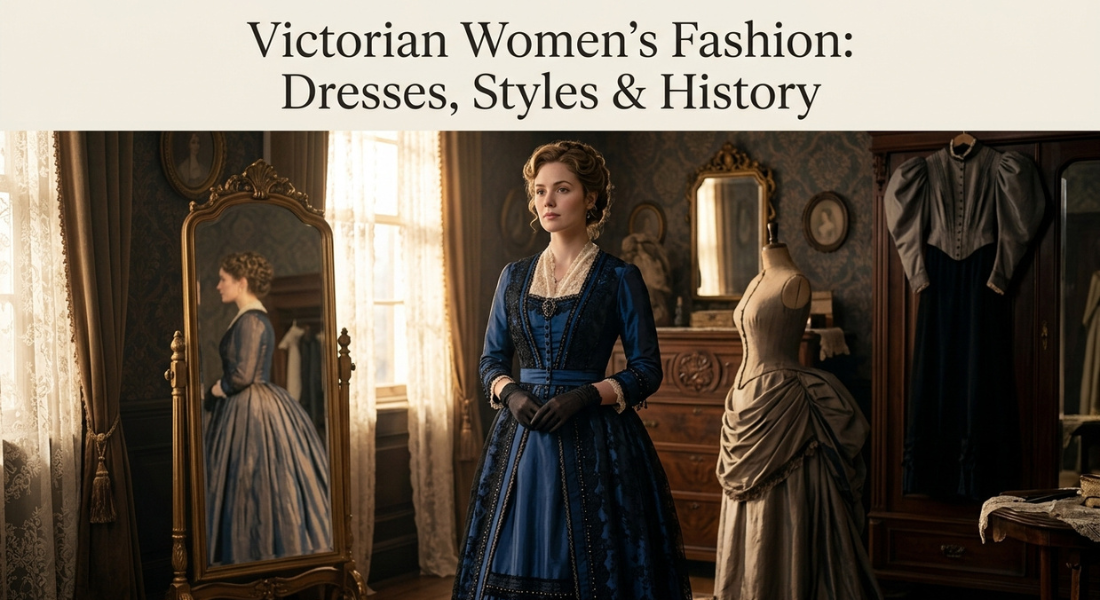
A single Victorian dress can hide decades of changing women's styles. Victorian Women's Fashion refers to the clothing and dress practices of women during Queen Victoria's reign from 1837 to 1901.
This guide focuses on recognisable dress details, occasions, period differences, construction and terminology used to understand authentic Victorian clothing.
Victorian Women's Fashion is one part of the wider history covered in our complete Victorian Fashion guide which places women's dress alongside the broader fashion system of the period. See the full guide here →
Victorian women's clothing changed substantially between 1837 and 1901 rather than following one fixed dress style.
Early dresses emphasised defined waists, broad skirts, fitted bodices and distinctive neckline and sleeve treatments.
Mid century silhouettes increasingly shifted skirt fullness towards the rear.
Late Victorian clothing developed highly structured bodices and rear shaping before moving towards simpler skirts and larger sleeves in the 1890s.
Daywear and eveningwear differed in coverage, neckline, decoration and formality.
Historical accuracy is best assessed by comparing several structural details with dated museum evidence.

Victorian women did not wear one standard dress. Their clothing varied by period, occasion and time of day with different combinations of bodices, skirts, layers, sleeves and decorative details.
Daywear was generally more covered and practical, while eveningwear could feature lower necklines and richer decoration. A historically accurate Victorian outfit should therefore be judged by its overall combination of features not one garment alone.
Women changed their clothing for daytime activities, visiting, walking, travel, sport and evening events. Day dresses were generally more practical and covered while formal eveningwear allowed lower necklines and more elaborate decoration.
A Victorian appearance came from the combination of a defined waist, shaped bodice, period specific skirt proportions, sleeves and decorative details. These features changed significantly throughout the Victorian period.
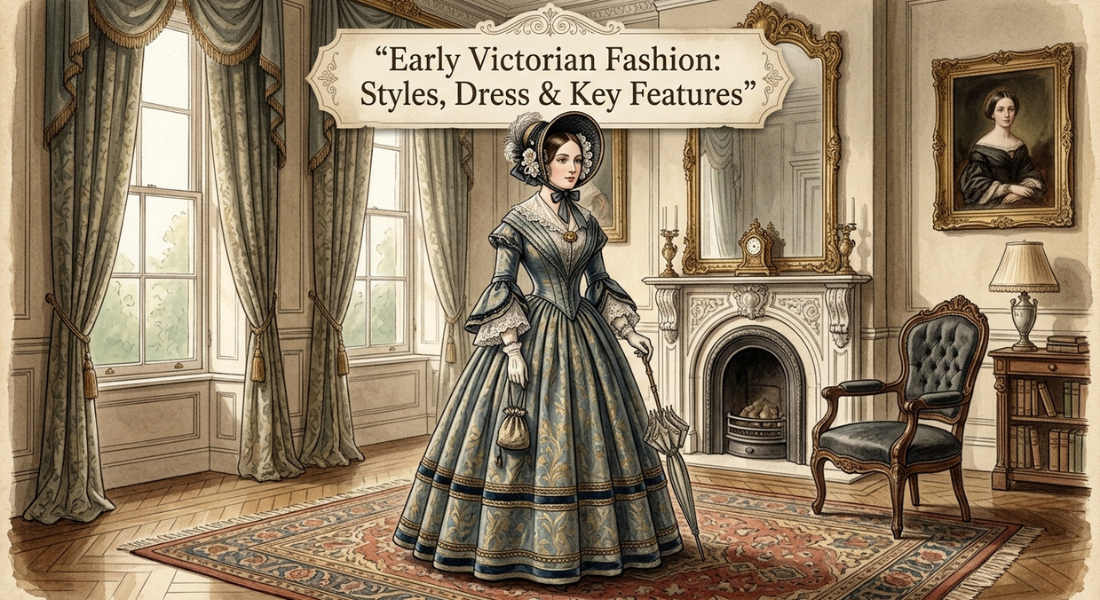
Early Victorian women's dresses featured defined waists, fitted bodices and fuller skirts. Necklines varied by occasion with daytime dresses generally more covered than eveningwear.
The V&A notes that between 1837 and 1849 evening necklines could be low and off the shoulder while daywear used higher necklines, collars and shawls. Sleeves also added width and helped balance the full skirt.
1840s dresses often combined elongated fitted bodices with defined waists and broad skirts. A Metropolitan Museum of Art example from about 1848 features a wide V shaped neckline treatment, pleating, shirring, fringe and tassels.
By the 1850s skirts became noticeably wider changing the overall proportions of women's dress. New structural support allowed this greater volume without relying entirely on layers of heavy petticoats.
During the 1860s and 1870s women's skirts gradually became flatter at the front with more fullness directed towards the back. Overskirts, draping and fitted bodices helped create this changing silhouette.
Skirt fullness increasingly moved towards the rear creating a less evenly rounded shape. Draping and overskirts further emphasised the back while the front became comparatively flatter.
A cuirasse bodice was a closely fitted, elongated bodice that extended over the torso and emphasised the waist and upper body. A British dress from 1879 to 80 in The Metropolitan Museum of Art provides a documented example.
Late Victorian women's dress changed noticeably between the 1880s and 1890s. The 1880s favoured fitted bodices, strong rear shaping and elaborate decoration while the 1890s shifted towards simpler skirts and fuller sleeves.
1880s dresses combined fitted bodices, shaped skirts, rear emphasis and detailed decoration. A British dress from 1879 to 80 in The Met demonstrates how fitted construction and elaborate trimmings reinforced the structured silhouette.
By the 1890s skirts became simpler and straighter as large rear shaping declined. Fuller sleeves brought greater volume to the upper body creating a noticeably different silhouette.
Victorian women’s daywear generally provided more coverage and practical construction while evening dress allowed lower necklines, richer decoration and more formal styling. The difference depended on the occasion not simply the colour or fabric.
Day dresses commonly featured higher necklines, collars and greater sleeve coverage. They could still be fashionable and decorative while remaining suitable for ordinary daytime activities.
Evening dresses often featured lower necklines and more elaborate decoration. The V&A records low almost off the shoulder evening necklines in early Victorian dress although styles changed throughout the period.
Historical identification works best when several characteristics are considered together. The overall silhouette usually provides a stronger starting point than an isolated decorative feature.
Look at the relationship between the waist and skirt first. Then consider the length and shape of the bodice, where the skirt's fullness sits, and the treatment of the sleeves and neckline.
Decoration provides additional evidence. Lace, braid, ribbons, pleats and patterned surfaces can help establish the character of a garment but they rarely provide a reliable date on their own.
Construction matters as well. A surviving garment can reveal how its proportions were actually achieved making it more useful for historical interpretation than an exaggerated modern costume reproduction.
A single sleeve, lace trim or bonnet can appear across more than one period. Fashion changed through overlapping transitions so individual features did not necessarily disappear the moment a new style appeared.
The stronger clue is the combination of features. Waist position, bodice length, skirt distribution, sleeve shape and neckline should support the same historical interpretation before a garment is assigned to a particular period.
Modern reproductions often simplify or exaggerate historical shapes because recognisable features make a costume immediately identifiable.
Surviving garments can tell a different story. Their proportions, seams, materials and decoration provide evidence of how clothing was actually constructed.
Comparing a reproduction with dated museum examples is therefore useful. The V&A and The Met both provide documented garments that allow visual details to be considered alongside dates and collection records.

Materials affected the appearance of women's clothing as much as its construction. Silk could create a smooth or lustrous surface while wool and cotton offered different weights, textures and practical qualities.
Decoration could transform an otherwise controlled silhouette. Lace, ribbons, braid, pleating, bows and beadwork were used to add visual interest and could deliberately draw attention towards particular areas.
The Met's 1879 to 80 British dress provides a useful example: the museum notes the Victorian use of machine made braid, lace and ribbons as elaborate surface decoration.
Colour also deserves careful interpretation. The familiar idea that Victorian women always dressed in black is inaccurate. Fashionable colour existed alongside specific circumstances such as mourning that could require darker clothing.
Decoration was often positioned strategically rather than scattered randomly across a garment. Trims could strengthen horizontal or vertical lines, frame a neckline, emphasise the bodice or draw the eye towards skirt fullness.
Pleats and bows could also create additional texture without changing the basic structure. This is why decoration should be interpreted together with silhouette.
The same ribbon or lace treatment could produce a different visual effect on an earlier full skirt than on a later narrower dress.
No. Victorian women's clothing included a broad range of colours, and the association between the period and dark clothing is partly shaped by the visibility of mourning dress in historical imagery.
The V&A records that aniline purple later known as mauve was patented by William Henry Perkin in 1856 helping make new bright shades available to fashionable consumers.
Colour should therefore be assessed alongside fabric, occasion and the circumstances in which a particular garment was worn.
Historical images are valuable but they do not all provide the same type of evidence. Fashion plates show what contemporary publications presented as fashionable while portraits and photographs show selected people and garments in specific contexts.
Surviving clothing provides another layer of evidence. It can reveal actual construction, material, seams, proportions and decorative techniques that an illustration may simplify.
The best interpretation comes from comparing these sources rather than treating any single image as a complete record of women's clothing.
This approach also explains why modern costume imagery can be misleading. A dramatic silhouette may be historically inspired while combining details that belong to different moments of the Victorian period.
Fashion plates are useful for identifying fashionable silhouettes, garment combinations and styling details. They can show how contemporary publications wanted particular clothing to appear and which features were being promoted.
However they represent selected fashionable ideals rather than every woman's everyday wardrobe. They should therefore be compared with surviving garments, photographs and other documented evidence before being treated as representative.

Museum garments preserve physical evidence that illustrations cannot fully provide. Their construction can reveal how a bodice was shaped, how fabric was assembled and where decoration was placed.
The Met's collections include documented garments with dates, materials, cultural attribution and departmental records while the V&A provides dated examples of changing women's dress structures. These records make museum collections valuable reference points for historical interpretation.
Victorian women's fashion was never one fixed dress. Its appearance changed through differences in silhouette, occasion, construction, decoration and the way volume was distributed across the body.
Reading those details together gives a far more accurate understanding of historical women's clothing than relying on the familiar exaggerated image of a single “Victorian dress”.
Victorian women wore different outfits for different periods and occasions, including daywear, visiting clothes, outdoor dress and eveningwear.
There was no single typical dress. Styles changed from broad early skirts to structured silhouettes and prominent sleeves in the later Victorian period.
It evolved from full early skirts to rear focused mid century shapes and later simpler skirts with more emphasis on the upper body and sleeves.
They used period specific construction, layered support, distinctive silhouettes and clothing conventions that reflected the occasion.
Yes. Victorian women wore many colours while darker clothing was especially associated with contexts such as mourning.
Compare its silhouette, construction, materials and decoration with dated museum garments and reliable historical images.




Reader Discussion
Leave a Reply