- by Daily Talkin Staff
- July 8, 2026
-

-
-
Loading
Loading
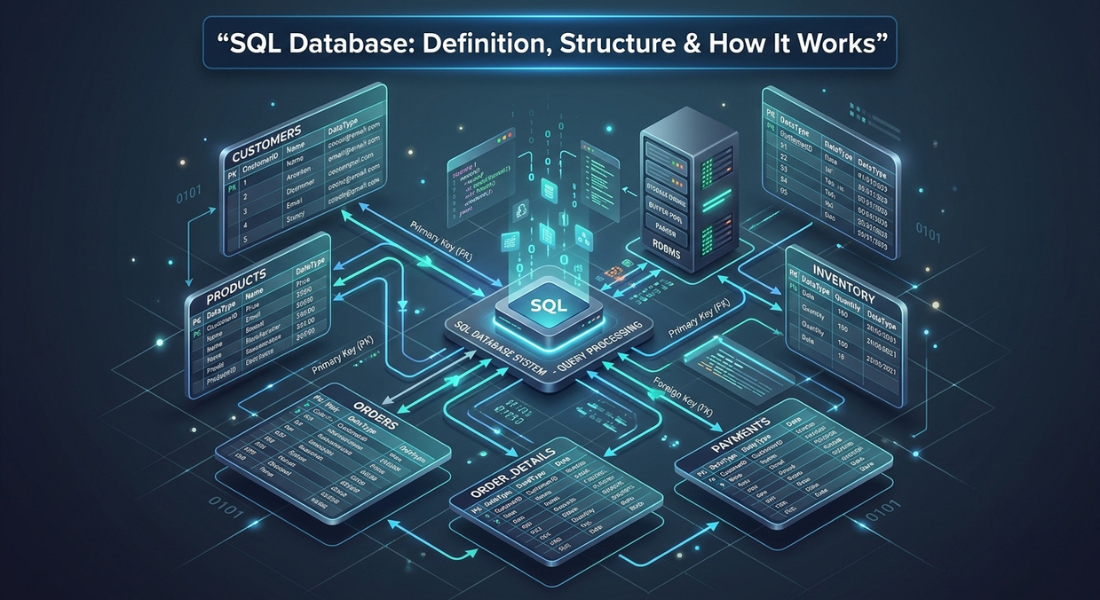
An online shop can connect each order to the right customer without storing the same details repeatedly. An SQL database stores structured data in related tables and uses SQL to work with that information.
This guide explains its structure, relationships, queries, operations, common systems, and defining characteristics.
Databases provide the broader foundation for storing and managing digital information while an SQL database focuses specifically on structured relational data handled through SQL.
This article explores that specialised area in detail see our complete Database Guide → for the broader context.
An SQL database generally uses relational tables to organise structured information.
SQL stands for Structured Query Language and provides the interface for working with relational data.
Tables contain rows and columns, while identifiers connect related records.
Common operations include SELECT, INSERT, UPDATE, and DELETE.
MySQL, PostgreSQL, SQL Server, Oracle Database, and MariaDB are common SQL database systems.
SQL databases are particularly suited to structured data with defined relationships and transaction-oriented requirements.

An SQL database generally refers to a relational database system that uses Structured Query Language (SQL) to define, query, and manipulate structured data. Information is organised into tables with relationships allowing connected records to work together.
The term describes both a practical data model and the systems built to work with it. MySQL, PostgreSQL, Microsoft SQL Server, Oracle Database, and MariaDB are examples of technologies used to implement this model.
SQL provides the common language for interacting with the stored information. A developer can request particular records, add new information, change existing values, or remove records without handling the underlying storage directly.
This makes the model particularly useful for applications where information has predictable fields and meaningful connections. A customer for example can have many associated orders while customer details remain represented separately.
SQL stands for Structured Query Language. It is the language used to interact with data in relational database systems, including operations such as querying, inserting, updating, and deleting records.
SQL is standardised although individual systems can add their own extensions or dialects. MySQL's documentation for example distinguishes standard SQL from MySQL specific extensions.
No SQL is a language not the database itself. The database contains the stored information while SQL provides a way to define, query, and manipulate that information.
An RDBMS such as Microsoft SQL Server implements the database technology and accepts SQL based statements. Microsoft describes SQL Server specifically as a relational database management system that communicates using Transact SQL (T SQL).
An SQL database organises structured information into tables with each table representing a particular type of entity or relationship. A table contains rows for individual records and columns for defined attributes.
For example, a Customers table might contain customer IDs, names, and email addresses while an Orders table stores order IDs, customer IDs, dates, and totals.
The connection between these tables allows an application to work with related information without combining everything into one oversized table.
PostgreSQL's documentation similarly demonstrates creating tables, populating rows, querying them, and joining related tables as core SQL activities.
This structure gives SQL queries a predictable logical model. Instead of searching an undifferentiated collection of information, a query can identify particular tables, columns, conditions, and relationships.
Think of a shop's customer table. Each row represents one customer while columns describe attributes such as customer ID, name, or email address.
An orders table follows the same principle. Each row represents an order while its columns hold values such as order ID, customer ID, order date, and amount.
This separation gives each table a clear purpose while allowing SQL to combine information when an application needs it. MySQL's documentation describes creating tables loading them with data and retrieving information from those tables using SQL.
Relationships connect records through identifiers. For example an order can contain a customer_id that corresponds to the ID of a customer in another table.
That connection lets a query associate the correct customer with the correct order. It also avoids repeatedly storing the customer's full details in every order record.
Primary and foreign keys commonly support these relationships while constraints can enforce rules on stored values. PostgreSQL documents primary key and foreign key constraints among its supported table constraints.
When an application needs information it sends an SQL statement describing the requested operation. The database system interprets that statement, determines which data it needs, processes the request, and produces a result or applies the requested change.
For a retrieval query, SQL can specify the relevant table, columns, and conditions. The system then evaluates those instructions against the available data rather than requiring the application to manage the underlying records itself.
The exact internal processing depends on the database system and query. PostgreSQL's query documentation for example covers table expressions, filtering, grouping, sorting, and other mechanisms used to construct and process queries.
This distinction matters because SQL describes what data operation is wanted, while the database system determines how to carry it out.
A query identifies the information it needs through elements such as tables, columns, and conditions. The database interprets these instructions and evaluates the relevant records before returning the matching result.
Indexes can also help a database locate relevant information efficiently, depending on the query and system design. They support retrieval without changing the logical way the SQL statement describes the requested data.
SQL supports the core operations required to work with stored records. These include retrieving existing information, inserting new records, updating values, and deleting records that are no longer required.
A SELECT statement can request customer details. An INSERT statement can add a new customer. UPDATE can change an email address while DELETE can remove a particular record.
These operations give applications a consistent interface for working with structured information. They can also be combined with conditions and relationships so that changes affect the intended records.
SQL is broader than these four operations alone but they provide the clearest starting point for understanding how applications interact with stored relational data. Official PostgreSQL documentation separately covers querying, updates, deletions, and related SQL functionality.
SELECT retrieves data, INSERT adds records, UPDATE changes existing values, and DELETE removes records. For example an application might use SELECT to find a customer's orders, INSERT to record a new order, and UPDATE to change its status.
These statements describe the intended operation rather than exposing the physical storage details. MySQL's documentation likewise groups creating, loading, and retrieving table data around SQL statements.

The SQL model fits information that has defined fields and meaningful relationships. Customer records, orders, invoices, products, and account transactions can each follow known structures while remaining connected through identifiers.
That predictability makes queries easier to formulate around specific fields and relationships. Rules can also be applied to tables and columns to restrict invalid or inconsistent values.
Transactions add another useful characteristic for workloads where several related changes should be treated as one logical operation. This is particularly relevant when an application must keep connected records aligned.
The result is a model designed around structured information rather than treating every record as an unrelated object. IBM's Db2 documentation describes relational data as tables containing columns and rows with SQL used to define and manipulate that data.
Relationships let separate tables represent connected parts of the same real world process. A customer can exist once in a customer table while multiple orders reference that customer's identifier.
This reduces unnecessary duplication and makes the connection explicit. A query can then bring customer and order information together when needed.
The approach is especially useful where relationships themselves carry meaning, such as customer to order, product to category, or account to transaction connections.
Several widely used database systems implement the relational model and provide SQL based ways to define and work with data. They share the broad SQL database concept but differ in implementation, supported features, and SQL dialects.
MySQL is an open source SQL database management system with relational databases and SQL support. PostgreSQL is an open source relational database system with extensive SQL functionality, including queries, joins, constraints, and transactions.
Microsoft SQL Server is Microsoft's RDBMS and uses Transact SQL for interaction. Oracle Database and MariaDB are also established relational database technologies that support SQL based data management.
Common examples include MySQL, PostgreSQL, Microsoft SQL Server, Oracle Database, and MariaDB. MySQL and MariaDB are widely associated with open source relational database technology, while SQL Server and Oracle Database are prominent enterprise database systems.
PostgreSQL is another major open source relational system. The important point is that these are separate products, not different meanings of SQL. They are technologies that provide relational database functionality and use SQL or SQL derived dialects to interact with data.
An SQL database combines several characteristics into one coherent model: structured tables, defined relationships, SQL based querying, rules for data integrity, and support for transaction oriented workloads.
Its structure gives applications predictable fields and relationships to work with. SQL provides a standardised way to express operations against that structure, while database systems implement those operations.
The model is therefore more than simply “data stored in tables”. Its value comes from how tables, relationships, rules, queries, and transactions work together.
SQL itself has also evolved as a standard. MySQL's documentation notes that SQL is defined by the ANSI/ISO SQL Standard and has evolved since 1986.
Modern SQL systems can therefore share a common foundation while still providing system specific extensions. That is why SQL knowledge transfers across products but statements are not always perfectly interchangeable.
A transaction groups related database changes into one logical unit. For example transferring money may require one account to be reduced while another is increased.
Treating those changes together helps prevent a partially completed operation from leaving related records out of alignment.
Consistency refers to maintaining valid data according to the rules defined for the database. PostgreSQL documentation includes transactions alongside querying, updates, foreign keys, and other relational capabilities.
The basic difference is the way information is modelled. SQL databases generally organise structured information through relational tables while NoSQL systems use other models designed for different data structures and access patterns.
An SQL model is a natural choice when defined fields and relationships are central to the data. A NoSQL model may be more suitable when the application's data structure does not fit neatly into relational tables.
This does not make one model universally better. The appropriate choice depends on how the application represents, connects, and queries its information.
For this article's purpose the key distinction is simple: SQL databases centre on relational, structured data and SQL based interaction.

The SQL model fits systems where relationships and predictable records matter. Customer and order systems are a straightforward example because each order can connect to a known customer.
Financial transactions and structured business records are other natural fits particularly when related changes need to remain logically consistent.
The common factor is not the industry itself. It is the data's structure: defined fields, meaningful relationships, and queries that need to work reliably across those relationships.
An SQL database combines structured relational data with SQL based interaction. Tables organise information, relationships connect related records, and SQL lets applications retrieve, insert, update, and delete that information.
The central distinction is straightforward: SQL is the language, the database stores the data, and an RDBMS provides the technology that manages and processes those interactions.
An SQL database generally refers to a relational database system that uses SQL to work with structured data organised through connected tables and relationships.
SQL stands for Structured Query Language. It is used to define, query, and manipulate data within relational database systems.
No SQL is a language used to interact with data. The database stores the information while database software provides the system for managing it.
Generally Yes The term SQL database commonly describes relational database systems that organise structured information through related tables and use SQL for interaction.
Common examples include MySQL, PostgreSQL, Microsoft SQL Server, Oracle Database, and MariaDB. Each provides relational database functionality with SQL based interaction.
SQL is used to retrieve, insert, update, and delete data as well as define database objects and perform other operations supported by relational database systems.





Reader Discussion
Leave a Reply