- by Daily Talkin Staff
- July 8, 2026
-

-
-
Loading
Loading
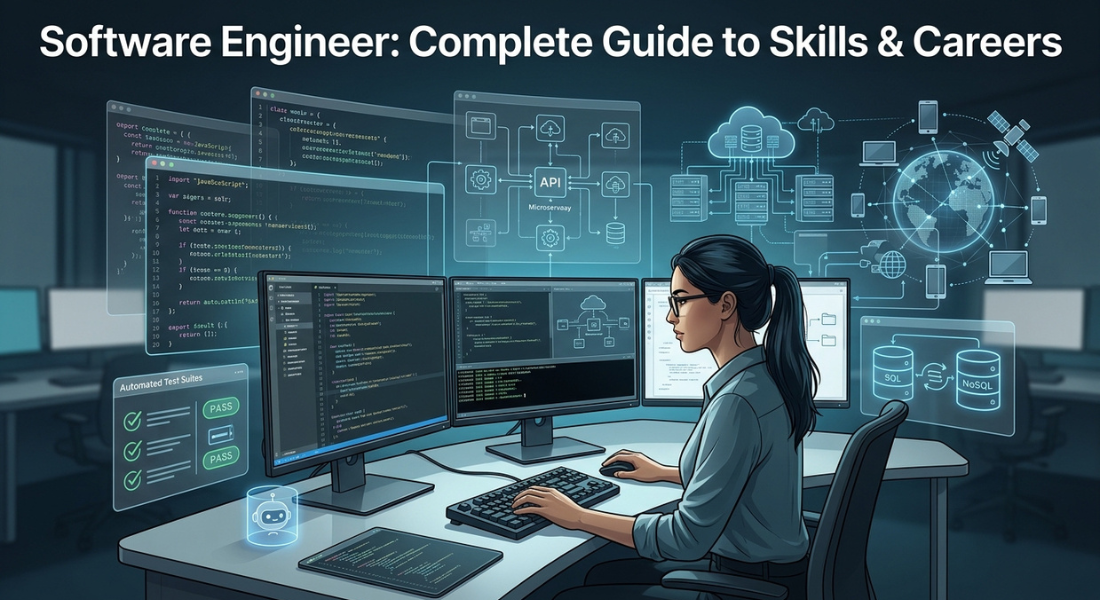
A software engineer is a technology professional who applies programming, computer science and engineering principles to design, build, test, deploy and maintain software systems.
The role goes beyond writing code engineers consider requirements, architecture, security, reliability, scalability and long term maintenance.
Software engineers work across web, mobile, cloud, enterprise, financial, healthcare, gaming, automotive and embedded systems. This guide explains their responsibilities, engineering lifecycle, specialisations, career levels, skills, technologies, tools and the changing role of AI.
Software engineering combines programming with system design, testing, deployment and maintenance.
Engineers work across front end, back end, cloud, mobile, security, data, embedded and AI systems.
Career progression can move from junior engineering work to senior, staff and principal technical leadership.
Strong fundamentals, problem solving and communication remain important alongside modern tools.
AI can accelerate coding and testing while increasing the importance of verification and engineering judgement.
Software engineering demand is supported by software expansion across AI, cloud, cybersecurity, automation and connected products.

A software engineer designs and develops software solutions that solve specific user or business problems.
Unlike simply writing code, software engineering considers the complete system, including requirements, architecture, testing, deployment, reliability and future maintenance.
The work connects people and technology engineers translate requirements into technical designs, implement features, test behaviour, deploy systems and monitor them after launch.
The discipline therefore combines programming with structured problem solving and engineering judgement.
Typical responsibilities include:
Analysing requirements and technical constraints
Designing software systems and components
Writing, reviewing and maintaining code
Testing and debugging applications
Creating technical documentation
Deploying software and managing releases
Monitoring performance and reliability
Improving scalability and security
Collaborating with product, design, data and security teams
Software engineers turn a real world requirement into a dependable technical system. For example a mobile banking application may connect a user interface to APIs, databases and authentication services.
The engineer must consider more than whether the application works. Performance, security, usability, data integrity, scalability and maintainability all influence the final solution.
Software engineers can work in technology companies, fintech, healthcare, ecommerce, automotive, aerospace, telecommunications, government, gaming and manufacturing.
They may join start ups with broad responsibilities or large enterprises with specialised teams. Their work can involve consumer applications, internal business systems, cloud platforms, connected devices or embedded software.
Software engineering is an ongoing lifecycle rather than a single coding task. Teams begin by understanding requirements, then plan, design, develop, test and deploy software before monitoring and improving it.
The exact workflow varies by organisation. Agile, Scrum, Kanban and DevOps can shape how teams organise work, while version control, automated testing and continuous integration help coordinate development. The lifecycle remains iterative because software often needs changes after release.
Engineers identify users, business requirements, scope, constraints, risks and priorities. Requirements are then translated into actionable technical work.
Good planning reduces ambiguity before development begins and helps teams make informed decisions about time, resources and system complexity.
Architecture defines how major system components work together. Engineers may choose databases, APIs, interfaces, services and dependencies according to the system's requirements.
Security, scalability, reliability and maintainability should be considered during design rather than treated as late stage fixes.
Engineers implement features using appropriate programming languages and frameworks. They normally follow coding standards and use version control to track changes.
Peer review helps identify defects, improve maintainability and share technical knowledge across a team.
Testing can include:
Unit testing
Integration testing
System testing
Regression testing
Performance testing
Security testing
Testing provides evidence that software behaves as expected and helps teams detect defects before and after deployment.
After testing software is released into a production environment. Monitoring can track availability, errors, performance and other reliability signals.
Engineering continues after launch through defect fixes, security updates, optimisation and new features. This ongoing maintenance is a core part of software engineering.
Software engineering includes multiple specialisations based on system layers, infrastructure, technology or domain. An engineer may focus on a particular area or work across several parts of a system especially in smaller organisations.
Career levels also affect responsibility. Entry level engineers generally work within established systems while experienced engineers increasingly own technical decisions, architecture, mentoring and cross team engineering outcomes.
Front end engineer: Builds interfaces and client side experiences.
Back end engineer: Develops servers, APIs, business logic and data services.
Full stack engineer: Works across front end and back end systems.
Mobile engineer: Develops applications for mobile platforms.
DevOps engineer: Connects development with deployment, automation and infrastructure.
Cloud engineer: Builds and manages cloud based systems and services.
Security engineer: Designs software and systems with security controls and threat resistance.
Data engineer: Builds systems for collecting, transforming and delivering data.
Embedded software engineer: Develops software for hardware driven products.
Machine learning / AI engineer: Builds software systems involving machine learning or artificial intelligence.
Site reliability engineer: Focuses on reliability, availability, automation and production operations.
A junior engineer typically learns established systems and implements defined tasks with guidance.
A mid level engineer works more independently, owns features and makes routine technical decisions.
A senior engineer handles complex systems, contributes to architecture, mentors others and takes broader technical responsibility.
Staff and principal engineers usually provide technical leadership without necessarily becoming people managers. They influence architecture, engineering strategy and long term technical direction across teams or an organisation.
Their work often involves solving problems that extend beyond a single project.
Start ups may expect one engineer to handle several layers of a product, including development, infrastructure and testing.
Large organisations may divide work among specialised front end, platform, security, data, infrastructure and reliability teams. Job titles also vary so responsibilities matter more than the title alone.

Effective software engineering requires technical knowledge alongside communication, analytical thinking and collaboration. Programming is fundamental but professional engineering also depends on architecture, testing, debugging, security, version control and system level reasoning.
Tools and technologies change quickly so durable computer science fundamentals are more valuable than dependence on one platform or programming language. Modern engineers also need to understand AI assisted workflows and evolving infrastructure.
Important foundations include:
Programming
Data structures and algorithms
Object oriented programming
Databases and SQL
Operating systems
Computer networking
APIs
Software architecture
Testing and debugging
Version control
Security fundamentals
Cloud computing
Common languages include Python, Java, JavaScript, TypeScript, C++, C#, Go and SQL. There is no single best language for every software engineer. The appropriate choice depends on the product, ecosystem, performance requirements, existing codebase and specialisation.
Software engineers commonly use several categories of tools:
IDEs and code editors
Git and GitHub
Issue and project tracking systems
CI/CD platforms
Testing frameworks
Containerisation tools
Cloud platforms
Monitoring and observability systems
Documentation and collaboration tools
Analytical thinking helps engineers understand complex systems and identify root causes. Problem solving supports practical technical decisions when requirements or constraints change.
Communication, teamwork and technical writing are equally important because software is built collaboratively. Attention to detail, adaptability and continuous learning help engineers remain effective as technologies evolve.
Professional practice also carries ethical responsibilities. ACM guidance highlights the importance of communication, professionalism and ethical conduct in software engineering.
Artificial intelligence is increasingly being used for code generation, code completion, refactoring, boilerplate creation and documentation assistance.
These tools can accelerate development but generated output still needs human verification. Engineers remain responsible for whether the resulting software is correct, secure, maintainable and appropriate for its intended use.
AI tools can help generate test cases, identify potential defects, explain unfamiliar code and assist with debugging.
They can also support code review workflows by highlighting patterns that deserve attention. Human review remains important because automated suggestions can be incomplete, incorrect or unsuitable for the system's context.
Software engineering still requires judgement when requirements are ambiguous or competing priorities must be balanced.
Engineers must make architectural trade offs understand business context assess security risks communicate with stakeholders and accept accountability for production systems.
Useful capabilities include strong programming fundamentals, system design, AI tool literacy, prompt formulation, verification of generated code, security awareness, critical thinking and continuous learning.
The practical advantage comes from combining AI assistance with engineering judgement rather than treating generated code as automatically correct.
Software engineering opportunities are connected with areas such as:
Artificial intelligence and machine learning
Cloud computing
Cybersecurity
Fintech
Healthcare technology
Ecommerce
Automotive and embedded systems
Enterprise software
Robotics and automation
The U.S. Bureau of Labor Statistics identifies AI, IoT, robotics, automation, cybersecurity and software enabled products among factors supporting demand for software developers.
The role is moving beyond coding only work toward greater system ownership, architecture, reliability and cross functional collaboration.
AI assisted development is changing workflows while security, observability and responsible technology are becoming increasingly important parts of engineering practice.

Long term capability comes from strong computer science fundamentals, continuous learning and adaptability.
Engineers can also benefit from combining a specialisation with broad systems knowledge, communication skills, leadership ability and practical project experience.
The U.S. Bureau of Labor Statistics projects 16% employment growth for software developers from 2024 to 2034. The broader category of software developers, quality assurance analysts and testers is projected to grow 15% during the same period.
These figures describe projected employment growth, not a guarantee of an individual job or salary. Demand can vary by technology, industry, location, experience and economic conditions.
Software engineer compensation varies by experience, location, specialisation, employer, industry and level of responsibility.
Entry level, senior and specialised engineering roles can therefore have substantially different compensation while geographic and industry differences also matter.
Salary is one part of career research rather than the defining feature of the profession. Detailed figures and compensation comparisons belong in the dedicated salary resource.
For a complete breakdown of software engineer salaries, compensation factors and earning potential see our full guide on Software Engineer Salary →
Software engineer jobs exist across technology, finance, healthcare, e commerce, automotive, gaming, government and other industries. Titles can include front end, back end, full stack, mobile, DevOps, cloud, security, data and embedded engineering roles.
Responsibilities vary by seniority, specialisation and employer. For a complete guide to finding and evaluating software engineer opportunities see our full guide on Software Engineer Jobs →
Remote software engineering allows engineers to work outside a traditional office although arrangements vary by company, role, location and employment structure.
Effective remote work often depends on documentation, communication, collaboration tools and time zone coordination.
Fully remote, hybrid and distributed teams can operate differently. For a complete guide to finding and evaluating remote software engineering opportunities, see our full guide on Remote Software Engineer Jobs →
A software engineer resume should communicate relevant technical skills, projects, engineering experience, technologies and measurable results. Strong resumes show what someone built, improved or solved rather than simply listing programming languages.
Experienced engineers can emphasise architecture, system ownership, performance, reliability and leadership. Beginners can demonstrate capability through projects, education and practical experience.
For a complete guide to creating a strong software engineer resume see our full guide on Software Engineer Resume →
A typical high level route involves learning programming and computer science fundamentals, building practical projects, developing engineering skills and gaining experience through internships or independent work.
People may enter the field through university degrees, self directed learning, bootcamps or other training routes depending on employer expectations.
For a complete step by step roadmap, education options and career entry guidance see our full guide on How to Become a Software Engineer →
Software developer and software engineer are often used interchangeably although the emphasis can differ.
Software engineering commonly includes broader system design, architecture, reliability, scalability and engineering processes while software development may emphasise building and implementing software.
In real workplaces responsibilities frequently overlap and job titles are not standardised. For a complete comparison of the two roles see our full guide on Software Developer vs Software Engineer →
Software engineering is a broad technology profession centred on designing, building, testing, deploying and maintaining software systems. The work combines programming with architecture, problem solving, collaboration, security and long term system thinking.
Understanding the lifecycle, specialisations, career levels, skills, tools and AI assisted workflows provides a clearer view of the profession.
The dedicated guides can then cover salary, jobs, remote work, resumes, career entry and developer versus engineer differences in greater depth. Strong fundamentals and continuous learning remain valuable as software engineering continues to evolve.
A software engineer designs, develops, tests, deploys and maintains software systems using programming, computer science and engineering principles.
Software engineers analyse requirements, design systems, write and review code, test software, deploy applications and maintain systems after release.
Key skills include programming, computer science fundamentals, problem solving, system design, testing, communication, collaboration and continuous learning.
It offers broad industry opportunities, technical challenges, continuous learning and multiple specialisations, although career outcomes vary by skills, experience, location and employer.
Common choices include Python, Java, JavaScript, TypeScript, C++, C#, Go and SQL with the best option depending on the role and technology stack.
AI is automating parts of development but engineering judgement, system design, requirements analysis, security, stakeholder communication and accountability remain important.





Reader Discussion
Leave a Reply