- by Daily Talkin Staff
- July 8, 2026
-

-
-
Loading
Loading
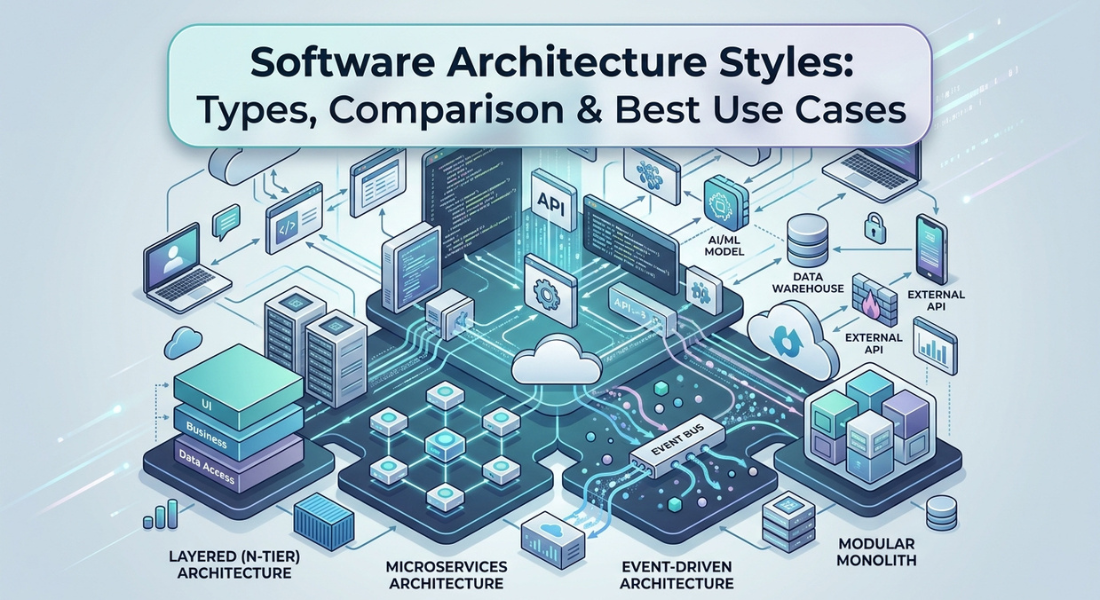
Choosing the wrong architecture style can make even well written software difficult to scale or maintain. Software architecture styles are proven ways of organising software systems based on component structure and communication.
This guide explains the main styles, compares them, highlights when to use them, and helps you choose the most suitable option.
This guide focuses only on software architecture styles. For broader concepts such as architecture principles, quality attributes, design processes, and documentation see our complete guide on Software Architecture →
Software architecture styles define how software components are organised and communicate.
Every architecture style offers different strengths, limitations, and ideal use cases.
Choose an architecture based on business requirements rather than industry trends.
Simpler architectures are often better for smaller applications.
Consider scalability, maintenance, and operational complexity before making a decision.

Software architecture styles are established ways of organising a software system's components and defining how they interact. They provide a high level structure for communication, responsibilities, and system organisation.
Different styles suit different applications. For example small business systems often use layered architecture while large scale platforms may benefit from microservices or event driven architecture.
According to the IEEE Computer Society software architecture describes the fundamental organisation of a system through its elements and relationships. Architecture styles apply these principles to help teams choose a structure that fits their requirements.
A software architecture style is a high level structural model that defines how software components are organised and communicate. It provides a blueprint for building systems without specifying implementation details.
The right architecture style improves system organisation, simplifies maintenance, and supports future growth. It also helps teams make consistent design decisions based on the application's requirements.
Although the terms are often used interchangeably they describe different concepts. A software architecture style defines the overall structure of a system while an architecture pattern solves a specific design problem within that structure.
Many applications combine one architecture style with multiple design patterns. As Martin Fowler explains architectural decisions should be based on system requirements and trade offs rather than trends.
Think of an architecture style as the layout of a city while an architecture pattern is the design of a building within that city.
Microservices is an architecture style, whereas MVC, Repository, and CQRS are architecture patterns. They solve different types of design challenges and should not be treated as the same concept.

Different applications need different architecture styles. Each style offers a unique balance of scalability, maintainability, flexibility, and complexity, making it suitable for specific use cases.
Layered Architecture divides an application into layers such as presentation, business logic, and data access.
Its clear structure improves maintenance and testing making it ideal for enterprise applications and traditional web systems. As applications grow tightly connected layers can reduce flexibility.
Client Server Architecture separates clients that request services from servers that process data and manage resources.
It is widely used for websites, email systems, and business applications. While easy to manage the server can become a bottleneck under heavy workloads.
Microservices Architecture splits an application into independent services that communicate through APIs or messaging. This enables independent deployment, better scalability, and faster development.
According to the Software Engineering Institute (SEI) architecture decisions directly affect maintainability and scalability. Microservices suit large applications but increase operational complexity.
Event Driven Architecture allows components to communicate through events instead of direct requests. Its loose coupling improves scalability and flexibility making it ideal for real time systems, IoT, and financial platforms.
However managing asynchronous events and message delivery adds complexity.
Service Oriented Architecture (SOA) organises software into reusable business services connected through standard interfaces.
It is widely used in large enterprises to integrate multiple systems. Although SOA improves interoperability its central infrastructure can increase complexity.
Microkernel Architecture keeps core functionality separate from optional plug ins. This makes applications easier to extend and maintain, making it suitable for IDEs, operating systems, and plugin based platforms. Careful plug in management is essential to avoid compatibility issues.
Hexagonal Architecture separates business logic from external systems using ports and adapters. This improves flexibility, testing, and long term maintenance making it ideal for domain driven applications. The added abstraction however may be unnecessary for smaller projects.
The table below compares the most common software architecture styles, highlighting their strengths, limitations, scalability, and complexity.
Architecture Style | Best For | Primary Strength | Main Limitation | Scalability | Complexity |
Layered | Business applications | Simple organisation | Limited flexibility | Medium | Low |
Client Server | Web and desktop systems | Centralised management | Server bottlenecks | Medium | Low |
Microservices | Large distributed systems | Independent deployment | Operational overhead | Very High | High |
Event Driven | Real time platforms | Loose coupling | Debugging complexity | Very High | High |
SOA | Enterprise integration | Service reuse | ESB dependency | High | High |
Microkernel | Extensible software | Modular plug ins | Extension management | Medium | Medium |
Pipe nd Filter | Data processing | Reusable processing stages | Processing overhead | High | Medium |
Hexagonal | Business critical systems | Separation of concerns | Additional abstraction | High | Medium |
Every architecture style involves trade offs. Simpler styles are easier to maintain while distributed architectures improve scalability but increase complexity. The right choice depends on your application's requirements and long term maintenance goals.
The right architecture style depends on your application's requirements not popularity. A small business application needs a different approach from a large scale platform.
According to the Software Engineering Institute (SEI) architectural decisions directly affect maintainability, scalability, performance, and long term system evolution. Evaluating these factors early helps avoid costly redesigns.
Small applications often work best with Layered or Client Server architectures because they are simple to develop and maintain. Larger systems with independent business functions are better suited to Microservices or SOA.
For rapidly growing or unpredictable workloads Event Driven and Microservices provide greater scalability. Stable applications with predictable demand often benefit from simpler architectures that reduce maintenance effort.
Choose an architecture your team can manage effectively. Distributed systems require expertise in monitoring, automation, deployment, and fault management.
Application Type | Recommended Style |
Small business applications | Layered or Client Server |
Medium sized platforms | Layered, Hexagonal, or Microkernel |
Enterprise systems | SOA or Microservices |
Real time event processing | Event Driven |
Data processing pipelines | Pipe and Filter |
Selecting the simplest architecture that meets both current and future requirements usually delivers the best long term results
Every architecture style has suitable and unsuitable scenarios. Choosing a style based only on trends can increase complexity, costs, and maintenance challenges.
Layered and Client Server architectures are often the better choice for small applications, internal systems, and predictable workloads. Using distributed architectures in these cases can add unnecessary operational effort.
Microservices and Event Driven Architecture are valuable for systems requiring independent scaling, frequent releases, or high availability. However smaller applications may not justify the added infrastructure, monitoring, and communication complexity.
Before selecting a style evaluate:
Expected growth
Update frequency
Team expertise
Operational resources
Long term maintenance needs
The best architecture is not the most advanced option but the one that fits the application's actual requirements.
Choosing an architecture style requires more than following popular trends. Poor decisions often come from ignoring project requirements, future maintenance, and operational limits.
Modern styles like Microservices and Event Driven Architecture are not suitable for every application. Selecting them only because large companies use them can introduce unnecessary complexity.
Architecture decisions affect long term operations. Distributed systems require monitoring, testing, deployment management, and ongoing support which can increase maintenance effort.
Small applications rarely need enterprise level architectures. Adding unnecessary complexity too early can slow development, increase costs, and make troubleshooting harder.

Use this quick reference to match common application needs with suitable architecture styles.
If your application is... | Recommended style | Why it fits | When to reconsider |
Small business application | Layered | Simple and maintainable | Rapid growth expected |
Traditional web application | Client Server | Centralised management | Heavy scaling needed |
Enterprise platform | SOA | Service integration | Independent deployments needed |
Large cloud application | Microservices | Independent scaling | Limited operational expertise |
Real time system | Event Driven | Asynchronous communication | Simple workflows |
Extensible platform | Microkernel | Plugin support | Extensions are unnecessary |
Data pipeline | Pipe and Filter | Modular processing | Low latency required |
Domain focused system | Hexagonal | Business logic separation | Small project scope |
This cheat sheet offers guidance not a fixed rule. The best choice depends on application needs, growth expectations, and maintenance goals.
No software architecture style is universally better than another. Each one solves different structural challenges and involves its own trade offs between scalability, flexibility, complexity, and maintenance.
The most effective choice is the one that matches your application's size, business goals, technical requirements, and long term evolution. Focus on solving real problems instead of following architectural trends, and your software will be easier to maintain as it grows.
A software architecture style defines how software components are organised and communicate. It provides a structural approach for building maintainable systems.
Microservices and Event Driven Architecture offer high scalability because components can scale independently based on demand.
Layered Architecture uses internal layers within one system while Microservices divides functionality into independent services connected through APIs or messaging.
Yes Applications can combine styles such as using layered structures inside individual microservices.
Layered and Client Server architectures are often suitable because they are simple, easier to maintain, and cost effective.
Styles define the overall system structure while patterns solve specific design problems within that structure.






Reader Discussion
Leave a Reply