- by Daily Talkin Staff
- July 8, 2026
-

-
-
Loading
Loading
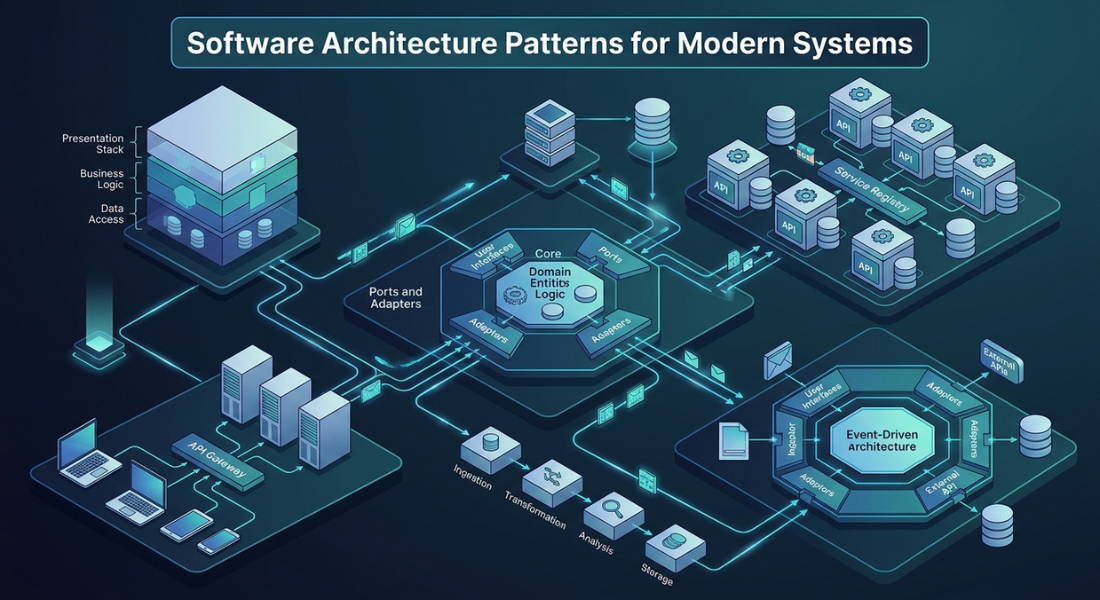
Software architecture patterns are proven structural solutions that help organise software systems to solve recurring design challenges. They provide reusable ways to structure components, improve scalability and maintainability, and simplify long term software development.
Choosing the right pattern depends on your application's goals, complexity, and future growth rather than following industry trends.
This guide explains the most common software architecture patterns compares their strengths and weaknesses, and helps you identify which pattern best suits your project.
Software architecture patterns are one part of software architecture. For principles, components, diagrams, and the complete design process, see our complete Software Architecture guide → see the full guide.
Software architecture patterns are reusable solutions for organising software systems.
Different patterns solve different architectural challenges and suit different project types.
Layered architecture is ideal for simple applications while microservices support large scale systems.
Event driven, pipe and filter, and hexagonal architectures address specialised technical requirements.
The best pattern depends on business goals, scalability needs, and team experienc

Software architecture patterns are reusable structural solutions for organising software systems.
They provide tested approaches to solving common architectural challenges making applications easier to build, scale, maintain, and evolve while reducing the need to design system structures from scratch.
According to the IEEE Computer Society, software architecture represents the fundamental organisation of a software system, including its components, relationships, and guiding principles.
This definition highlights why structured architectural approaches are essential for building maintainable and reliable systems.
Software architecture patterns are proven approaches for organising the major parts of a software system. Instead of designing a new structure for every project architects use reusable patterns that solve common architectural challenges.
A pattern defines how components interact, how responsibilities are separated, and how the overall system is organised. While implementation details may differ the core structure remains consistent.
Using established patterns improves consistency, reduces architectural risks, and helps development teams build scalable maintainable software more efficiently.
As software systems grow they become more complex to manage. Software architecture patterns provide a structured foundation that keeps applications organised, scalable, and easier to maintain.
They improve maintainability by separating responsibilities making updates and testing simpler. They also support scalability allowing applications to handle increasing workloads without major redesign.
Another benefit is better collaboration as familiar patterns help development teams understand systems faster. Using proven patterns also reduces architectural risks and supports more reliable long term software development.
Architecture patterns and architecture styles are closely related but serve different purposes. An architecture style defines the overall structure of a software system while an architecture pattern provides a reusable solution to a specific structural challenge within that system.
Although the terms are often used interchangeably styles describe broad approaches whereas patterns offer practical solutions for recurring architectural problems.
Different software architecture patterns solve different architectural problems. Each pattern has its own strengths, limitations, and ideal use cases making it important to understand when each approach is most suitable for building reliable and scalable software systems.
Layered architecture divides an application into separate layers, such as presentation, business logic, and data access with each layer handling a specific responsibility.
Its clear structure improves maintainability, simplifies testing, and allows teams to update one layer with minimal impact on others. It is easy to understand and works well for applications with predictable workflows.
The main limitation is that multiple layers can reduce performance and become harder to scale independently as systems grow. Layered architecture is commonly used for business applications, enterprise software, and traditional web applications.
The client server architecture pattern separates a system into two parts the client handles user interaction while the server processes requests, manages business logic, and stores data.
This structure simplifies maintenance, centralises data management, and allows multiple clients to access shared resources. It also improves security and data consistency.
Its main drawback is that the server can become a performance bottleneck under heavy traffic unless additional infrastructure is added. Common use cases include web applications, online banking, email services, and cloud based business software.
Microservices architecture divides an application into independent services with each service responsible for a specific business function and communicating through APIs or messaging.
This approach improves scalability allows independent development and deployment, and supports continuous delivery. It is well suited for large applications managed by multiple development teams.
The main challenge is increased operational complexity as managing communication, monitoring, and security across multiple services requires experienced teams. Microservices are commonly used for SaaS platforms, enterprise systems, ecommerce applications, and cloud native software.
Event driven architecture enables components to communicate by publishing and responding to events instead of making direct requests.
This approach supports real time processing, improves scalability, and reduces dependencies between services. It is ideal for applications that require fast asynchronous communication.
The main drawback is increased complexity in monitoring and debugging distributed events. Common use cases include financial systems, IoT platforms, notification services, and real time analytics.
The pipe and filter architecture processes data through a sequence of independent filters with each stage performing a specific task before passing the output to the next.
Its modular design improves reusability, maintainability, and testing because each filter has a single responsibility. Filters can also be replaced without affecting the entire pipeline.
Long processing pipelines may introduce latency making this pattern best suited for data transformation, media processing, document conversion, and batch processing systems.
Hexagonal architecture also known as Ports and Adapters Architecture separates core business logic from external systems such as databases, APIs, and user interfaces.
This design improves maintainability, testability, and flexibility by allowing external technologies to change without affecting business rules.
Its additional abstraction increases complexity making it less suitable for small applications. It is commonly used for enterprise software, financial systems, and domain driven applications.

Comparing software architecture patterns helps identify the most suitable option based on scalability, complexity, maintainability, deployment, and project requirements.
Understanding these trade offs enables teams to make informed architectural decisions instead of selecting patterns simply because they are widely used.
Pattern | Complexity | Scalability | Maintainability | Deployment | Best For |
Layered | Low | Medium | High | Simple | Business applications and CRUD systems |
Client Server | Low | Medium | Medium | Simple | Web applications and online services |
Microservices | High | Very High | Medium | Complex | Large enterprise and cloud platforms |
Event Driven | High | High | Medium | Moderate to Complex | Real time and distributed systems |
Pipe and Filter | Medium | Medium | High | Moderate | Data processing and transformation |
Hexagonal | Medium to High | High | Very High | Moderate | Enterprise software with complex business logic |
The table highlights that no pattern performs best in every category. Each one balances complexity, scalability, and maintainability differently depending on project goals.
Layered architecture is simple to implement and maintain making it ideal for small and medium sized applications but it can become harder to scale as systems grow.
Client erver architecture centralises management and data though the server may become a performance bottleneck under heavy workloads.
Microservices provide excellent scalability and deployment flexibility but require experienced teams to manage their distributed complexity.
Event driven architecture supports real time processing and loose coupling although asynchronous communication can make debugging more difficult.
Pipe and filter architecture is easy to maintain and reuse for data processing but it is less suitable for applications with complex business workflows.
Hexagonal architecture offers high flexibility and testability by isolating business logic but its additional abstraction increases implementation complexity.
Choosing the right software architecture pattern depends on business goals, application complexity, scalability requirements, team expertise, and long term maintenance.
Evaluating these factors helps architects select a solution that balances flexibility, performance, and operational simplicity.
According to the Google Cloud DORA Report, high-performing technology teams achieve faster and more reliable software delivery through effective engineering practices, automation, and well-structured development approaches.
This supports the need for choosing architectures that match team capability and operational needs.
Start by defining what the application must achieve. Business objectives should guide architectural decisions rather than personal preferences or technology trends. Consider expected users, required features, compliance needs, and long term business goals.
A simple internal application rarely needs the same architecture as a global SaaS platform. hoosing a pattern that aligns with functional requirements reduces unnecessary complexity and supports future development.
Think about how much the application is expected to grow over time. Some systems remain relatively stable while others experience rapid increases in users, transactions, or data.
If significant growth is expected choose a pattern that supports independent scaling without requiring major structural changes. For smaller applications with predictable workloads a simpler architecture often delivers better value while reducing maintenance costs.
Every architecture pattern involves compromises. Improving one quality often introduces additional complexity somewhere else. Microservices improve scalability but require sophisticated deployment and monitoring.
Layered architecture is easier to manage but offers less flexibility for independently scaling components. Comparing these trade offs helps ensure the selected pattern matches both technical requirements and available resources.
The skills of your development team should influence architectural decisions. A highly complex architecture can slow delivery if developers lack experience with distributed systems.
Smaller teams often achieve better results using simpler patterns that are easier to understand and maintain. Larger organisations with specialised teams may benefit from more advanced architectures that support independent development and deployment.
If Your Project Is... | Recommended Pattern |
Small business application | Layered Architecture |
Traditional web application | Client Server Architecture |
Large enterprise platform | Microservices Architecture |
Real time event processing | Event Driven Architecture |
Data transformation pipeline | Pipe and Filter Architecture |
Highly testable business system | Hexagonal Architecture |
This cheat sheet provides a practical starting point. Final decisions should always consider business priorities, technical constraints, and future growth plans.

Selecting the wrong architecture pattern can increase development complexity, reduce maintainability, and create scalability issues.
Understanding common selection mistakes helps teams avoid unnecessary technical debt and choose architectures that better support long term software evolution.
Many teams adopt fashionable architecture patterns because successful companies use them. However what works for a global technology platform may be unnecessary for a smaller business application.
Architecture decisions should always be driven by project requirements rather than industry trends.
Adding distributed services, complex messaging systems, or advanced abstractions to a simple application often increases costs without delivering meaningful benefits. A straightforward architecture is usually easier to build, maintain, and extend as the project grows.
Designing only for current requirements can create expensive migration projects later. If steady growth is expected scalability should be considered during the initial architecture selection. Planning ahead reduces the risk of major structural changes as user demand increases.
Combining multiple architecture patterns without a clear purpose can create unnecessary complexity and inconsistent system behaviour. It is often better to apply one primary pattern effectively than to combine several approaches that overlap or conflict.
Every architecture pattern offers strengths and limitations. Focusing only on benefits while ignoring disadvantages often leads to poor long term decisions.
Evaluating complexity, scalability, maintainability, operational cost, and team capability helps ensure the chosen architecture remains effective throughout the application's lifecycle.
Software architecture patterns provide proven ways to organise software systems for different technical and business needs. Each pattern offers unique advantages whether your priority is simplicity, scalability, flexibility, or maintainability.
There is no universally best architecture pattern. The right choice depends on your project requirements, expected growth, team experience, and long term goals.
Understanding the strengths and trade offs of each pattern helps you build software that remains reliable and easier to evolve over time.
Software architecture patterns are reusable solutions for organising software systems and solving common structural design challenges.
They improve maintainability, scalability, collaboration, and flexibility while reducing architectural risks.
Layered architecture is the most common because it is simple, maintainable, and suitable for many business applications.
Architecture styles define overall system structure while architecture patterns provide reusable solutions to specific structural problems.
Yes. Many modern systems combine compatible patterns such as microservices with event driven or hexagonal architecture.
Choose a pattern based on business goals, scalability needs, project complexity, and your team's experience.






Reader Discussion
Leave a Reply