- by Daily Talkin Staff
- July 8, 2026
-

-
-
Loading
Loading
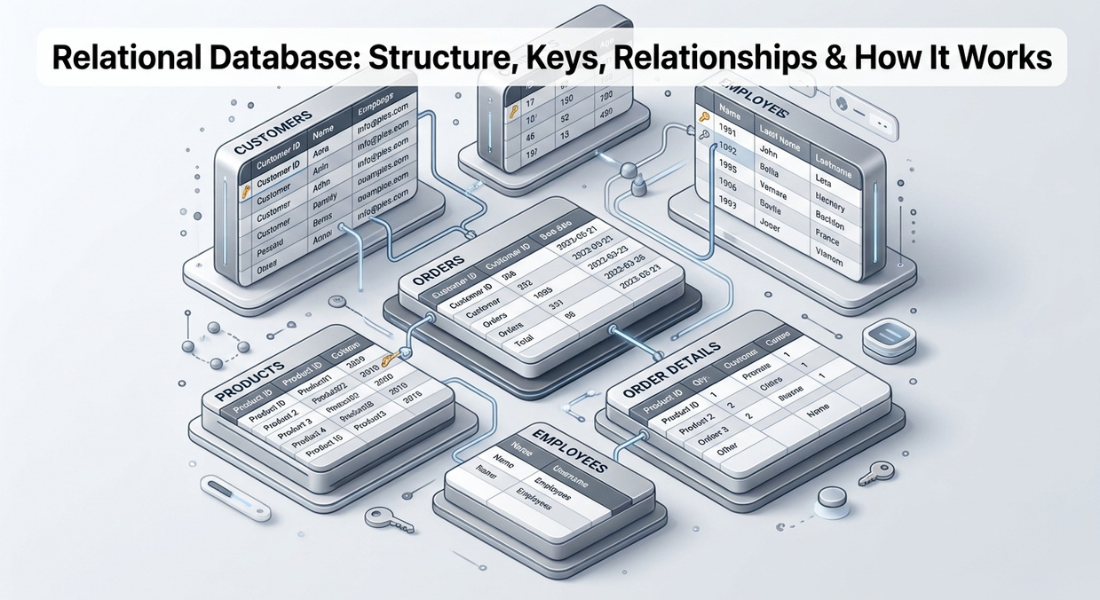
A customer can place several orders while their details remain stored once and linked to each order. A relational database makes this possible by organising structured data into related tables.
This guide explains its relational model, tables, keys, relationships, constraints and how these parts work together. A database is the broader system for storing, managing and retrieving information across different models and workloads.
This article focuses specifically on the relational model. This is part of our complete Database Types, Uses, Components, Security & More Guide → see the full guide here.
A relational database organises structured information into related tables.
Rows represent records, while columns represent attributes of those records.
Primary keys identify records and foreign keys connect related tables.
One to one, one to many and many to many relationships describe how records correspond.
Referential integrity and database constraints help prevent invalid or inconsistent data.
SQL provides a common way to query and modify relational data.

A relational database is defined by the way it represents structured information as relations, usually displayed as tables, and connects related records through defined relationships. The model gives data a logical structure rather than treating every record as an isolated item.
The key idea is that a table represents a particular type of information while relationships connect information held in separate tables. A customer for example can exist in one table while their orders exist in another.
Those tables can be connected using identifiers such as primary and foreign keys. This lets the database represent related information without storing every customer detail repeatedly inside every order.
IBM describes the relational model as data organised in tables that can be connected through primary and foreign keys.
The relational data model is a framework for representing information as relations made up of rows and attributes. In practical database terminology these relations are represented as tables with relationships allowing related information to remain logically connected.
A relation broadly corresponds to a table, a record corresponds to a row, and an attribute corresponds to a column or property. These terms describe the same underlying structure from the perspective of relational theory and practical database use.
A relational database is organised around a schema containing defined tables, columns, keys and relationships. Each table normally represents a particular entity or subject while its rows represent individual records and its columns describe their attributes.
For example a Customers table could contain CustomerID, Name and Email. Each row represents one customer while each column describes one property of that customer.
An Orders table can separately contain OrderID, CustomerID and OrderDate. The repeated CustomerID does not duplicate the customer's full details; it provides the connection between the two tables.
This structure makes the relationships explicit. Instead of putting customer information into every order record, the database can store customer information once and connect orders to it through keys.
A table stores a particular category of related information. A row represents one record within that table while a column represents a defined attribute.
For example one Customers row represents one customer while CustomerID, Name and Email are columns describing that customer.
At the logical level relational database architecture can be understood as schema → tables → columns → keys → relationships → constraints.
The schema defines how these objects are organised and how they are expected to relate. This is a logical view of architecture, not a discussion of servers, cloud infrastructure or enterprise deployment.
Keys provide the identification and connection mechanism that allows separate tables to function as one related dataset. A primary key identifies a record within its own table while a foreign key refers to a related record in another table.
Consider a Customers table where CustomerID identifies each customer uniquely. An Orders table can also contain CustomerID allowing each order to be associated with its customer.
The two columns serve different roles even though they contain related values. The primary key establishes identity the foreign key establishes a reference.
This distinction is fundamental to the relational model because relationships depend on reliable identifiers rather than repeated descriptive information.
A primary key uniquely identifies a row in a table. CustomerID is a suitable example because each customer can have a distinct identifier even when two customers have similar names.
A primary key can consist of one column or in some designs multiple columns. PostgreSQL's documentation specifies that primary key values must be unique and not null.
A foreign key stores a value that references a related record in another table. If CustomerID is the primary key in Customers the same identifier can act as a foreign key in Orders.
This means several orders can reference the same customer while the customer's core information remains stored in one place.
Relationships describe how records in one table correspond to records in another. The three fundamental patterns are one to one one to many and many to many with the appropriate structure depending on how the real world entities relate.
A one to one relationship connects one record to one corresponding record. A one to many relationship allows one record to connect to several records. A many to many relationship allows multiple records on both sides to be associated.
These patterns are not merely labels. They influence how foreign keys and where necessary intermediary tables represent the underlying data relationships.
In a one to one relationship one customer might have one dedicated profile record. In a one to many relationship one customer can have many orders.
The customer orders pattern is especially common because one parent record can naturally be associated with multiple child records through a foreign key.
A many to many relationship exists when multiple records on both sides can relate to multiple records on the other side. Students and courses provide a simple example because one student can take several courses and each course can contain several students.
A junction or intermediary table represents these associations. PostgreSQL's documentation also demonstrates many to many relationships using a table containing foreign keys to both related tables.
Referential integrity keeps relationships between tables logically valid by ensuring that foreign key references correspond to appropriate records in the referenced table.
Suppose an Orders record contains CustomerID = 105. If that identifier is a foreign key the database can require customer 105 to exist in the Customers table.
This prevents a relationship from pointing to a record that does not exist. The result is a connected dataset in which references have a valid destination.
Referential integrity is therefore closely tied to foreign key constraints. It does not merely describe the existence of a relationship; it helps enforce the validity of that relationship.
Imagine that Customers contains customer 105 and Orders contains several records referencing 105. Those orders remain connected to the correct customer through the shared identifier.
If a new order attempted to reference customer 999 when no such customer existed a foreign key constraint could reject that invalid reference. PostgreSQL explicitly describes foreign keys as maintaining referential integrity between related tables.
Broken relationships can create orphaned records where a record refers to something that no longer exists. They can also produce inconsistent relationships and unreliable query results.
The problem is especially serious when applications assume that a foreign key reference always points to a valid related record. Enforcing the relationship at the database level helps protect that assumption.
Database constraints are rules that restrict the values or relationships a table can accept. They provide a formal way to protect data quality instead of relying entirely on application code or user behaviour.
A primary key can require unique identification while a foreign key can require a valid relationship. Other constraints can prevent missing, duplicated or unacceptable values.
PostgreSQL's current documentation identifies check, not null, unique, primary key and foreign key constraints among its core constraint types. Together these rules help a relational database maintain structured and trustworthy information.
Primary key identifies rows uniquely. Foreign key protects references between tables. unique prevents duplicate values within a constrained column or combination.
Not null prevents a column from accepting a null value while check restricts values according to a defined condition. These rules describe what valid data looks like without requiring detailed SQL syntax.
Keys identify records, foreign keys connect records and constraints restrict invalid values. These functions complement one another rather than serving as interchangeable concepts.
For example a CustomerID primary key can identify a customer a CustomerID foreign key can connect an order to that customer, and a constraint can prevent required identifying information from being missing.

When an application needs related information a relational database can use the defined structure and relationships to locate the relevant records and combine information from the appropriate tables.
Imagine an application requesting a customer's recent orders. The relevant customer record can be identified, related order records can be located through their shared key, and the required information can then be returned.
The important point is that the database does not need to store the same complete customer record inside every order. The relationship provides the connection.
This is one reason the relational model can represent complex datasets while keeping individual tables focused on particular types of information.
A query can retrieve information from more than one related table by using the relationships already represented in the schema.
For example customer details can remain in Customers while order information remains in Orders. A query can bring those records together when the application needs to show a customer's orders.
A join combines related rows from separate tables using matching values or defined relationships. In the customer example a query can match the CustomerID in Customers with the corresponding CustomerID in Orders.
The concept matters more here than SQL syntax. The join demonstrates how separately stored information can be retrieved as a connected result.
Relational database design separates distinct types of information so that each table has a clear purpose and relationships can connect the resulting records.
If every order stored the customer's name, email address and other details the same information could appear repeatedly. A change to the customer's email could then require updates across multiple records.
Separating customers from orders reduces this unnecessary repetition and makes the relationship explicit. The database stores the customer once and associates orders with that customer through an identifier.
This approach also provides a foundation for normalisation which organises data to reduce unnecessary redundancy and certain update problems.
Suppose one customer has 20 orders. Storing the customer's full details in all 20 records creates repeated information. Keeping customer details in Customers and order details in Orders means the relationship carries the connection.
If the customer's email changes the authoritative customer record can be updated rather than repeatedly changing copied values.
Normalization is the process of organising related data to reduce unnecessary redundancy and update anomalies. It supports the relational model by encouraging information to be stored according to its logical relationships.
The goal here is not to study individual normal forms but to understand why related information is separated in the first place.
The phrase “types of relational databases” can refer to different implementations of the relational model rather than completely different data models.
Relational database software implements the model through an RDBMS with differences in features, supported workloads and implementation details. The underlying relational approach still centres on structured tables and relationships.
Examples include PostgreSQL, MySQL, Oracle Database and Microsoft SQL Server. They are technologies used to manage relational data not separate database models in the same sense as document or graph databases.
An RDBMS, or relational database management system, is software used to create, store, manage and interact with relational databases.
The relational database describes the organised data and its model, while the RDBMS provides the software capabilities used to work with that data.
Common relational database technologies include PostgreSQL, MySQL, Oracle Database and Microsoft SQL Server. They provide environments for managing table based relational data and commonly support SQL.
Their individual features differ but comparing vendors or selecting software is outside this article's narrow focus.
SQL, or Structured Query Language provides a common way to express operations against relational data. It can be used to retrieve, insert, update and delete information and to work with the structures that hold that information.
SQL is therefore closely associated with relational databases but the two terms are not interchangeable. A relational database is based on a data model; SQL is a language used to interact with data in that model.
This distinction helps explain why “SQL database” is often used informally to describe a relational system even though SQL itself is not a database model.
SQL queries can retrieve information from one table or combine related information from several tables. For example an application could request a customer's orders and combine customer and order information through their shared relationship.
Understanding that relationship is more important here than learning individual SQL commands.
Transactions group related database operations into a controlled unit. This is useful when several changes belong to one logical operation and should be handled consistently. For example an order process might involve recording an order and its associated items.
The transaction concept helps ensure that related changes are handled as one logical operation rather than leaving incomplete changes behind.
The relational model works particularly well when information has a defined structure and relationships between entities need to remain clear and reliable.
Tables make data easy to organise conceptually while keys and constraints provide explicit mechanisms for identifying records and maintaining relationships.
The same structure can become demanding when requirements change frequently or when data does not fit naturally into predefined relationships. Designing highly interconnected tables also requires care because changes to one part of the model can affect related structures.
The model suits structured information where entities have clear attributes and meaningful relationships. Customers, orders, products and similar business records are natural examples.
It is particularly useful when applications need dependable relationships and consistent handling of structured records.
A predefined schema can require more planning when the shape of incoming data changes frequently. Highly interconnected designs can also become difficult to maintain if relationships are poorly planned.
Other database models may suit different requirements, but choosing among database models is a broader topic than this cluster.

The relational model becomes easiest to understand when its parts are viewed as one connected structure:
schema → tables → rows and columns → primary keys → foreign keys → relationships → constraints → queries.
Consider a simple commerce system. Customers stores customer records, Orders stores order records, and an Order Items table can connect orders with individual products.
CustomerID can connect a customer to their orders while OrderID identifies each order and ProductID identifies the relevant product. Foreign keys represent these connections without requiring all information to be duplicated.
The result is a set of focused tables that behave as a connected dataset through defined relationships and rules.
Customers can store CustomerID and customer details. Orders can store OrderID and CustomerID linking each order to its customer.
An Order Items table can use OrderID and ProductID to connect orders with products. Each table owns a particular type of information while keys establish the relationships.
A relational database separates structured information into tables, identifies records with keys, connects related records through relationships and applies constraints to keep those relationships and values valid.
Once this model is clear tables are no longer isolated collections of rows. They become connected parts of one logical data structure.
A relational database organises structured information into tables and connects those tables through defined relationships. Rows represent records, columns describe attributes, primary keys identify records and foreign keys create references between related data.
Relationship types explain how records correspond while referential integrity and constraints help keep those connections valid. SQL provides a common way to interact with the model but the central idea remains the organised relationship between data.
A relational database organises structured data into tables and connects related records using keys and defined relationships.
A relational database is the data structure while an RDBMS is software used to manage and interact with it.
A primary key uniquely identifies each row in a table and can be referenced by related tables.
A foreign key connects one table to another by referencing a related record.
Referential integrity ensures foreign key references point to valid related records preventing broken relationships.
The main types are one to one one to many and many to many relationships.





Reader Discussion
Leave a Reply