- by Daily Talkin Staff
- July 8, 2026
-

-
-
Loading
Loading
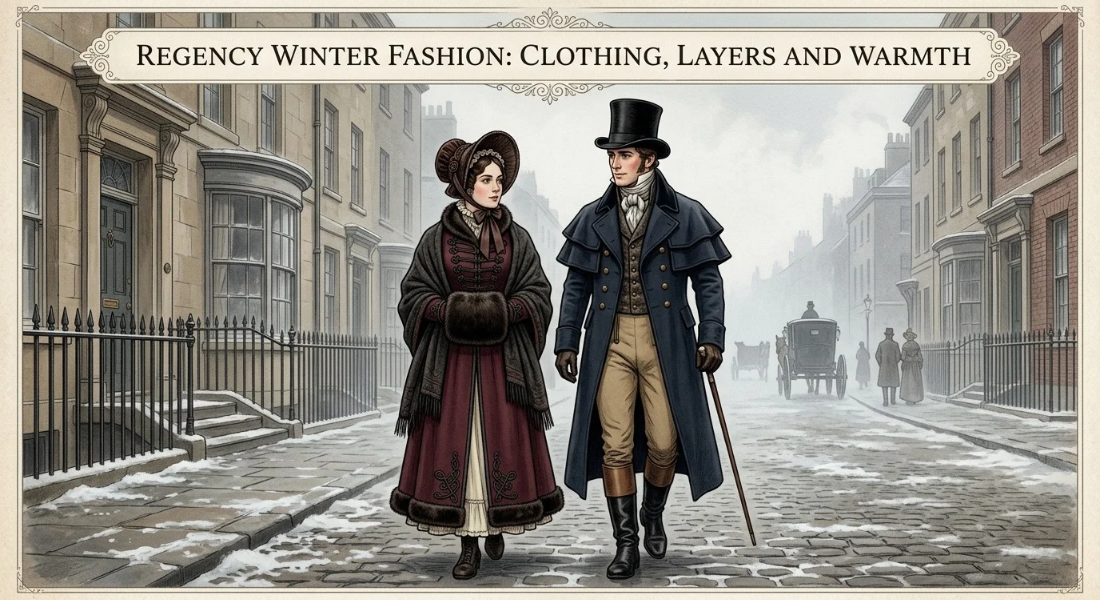
Cold weather challenged the fashionable lines seen in Regency portraits. Regency Winter Fashion explores the garments, fabrics and layers people used to dress for cold conditions in early nineteenth century Britain.
Our complete Regency Fashion guide covers the wider history, silhouettes, everyday and formal clothing, social influences and period changes beyond this seasonal focus. See the full guide here →
Regency winter clothing balanced coverage, movement and fashionable proportions.
Pelisses and redingotes offered different forms of women's outerwear; Spencers, cloaks and shawls provided alternative coverage.
Men could layer outdoor coats over shirts and waistcoats but individual designs need dated evidence.
Fabric weight, lining and construction matter; a textile name alone cannot establish warmth.
Bonnets, gloves and muffs had practical or decorative roles while pattens raised footwear above wet or muddy ground.
Museum records and contemporary fashion plates help establish accuracy but each source has limitations.

Regency winter clothing balanced warmth, movement and protection from outdoor weather while preserving the shape of fashionable dress. The right combination depended on a person's work, means, destination and time spent outside.
No single garment or outfit served everyone equally well. A fitted gown or tailored coat could look appropriate without providing enough coverage for a cold walk or an open carriage journey.
An additional outer garment helped shield the body from wind and damp while a shawl or wrap could cover exposed areas. Indoor and outdoor clothing also served different purposes.
Someone travelling through wet streets needed more protection than someone moving briefly between sheltered rooms. Clothing choices therefore reflected practical circumstances as well as appearance.
The National Gallery of Victoria dates the British Regency to 1811 to 1820 a useful reference range for this article. Individual garments may fall outside those years so their dates should be checked before treating them as exact examples of Regency dress.
Which Outerwear Kept Women Warm During Regency Winters?
Women's outerwear included longer garments such as pelisses and redingotes as well as shorter Spencers, cloaks and shawls.
Their coverage differed some enclosed much of the body while others added warmth around the shoulders or torso. Surviving objects and contemporary fashion plates help establish their forms and uses.
A pelisse was an outer garment worn over a gown, often extending well below the waist and sometimes towards the ankles. Its length, fastening, sleeves and fabric varied across the period.
A redingote was another coat like garment commonly shaped with a more tailored or riding coat influence. The terms should not be treated as exact synonyms.
The NGV records a French pelisse and petticoat dated 1810 to 1825, and a redingote with shawl dated 1808 to 1812. These examples confirm that both names appear in period collections but one object cannot establish a universal cut or winter use.
When Were Spencers, Cloaks and Shawls Useful?
A Spencer was a short jacket that covered the upper torso but left more of the skirt exposed than a long pelisse. It could add a layer without the coverage of a full length coat.
Cloaks provided looser external coverage while shawls could be draped around the shoulders and upper body.
A dated fashion plate offers a specific example the Los Angeles County Museum of Art's March 1811 carriage dress plate shows a pelisse, dark shawl and bonnet together.
This illustrates one fashionable combination, not proof that every woman wore those items in winter. Fabric, length, fit and the conditions of travel all affected their usefulness.
Men could add a substantial outdoor coat over their shirt, waistcoat and other clothing. The exact combination depended on activity and resources, so surviving coats and dated descriptions are more reliable than assuming every man wore the same winter outfit.
A coat worn over existing clothing added coverage without replacing the layers underneath. Longer heavier outerwear could protect more of the body during outdoor journeys although the term greatcoat should be tied to period evidence rather than applied to every long coat in a later image.
The Metropolitan Museum of Art records a British wool coat dated 1810 to 1820, placing a surviving example close to the Regency period.
Its catalogue establishes the garment's date, origin and material; it does not, by itself, prove that the object was specifically designed for winter or that all men wore this style.
A shirt formed a layer beneath a waistcoat and coat. Additional outerwear could be added for exposure outdoors then removed when circumstances allowed. The practical benefit came from the combined coverage rather than any single item working as a complete defence against cold.
Breeches or trousers, stockings and footwear also mattered during outdoor activity but their precise forms changed over time and varied by setting.
A historically accurate account should avoid importing later nineteenth century coat designs into the Regency simply because they look familiar today. Where a specific outfit is described, use a dated garment or contemporary image to verify its details.
Fabric names alone cannot establish how warm a garment felt. Weight, weave, surface, fit, lining and the number of layers all affected coverage and comfort. Museum records can confirm a textile's presence in a surviving garment but claims about its insulating performance require care.
Wool was used in period clothing including the British coat dated 1810 to 1820 in the Met's collection. Its suitability depended on the particular cloth and garment not simply on the word wool.
Velvet has a raised pile surface while flannel is a soft woven fabric; their properties depended on fibre, weave and finish. Lightweight cottons and muslins also appear in Regency collections but they should not automatically be labelled summer only.
The NGV describes the period's fashionable dress as often using lightweight muslins and silks. A garment's construction and intended use matter as much as its material: a lighter gown could be worn with a separate outer layer.
A lining can show how a garment was finished and may add another layer between the body and the outer fabric. Seams, closures, sleeve shape and hem length help researchers understand fit and coverage.
Yet these details should be described only when visible in an object record or reliable examination. The Met's wool coat record identifies the material and date while the NGV lists a pelisse and petticoat as a paired collection item.
These records support discussion of documented textiles and garment combinations; they do not justify inventing hidden linings, exact warmth ratings or construction details that the institutions have not recorded.

Winter layering combined garments with different roles: clothing worn next to the body, a main gown or coat, and outerwear suited to the activity. The exact combination varied by person and circumstance, and surviving examples should guide any specific reconstruction.
One documented example is the carriage dress shown in LACMA's fashion plate dated 1 March 1811. It depicts a pelisse worn with a dark shawl and bonnet over the main dress.
The image gives a useful reference for how outerwear and accessories could appear together in fashionable dress. For a written reconstruction describe the combination as an example rather than a universal winter uniform.
A gown provided the main clothing layer; the pelisse added outer coverage while the shawl could cover the shoulders. The plate demonstrates the pictured arrangement but it cannot tell us how warm the wearer felt or how commonly the outfit was used.
A person leaving home for a walk or carriage journey could add a coat, pelisse, cloak or shawl then remove some outerwear on arrival. The choice depended on exposure, movement and the setting.
A garment suitable for travel might be cumbersome during indoor work or prolonged activity. Do not assume every home was equally warm or that all households followed the same routine.
The evidence supports the distinction between external layers and the clothing worn beneath them but daily practice varied with resources and circumstances.
Some accessories offered practical coverage while others chiefly completed a fashionable appearance. Bonnets, gloves and muffs could have protective uses but their exact materials and construction matter.
Pattens served a different purpose: they raised footwear above wet or dirty ground rather than insulating the body.
Bonnets covered the head and could shield the face from sun, wind or passing weather depending on their shape. Gloves covered the hands while a muff provided a place to keep the hands together inside a fabric covered accessory.
Warmth depended on materials and construction which should be verified from specific examples. LACMA's 1811 carriage dress plate depicts a bonnet alongside a pelisse and shawl showing these accessories as part of an assembled outfit.
It is evidence of a fashionable representation not proof that all women wore the same headwear or that every bonnet was designed primarily for warmth.
Yes. Pattens were overshoes designed to raise footwear above dirty or wet ground. The Met describes examples with wooden soles elevated on an iron ring a construction that kept the shoe above the surface.
They protected footwear from ground conditions; they were not a substitute for warm socks or insulated clothing. The Met's patten record describes an eighteenth century European example, while its British pair dated 1830 to 1850 is later than the Regency.
These records support the function of pattens but also show why dates matter: later examples should not be presented as direct evidence for a specific Regency outfit.

Historically accurate winter dress relies on dated garments, contemporary descriptions and fashion illustrations interpreted within their limits.
A convincing reconstruction should match the proposed date and distinguish what an object directly demonstrates from what remains uncertain about everyday use, warmth or social prevalence.
Start with a dated museum object or contemporary fashion plate, then check the garment name, date, material and visible construction. For example the NGV lists a pelisse and petticoat dated 1810 to 1825 while LACMA's March 1811 plate shows a pelisse, shawl and bonnet in one ensemble.
These sources answer different questions. A surviving garment can document actual materials and construction a fashion plate shows how a publisher presented fashionable dress. Plates may idealise clothing and do not necessarily represent ordinary wardrobes.
Museum collections also preserve only a fraction of what people wore so the absence of an item is not proof that nobody used it. For historical research, compare multiple records and state uncertainty plainly.
A modern period drama costume may suggest a silhouette, but it should not replace dated evidence when identifying a garment or claiming that a particular combination was typical.
Regency winter clothing combined outer garments, suitable textiles, additional layers and practical accessories to meet different needs. Pelisses, cloaks, shawls and men's outdoor coats provided varying degrees of coverage while pattens helped protect footwear from wet ground.
The most reliable reconstruction is one supported by dated garments and contemporary illustrations. Clothing varied with activity and resources so treat individual examples as evidence of particular outfits rather than universal rules.
Women wore gowns with pelisses, redingotes, cloaks or shawls, sometimes adding bonnets and gloves for outdoor protection.
A pelisse was a coat-like outer garment worn over a gown, with varying lengths, fabrics and designs.
Men wore outdoor coats over their clothing. Dated garments help verify period-appropriate styles.
Wool, velvet and flannel were used alongside lighter fabrics such as cotton and muslin, depending on the garment.
They combined foundation garments, gowns or waistcoats with suitable outerwear depending on the weather and activity.
Check dated museum garments, catalogue records and contemporary fashion plates to verify clothing details.


Reader Discussion
Leave a Reply