- by Daily Talkin Staff
- July 8, 2026
-

-
-
Loading
Loading
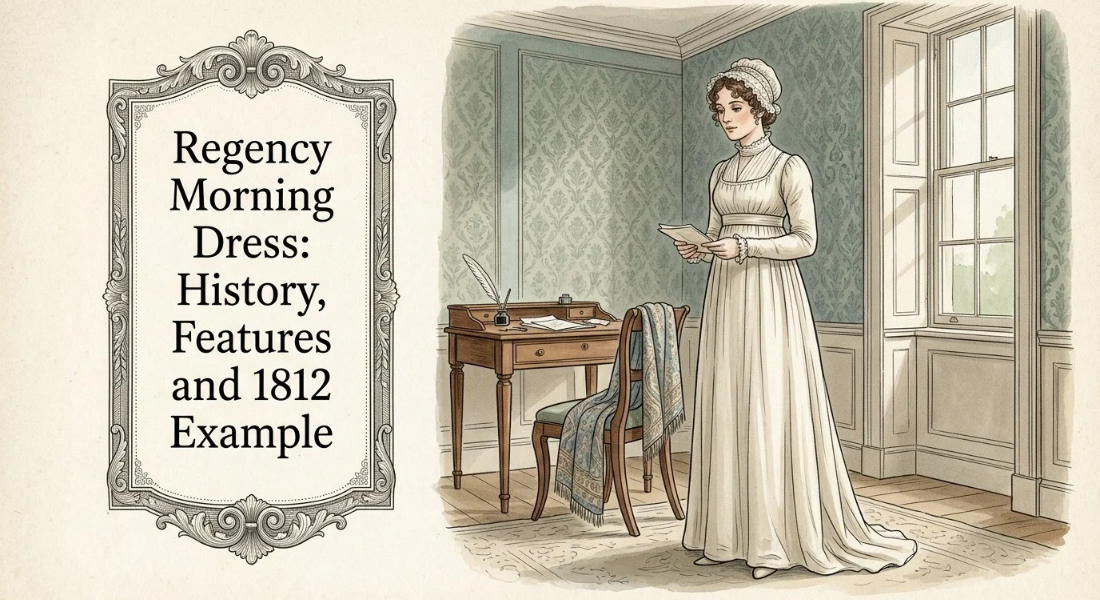
A gown intended for a quiet morning at home could look quite different from one illustrated for a fashionable public appearance. Regency morning dress was a category of early nineteenth century daytime clothing associated with domestic routines and depending on context some morning social activities.
This article examines its terminology, garments, indoor and outdoor use, and a documented April 1812 example. Regency morning dress was one part of a wider historical clothing system shaped by occasion, setting and changing taste.
For the broader historical context and other clothing categories, see our complete Regency Fashion guide → see the full guide here.
Regency morning dress was a context dependent category of early nineteenth century daytime clothing, not one standardised gown.
Its formality and appearance depended on the intended activity and setting.
Gowns, wrappers and additional layers should be discussed only where sources support their identification.
The April 1812 example documents specific materials and decorative details, including cambric and a ruff.
Fashion plates show how clothing was presented in publications; they do not establish how common a design was.
Historical descriptions, original illustrations and museum records should be compared before making broad claims.

Regency morning dress described clothing associated with the morning but it did not refer to one universally standardised gown. Its meaning depended on the activity, setting and the way a contemporary description or illustration presented the garment.
A dated fashion plate can show how a publisher represented a fashionable morning ensemble. Written descriptions and surviving garments can add details about construction and materials but each source needs to be read in its own context.
Morning dress was generally less formal than clothing intended for major evening occasions but informal did not necessarily mean plain or undecorated. A morning gown could include carefully arranged layers, lace or other details.
The term describes a clothing category not a rule followed identically by every woman. The wearer's circumstances and the purpose of the outfit matter when interpreting a particular example.
A morning gown is a useful general description for a gown worn during morning activities. Morning robe also appears as a clothing term but the words should not automatically be treated as names for two separate standardised garments.
To establish a precise distinction a writer needs a dated description or reliable costume history source that defines the terms in context. Modern meanings of robe alone cannot establish how a writer in the early nineteenth century used it.
Morning dress was associated with daytime routines particularly activities at home. Its use could extend to morning social situations but the label alone does not establish exactly where the wearer was going or how formal the occasion would be.
The time of day offers a useful clue not a rigid timetable. Clothing descriptions, illustrations and the circumstances attached to a specific example provide stronger evidence than assumptions about a universal morning routine.
Breakfast, reading, writing and sewing are plausible domestic activities to investigate when interpreting morning clothing but they should not be attributed to a particular garment without supporting evidence.
A fashion illustration may show a costume rather than document what its wearer did throughout the day. When a source identifies the activity or setting use that information directly.
Otherwise describe the garment as associated with morning or domestic use without presenting a guessed activity as historical fact.
The intended setting could affect how an outfit was presented. Clothing for private domestic activity might differ from an ensemble prepared for receiving visitors or appearing in a morning social setting.
However a neat or decorative gown does not by itself prove that its wearer expected visitors. Claims about etiquette should be tied to contemporary descriptions or specialist scholarship rather than inferred solely from an illustration.
There was no single appearance that identified every morning gown. Dated illustrations and surviving garments can reveal differences in the bodice, waist placement, sleeves, neckline, layers and decoration.
The most reliable descriptions separate visible details from interpretation. A feature shown in one illustration can document that particular ensemble but it does not establish that all morning gowns used the same construction or styling.
A useful examination begins with the garment's visible construction: how the bodice fits, where the waist sits, how the sleeves are shaped and how the skirt falls. These features should be described from a dated image or a catalogued garment wherever possible.
A raised waist may be visible in an example but it should not be assumed from the date alone. Specific construction details are more informative than assigning every garment the same silhouette without checking the evidence.
Necklines and layers varied by garment. A chemisette is an insert worn to fill or cover the neckline while a fichu is a light cloth worn around the shoulders and upper chest. Either term should be used for an example only when the source supports the identification.
A higher neckline or added layer may help explain how a particular gown was presented. It does not mean every morning gown had the same coverage or included both items.
Morning gowns could be visually restrained or include decorative details. Lace trim or other embellishment should be mentioned when it appears in a dated illustration or is recorded in a garment description.
The April 1812 example discussed below includes distinctive decorative features. Those details help explain that individual costume but they should not be used to claim that elaborate decoration was typical of every morning gown.
Fabric descriptions are most useful when linked to a specific garment or dated source. Cambric and muslin may appear in descriptions of period clothing while satin and lace can be relevant to particular examples; their presence should not be assumed without evidence.
Fashion plates also need careful interpretation. Printed colours and drawn textures may not reproduce a garment's actual appearance precisely so descriptions should distinguish named materials from what an image merely seems to show.
Cambric is a fine, closely woven fabric traditionally made from linen or cotton. The April 1812 description discussed by Jane Austen's World refers to Scotch and French cambric in connection with the illustrated costume.
These are details attributed to that specific example. They do not on their own prove that cambric was used in every morning gown or establish how comfortable, costly or common the garment would have been.
A fashion plate can preserve evidence of how a publisher presented a fashionable outfit, including its apparent colours and decorative arrangement. Yet printing methods, later reproductions and the limitations of illustration can affect what viewers see.
Treat a material named in the original description as stronger evidence than a fabric guess based only on appearance. Likewise do not generalise from one illustrated colour scheme to all morning clothing in Britain.

The key distinction is the intended setting rather than a strict division between two fixed garment types. Domestic morning clothing could include gowns or wrappers while outdoor morning ensembles might require additional coverage or headwear according to the activity and conditions.
These categories may overlap. The table is a practical guide to interpreting context not proof that historical sources always treated indoor and outdoor clothing as separate classifications.
Indoor morning dress is best identified through a source that connects the garment with domestic or private use. A gown or wrapper may be relevant where the contemporary description or historical commentary supports that identification.
The indoor setting can help explain the outfit's purpose but it does not prove that the wearer chose comfort over appearance. Avoid describing all domestic garments as loose, plain or purely practical unless the evidence supports those details.
Outdoor use could involve extra coverage or headwear, depending on the documented outfit and circumstances. A bonnet, shawl or cloak should be named only when it is visible in a reliable image or recorded in a source.
Do not treat these additions as mandatory parts of every morning ensemble. Nor should every outfit worn outside in the morning automatically be classified as walking dress the source's wording and the garment's intended use remain important.
An April 1812 example discussed by Jane Austen's World provides a dated point of reference for examining morning dress. Its value lies in the specific garment description and illustrated details not in proving that every woman wore a similar outfit.
The original description should be distinguished from later commentary. Where a detail comes from the illustration rather than the accompanying text identify it as a visual observation rather than a confirmed material or construction fact.
The April 1812 account refers to Scotch and French cambric, a cambric slip, long sleeves and a ruff. These details should be attributed to the illustrated ensemble with terminology checked against the original description wherever it is accessible.
A slip is an undergarment or layer worn beneath another garment but its precise construction can vary by period and context. Do not infer more about the illustrated slip than the source actually records.
The account also discusses a Flora cap, lace and a ruff. These distinctive details help readers understand the particular costume presented in the plate but they are not evidence that all Regency morning gowns included such features.
The ruff is especially important to treat as a specific design element rather than a defining requirement of morning dress. A single fashionable illustration documents one presentation, not the full range of clothing worn across British households.
A period fashion plate provides evidence of how clothing was represented in a contemporary publication. It can preserve named garments, styling details and materials especially when the illustration is accompanied by a written description.
It does not necessarily document ordinary daily wear or show how common a design was. Comparing the plate with surviving garments and museum catalogues can strengthen an interpretation while any uncertainty should remain explicit.
Morning, walking and evening dress served different contexts but fabric or silhouette alone may not identify a garment's category. The intended activity, time and wording of the historical source provide essential clues.
Regency Morning Dress vs Walking Dress
Morning dress was associated particularly with morning routines and domestic settings. Walking dress was intended for outdoor walking although garments in the two categories could share visible features.
Context is therefore more reliable than appearance alone. A gown shown outdoors is not automatically a walking dress, and a source's explicit description should take priority over a modern label.
Evening dress belonged to a different social context and could involve a more formal presentation. The distinction is chiefly about the occasion and intended use, rather than a single fabric, neckline or decorative feature.
This comparison is sufficient to clarify the categories. The April 1812 morning dress plate should be read on its own terms not treated as a model for evening clothing.
A reliable identification starts with a dated source and the wording used to describe the garment. Original fashion plates, contemporary descriptions and catalogued surviving clothing can provide different kinds of evidence, and each has limitations.
For the April 1812 example Jane Austen's World provides a useful entry point. Its discussion should be checked against the original publication and illustration where available, particularly before treating a specific feature as a general characteristic of morning dress.
Before publishing a description, check the date, publication, original wording, fabric terminology and visible construction details. Establish whether the source itself calls the garment morning dress or whether a later writer has applied that label.
Museum catalogue records can help verify surviving garments and construction. For example, the Victoria and Albert Museum and The Metropolitan Museum of Art provide collection resources but each specific claim must be matched to a relevant record.
A fashion plate records a selected fashionable presentation; it does not show how frequently the design appeared in daily life. Surviving garments also represent only a portion of clothing once worn while written records may be incomplete.
For that reason describe the April 1812 plate as a documented example. Broader claims about typical morning dress require corroboration from additional contemporary descriptions, illustrations or catalogued garments.

Regency morning dress is best understood through its intended time, setting and documented garment details. It was not one universal design, and labels such as gown or robe need historical context rather than assumed modern distinctions.
The April 1812 plate offers a valuable dated example, particularly for its recorded materials and distinctive styling. Its features should remain attached to that example unless further evidence establishes that they were more widespread.
The most useful clues are the source's date, its description of the garment and the setting for which the clothing was intended. These help distinguish morning dress from adjacent categories without relying on appearance alone.
The April 1812 example adds detail to the historical record but it should not stand in for every wearer or household. Careful attribution makes the description both more accurate and more useful.
Regency morning dress described a context dependent category of daytime clothing rather than one fixed gown design. Its garments, layers and decoration varied by example while indoor and outdoor settings could influence how an ensemble was presented.
The April 1812 fashion plate offers specific evidence of materials and styling but not a universal model. The strongest historical account distinguishes what a source documents from what can reasonably be inferred.
Regency morning dress was a context dependent category of early nineteenth century clothing associated particularly with domestic activities and, in some cases, morning social settings.
Documented examples may include gowns, wrappers and additional layers. The precise combination varied so individual garments should be identified through reliable descriptions or illustrations.
It was generally less formal than clothing for major evening occasions, but morning dress was not necessarily plain or undecorated. Its presentation varied by context.
The terms may overlap. Their precise historical meanings should be established through contemporary descriptions or reliable scholarship rather than assumed to identify separate standardised garments.
Morning dress was associated with morning routines and domestic settings; walking dress was intended for outdoor walking. Their appearance could overlap making context important.
It documents specific details, including cambric, long sleeves and a ruff in the described costume. It does not prove that all morning gowns shared those features.


Reader Discussion
Leave a Reply