- by Daily Talkin Staff
- July 8, 2026
-

-
-
Loading
Loading
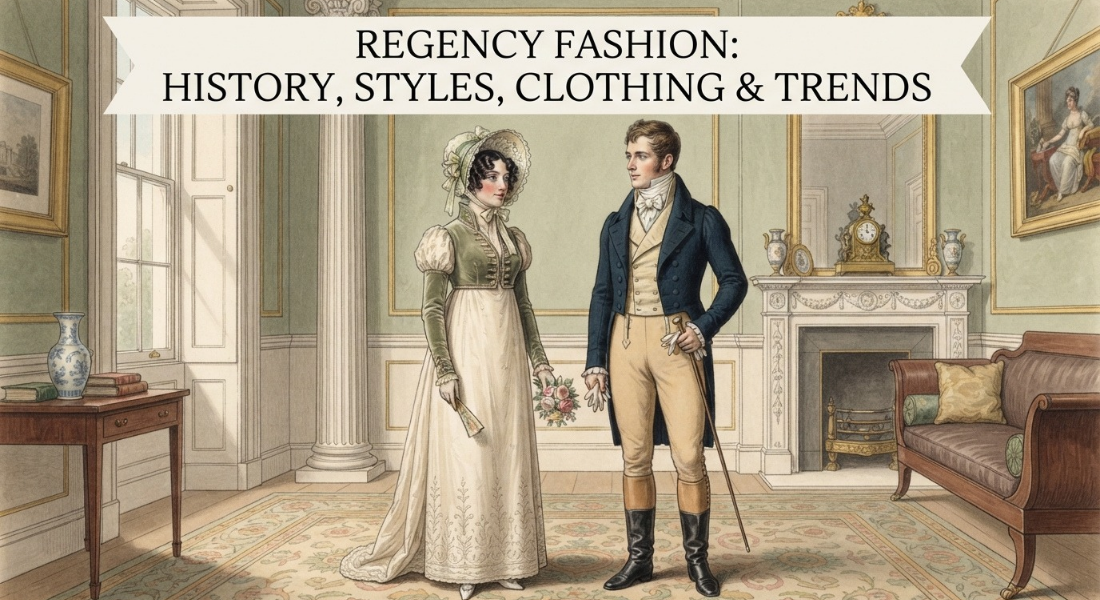
Regency Fashion is the distinctive early 19th century style associated with Britain best known for women's high waisted Empire silhouettes and the sharply tailored clothing worn by men.
Its familiar look developed through changing ideas about classical beauty, social formality, international influence and practical dress. The political Regency lasted from 1811 to 1820 but Regency fashion is often used more broadly for styles developing from the late 1790s into the 1820s.
This guide focuses primarily on historical clothing, covering women's and men's wardrobes, fabrics, social class, influences and changes from 1800 to 1825 before briefly examining the modern Regency revival.
Regency fashion is primarily associated with early 19th century British dress especially the high waisted Empire silhouette.
The political Regency lasted from 1811 to 1820 but Regency fashion developed across a broader period.
Women's wardrobes included different garments for formality, activity, season and social position.
Men's fashion increasingly emphasised precise tailoring, fitted coats and restrained elegance.
Regency clothing changed significantly between 1800 and 1825 rather than remaining one fixed style.
Modern Regencycore and Bridgerton borrow historical features but should be separated from historically accurate Regency dress.

Regency fashion refers to the clothing and dress culture associated with Britain during the early 19th century particularly the period surrounding the political Regency of 1811 to 1820.
Women's dress became strongly associated with the high waisted Empire silhouette while men's fashion increasingly favoured fitted tailoring, restrained colours and precise construction.
The style was not one fixed look. It included informal morning clothing, walking and carriage dress, elaborate evening gowns, military influenced outerwear, tailored menswear and numerous accessories.
Muslin, cotton and silk were important materials while classical motifs, French influence and changing ideas about the body shaped women's silhouettes.
The most recognisable feature is the Empire waist positioned high on the torso often just below the bust. Women's skirts generally fell in a relatively narrow column from this raised waist rather than creating the wide structured shape associated with later Victorian fashion.
Neoclassical inspiration was also important. Classical Greek and Roman art influenced drapery, decoration and the preference for lighter looking garments.
Muslin, cotton and silk helped create flowing silhouettes while evening clothing could include embroidery, lace, ribbons and other ornament. Men's clothing followed a different path.
Tailored coats, waistcoats, high collars and cravats placed greater emphasis on fit and controlled presentation. Accessories such as bonnets, gloves and shawls also played an important role in women's dress.
The political Regency officially refers to 1811 to 1820 when George Prince of Wales acted as Regent for his father George III. Fashion however does not change according to political boundaries.
Many historians and museums use broader dates when discussing Regency dress. The fashion transition began during the 1790s and continued through the 1820s with the high Empire silhouette developing before 1811 and changing substantially afterwards.
For that reason “Regency fashion” can describe a longer period than the political Regency itself. The exact dates depend on whether the discussion concerns political history, fashion history or a particular garment.
Regency fashion sits between earlier Georgian styles and the more structured silhouettes that developed later in the 19th century.
Its defining combination is the raised women's waistline, relatively light and flowing fabrics, classical decoration, occasion specific dress, increasingly sophisticated men's tailoring and elaborate accessories.
This combination gives Regency clothing its recognisable identity without reducing the period to the Empire dress alone.
The political Regency era in Britain lasted from 1811 to 1820. During this period George III was unable to perform his royal duties so his eldest son George Prince of Wales governed as Prince Regent. The period ended when George IV succeeded his father in 1820.
Regency fashion extends beyond those nine years because clothing evolved gradually. The Empire silhouette was already developing before 1811 while changes in waistlines, sleeves and skirts continued through the 1820s. This makes the fashion period broader than the political Regency.
George III's illness led Parliament to establish the Regency under the Regency Act of 1811. His son became Prince Regent before eventually becoming George IV.
The political period is therefore clearly defined but fashion during these years continued developments that had begun earlier. Clothing also differed according to gender, wealth, occupation, occasion and location.
During the late 1790s and early 1800s women's fashion moved away from the highly structured and heavily ornamented forms of the previous century.
The influence of the French Revolution, Neoclassicism and renewed interest in ancient Greece and Rome helped encourage simpler silhouettes. Early Empire style gowns established the raised waist that became central to Regency dress.
The end of the political Regency did not immediately end Regency fashion. Through the 1820s, the waist gradually moved lower and skirts became fuller.
Decoration also became more substantial while sleeves and shoulders gained visual volume. These developments formed part of the longer transition from the column like Empire silhouette towards the more elaborate shapes associated with later Georgian and early Victorian fashion.
Period | Key fashion development |
1790s | Transition towards simpler, and Neoclassical silhouettes |
1800 to 1805 | Empire silhouette becomes established |
1806 to 1810 | French, military and decorative influences develop |
1811 to 1815 | Political Regency and refined Empire styles |
1816 to 1820 | Waistline begins changing and decoration increases |
1821 to 1825 | Lower waist and wider skirts signal transition |
Regency clothing is easiest to recognise when silhouette, fabric, decoration and accessories are considered together. The period favoured a lighter visual effect than many earlier Georgian styles but it was not uniformly simple or plain.
Individual garments could be highly decorated while heavier fabrics and elaborate trims became increasingly important as the period progressed. Surviving museum garments show that the fashionable silhouette changed considerably even within the Regency years.
The Empire waist sat directly below or close to the bust, visually shortening the bodice and creating a long flowing skirt. This became the defining silhouette of women's Regency gowns.
The style changed gradually. Earlier dresses could appear extremely light and column like while later Regency garments incorporated heavier fabrics, additional decoration and increasingly noticeable changes in the waistline.
Commonly associated Regency materials include:
Muslin
Lawn
Batiste
Cotton
Linen
Silk
Wool
Velvet
Flannel
Fine cotton and muslin were especially associated with the fashionable lightweight look. Wool, velvet and other heavier materials were more suitable for colder conditions and outerwear.
The surviving collections of institutions such as the National Gallery of Victoria demonstrate how different textiles contributed to the changing appearance of Regency garments.
White and pale colours are strongly associated with Regency women's fashion but the period was not limited to white dresses. Embroidery, lace, ribbons, ruffles, borders and contrasting trims could add substantial visual detail.
Classical motifs were particularly important earlier in the period while military and Gothic influences became increasingly visible.
Square necklines were common in fashionable women's gowns while sleeves could range from relatively simple shapes to increasingly elaborate puffed forms.
The skirt initially followed the narrow column like Empire silhouette. As the period progressed, skirts widened and the waist descended creating a visual transition towards later 19th century styles.
Fashion plates provide valuable evidence for studying changing dress because they show garments, silhouettes, accessories and styling in dated contexts.
Period publications such as Ackermann's Repository and Le Journal des Dames et des Modes help researchers trace fashionable changes although fashion illustrations should not automatically be treated as photographs of everyday clothing.
Museum garments provide another layer of evidence because they preserve actual construction, textiles, stitching and decoration.
Women's Regency fashion was organised around more than the famous Empire gown. A woman's wardrobe could include undergarments, daytime gowns, visiting and walking clothing, riding habits, evening dress, outerwear and numerous accessories.
What she wore depended on formality, time of day, season, social position and activity. This is why a single “Regency dress” cannot represent the entire women's wardrobe.
Women's clothing began with foundational layers such as the chemise or shift, stays, petticoat and stockings. Other garments and accessories included garters, pantaloons and the chemisette. These layers affected both comfort and the finished silhouette.
Different activities called for different garments including:
Morning gowns
Visiting gowns
Walking gowns
Promenade dresses
Carriage dresses
Riding habits
Dinner dresses
Ball gowns
Evening dresses
These categories demonstrate that Regency clothing was strongly influenced by occasion and social etiquette rather than being one universal style.
Undress referred to relatively informal clothing rather than literal lack of clothing. It could be worn during quieter parts of the day.
Half dress occupied an intermediate position, while “full dress” represented greater formality. Evening dress could form part of full dress for social occasions such as balls, concerts and formal gatherings.
Regency outerwear included Spencer jackets, pelisses, redingotes, cloaks, shawls, mantles, mantelets and capes. These garments were practical as well as fashionable.
They provided warmth and coverage while allowing women to preserve the fashionable silhouette of the period.
Accessories completed the Regency appearance. Common examples included bonnets, fichus, tippets, pelerines, muffs, parasols, reticules, gloves, turbans, bandeaux and veils.
Headwear was particularly important because bonnets framed the face and helped distinguish outdoor and social dress.
Men's Regency fashion deserves equal attention because the period helped establish a more restrained and highly tailored ideal of male dress. Rather than relying on elaborate decoration, fashionable men increasingly emphasised cut, fit, fabric quality and careful presentation.
This was closely associated with dandyism and the influence of figures such as Beau Brummell. The resulting look became one of the defining foundations of modern Western menswear.
Tailcoats and other fitted coats shaped the male silhouette. Riding coats and greatcoats provided practical alternatives for outdoor activity and colder conditions.
The fit of the coat was particularly important. A well cut garment could communicate refinement without excessive ornament.
Waistcoats added structure beneath the coat while shirts and high collars framed the neck. The cravat became a highly visible element of male dress. Its arrangement could communicate personal taste and the level of attention given to appearance.
Knee breeches remained part of Regency formal dress while full length trousers became increasingly important in men's wardrobes. The balance between breeches and trousers changed over time and depended on occasion, fashion and social setting.
Men wore shoes for formal settings and boots for riding, walking and other outdoor activities. Riding footwear was particularly practical while polished dress shoes complemented formal tailoring.
Top hats became strongly associated with fashionable men's dress. Riding gloves and walking sticks could also complete the appearance. Watches and other personal accessories added refinement without overwhelming the tailored silhouette.
Beau Brummell became an influential figure in Regency men's fashion. His importance was less about creating one garment than about establishing the cultural importance of precise tailoring, cleanliness, fit and restrained elegance.
His influence helped reinforce the idea that male fashion could communicate status through construction and presentation rather than elaborate decoration.
Regency fashion emerged from several overlapping forces rather than one designer or event. Political upheaval, international exchange, classical art, military conflict and British tailoring all contributed to its development.
The result was a period in which French and British tastes interacted with historical references to Greece and Rome while military and Gothic influences gradually became more visible.
French fashion had a major influence on the early 19th century silhouette. Empress Joséphine became closely associated with the fashionable Empire style and its classical aesthetic.
French court fashion helped popularise high waisted gowns and elaborate interpretations of Neoclassical dress while British fashion developed its own Regency expression.
The Napoleonic Wars brought military aesthetics into civilian fashion. Military trims, structured outerwear and Hussar inspired details influenced garments such as pelisses and Spencers.
These references could be decorative rather than directly military allowing fashionable clothing to borrow the visual authority of uniforms.
Neoclassicism encouraged designers and wearers to look towards ancient Greek and Roman art for inspiration. Flowing drapery, simplified lines and classical decoration helped establish the visual language of Regency women's fashion.
The French Revolution formed part of a wider cultural shift away from the heavily ornamented aristocratic appearance of the previous era.
Simpler clothing could communicate new ideas about natural form, classical taste and social change, although luxury and elaborate fashion certainly did not disappear.
British tailoring became particularly important in men's fashion while Anglomania reflected European interest in English styles. British fashion was therefore not simply copying France. It developed its own preferences, especially around tailoring, outerwear and practical dress.
By the later Regency period, Gothic and Romantic influences became more visible. Tudor and Elizabethan references, broader shoulders, fuller sleeves and stronger decoration helped move fashion away from the earlier classical column.
These changes prepared the way for the silhouettes of the 1820s and beyond.

Regency fashion was not static. The high Empire waist and lightweight silhouette that dominate modern images of the period were only part of a longer evolution.
A chronological framework makes this clearer: early Regency styles emphasised Neoclassical simplicity, while later fashions developed stronger decoration, wider skirts, larger sleeves and a lower waistline.
Women's dresses increasingly used a high waist and relatively narrow skirt. Light fabrics such as muslin helped create the flowing appearance associated with early Empire fashion.
Classical decoration and Neoclassical references reinforced the connection with ancient Greece and Rome.
As the decade progressed, decoration became more varied. Military details influenced trims, sleeves and outerwear while pelisses and Spencers became important parts of fashionable wardrobes.
Heavier fabrics and stronger ornament could also appear alongside the lightweight gowns commonly associated with the period.
The political Regency began in 1811 but the fashion itself was already established. High waisted gowns remained central to women's dress while formal clothing became more elaborate.
French and British influences continued to interact through fashion publications, trade and social exchange.
The later 1810s brought noticeable changes in proportion. The waist gradually moved downwards, skirts gained width and decoration became more substantial.
Gothic and Romantic references also became increasingly visible, creating a bridge between the classical Empire look and later 19th century fashion.
During the early 1820s the waist continued to descend and skirts became fuller. Sleeves and decorative elements gained greater visual importance.
This period should therefore be viewed as transitional rather than as a sudden end to Regency fashion. The changes eventually contributed to the more pronounced silhouettes of later decades.
Several forces worked together:
Political and military change
French and British fashion exchange
Textile production and trade
International access to materials
Changing social taste
Fashion plates and publications
Increasing communication between fashion centres
Fashion therefore changed through a combination of cultural influence, material availability and consumer preference rather than one single cause.
Regency clothing varied according to wealth, occupation, social status and access to fabrics and skilled tailoring.
The fashionable garments preserved in museums and shown in portraits often represent wealthier people so they should not be treated as a complete picture of what everyone wore.
Social class affected the quality, quantity and durability of clothing as well as the ability to follow fashionable changes quickly. Practical needs could be more important than strict adherence to elite styles.
Wealthier people had greater access to luxury fabrics, skilled dressmakers, elaborate accessories and clothing for multiple occasions.
Formal dress could involve expensive materials, detailed decoration and specialised garments for social events, travel and outdoor activities.
Middle class clothing could adopt fashionable silhouettes while placing greater emphasis on practicality and cost.
Garments might be reused, altered or made from more affordable materials. The fashionable ideal could therefore influence dress without being reproduced exactly.
Working class and commoner clothing generally prioritised durability, affordability and occupational practicality. Fashionable influences could still appear, but economic circumstances and the demands of work affected what could realistically be worn.
Clothing also tended to remain useful for longer rather than being replaced rapidly with every fashionable change.
Fashion plates often emphasise fashionable consumers. Portraits disproportionately preserve people whose images were commissioned, while museum collections necessarily depend on garments that survived.
These sources are invaluable but they should be interpreted alongside occupational records, contemporary writing and material evidence. This prevents elite fashion from being presented as universal Regency clothing.
Regency fashion is associated with high Empire waists, relatively narrow flowing skirts and early 19th century styling while Victorian fashion developed later with lower waists, fuller skirts and increasingly elaborate silhouettes.
The transition was gradual rather than instantaneous particularly through the 1820s and 1830s. For a complete breakdown of the differences between these two periods see our full guide on Regency vs Victorian Fashion →
Commoner fashion refers to clothing worn by working and lower income people rather than the elite wardrobes most often preserved in fashionable sources.
Practicality, durability, affordability and occupational needs strongly influenced everyday dress while fashionable ideas could still be adapted. For a complete breakdown of what ordinary people wore during the period see our full guide on Regency Era Commoner Fashion →
Winter Regency clothing added warmth through heavier fabrics and additional layers while preserving fashionable proportions.
Wool, velvet, flannel, cloaks, pelisses, redingotes and shawls could all provide protection from cold weather. For a complete breakdown of cold weather clothing and layering see our full guide on Regency Winter Fashion →
Morning dress was relatively informal daytime clothing associated with the beginning of the day and quieter domestic activities. Gowns, wrappers, modest necklines and practical fabrics helped distinguish it from more formal dress.
For a complete breakdown of Regency morning dress, see our full guide on Regency Morning Dress →
Walking dress was designed for outdoor daytime activity and could combine fashionable gowns with practical outerwear, suitable footwear, bonnets and shawls.
It occupied a different role from informal morning clothing and formal evening dress. For a complete breakdown of Regency walking dress and its defining features see our full guide on Regency Walking Dress →
Modern Regency inspired outfits borrow selected historical features rather than reproducing an exact period wardrobe.
Empire waistlines, flowing skirts, puff sleeves and classical accessories can reference Regency aesthetics while Regencycore and Bridgerton have increased modern interest.
For modern styling ideas based on Regency aesthetics see our full guide on Regency Era Inspired Outfits →
Modern Regency inspired fashion uses selected historical characteristics rather than reproducing the complete clothing system of the early 19th century.
Separating historical clothing from modern interpretation is important because contemporary garments may borrow the Empire waist, romantic sleeves or classical details while using modern construction, fabrics and styling.
Bridgerton has helped introduce Regency inspired aesthetics to a large modern audience. Its costumes draw on historical silhouettes but also adapt colour, decoration, fabrics and styling for television.
Costume drama therefore works as interpretation rather than a perfect reconstruction of everyday historical clothing.
Regencycore commonly borrows:
Empire waistlines
Puff sleeves
Flowing skirts
Romantic details
Classical references
Period inspired accessories
These features can appear in modern dresses, bridalwear and occasion clothing without making the garments historically accurate.
Historical Regency | Modern Regency inspired |
Period specific construction | Modern construction |
Historical fabrics and garments | Contemporary fabrics |
Historical dress codes | Modern styling |
Period appropriate accessories | Fashion accessories inspired by the era |
The Regency aesthetic remains useful because its emphasis on flowing lines, raised waists and romantic detailing can be adapted to contemporary clothing.
Its influence appears in bridalwear, eveningwear, costume events, period dramas and fashion reinterpretations where designers can reference historical details without reproducing an entire historical wardrobe.
Historical fashion claims are strongest when they can be connected to surviving garments, fashion plates, portraits, museum collections or contemporary publications. No single source represents the entire Regency population.
Surviving evidence is incomplete and often favours wealthy or fashionable people so responsible fashion history distinguishes documented evidence from reasonable interpretation.
Ackermann's Repository and Le Journal des Dames et des Modes are valuable for examining fashionable silhouettes, garments, accessories and decoration.
Fashion plates show what contemporary publications presented as fashionable, but they should not automatically be interpreted as evidence that every reader dressed in exactly the same way.
Museum collections provide physical evidence of construction, textile choice, decoration and silhouette.
Institutions including the Victoria and Albert Museum, Metropolitan Museum of Art, National Gallery of Victoria and Smithsonian hold material relating to historical dress and early 19th century fashion.
Portraits can reveal garments, accessories, hairstyles and social presentation. They can also provide clues about status and occasion.
However portraits are selective representations. A formal portrait may show an unusually polished version of dress rather than ordinary everyday clothing.

Historical fashion research should distinguish between surviving evidence and generalisation. A single surviving dress cannot prove what everyone wore while a fashion plate cannot prove that every illustrated garment was commonly worn.
Stronger conclusions come from comparing garments, portraits, publications and historical context. This evidence based approach also helps explain why some details of Regency clothing remain debated rather than presenting uncertain interpretations as established facts.
Regency fashion was a broad early 19th century clothing system shaped by changing silhouettes, classical influence, British tailoring, French fashion and social distinction.
Women's Empire waisted gowns became its most recognisable feature while men's fitted coats, waistcoats and cravats established a contrasting ideal of tailored elegance. From 1800 to 1825, the fashion changed considerably as waistlines fell, skirts widened and decoration increased.
Understanding those changes along with social class and historical evidence gives a more accurate picture than treating Regency style as one fixed look. Its influence also continues through modern Regency inspired fashion.
Regency fashion is the early 19th century clothing associated with Britain, especially high waisted women's dress, tailored men's clothing, classical influences and elaborate accessories.
The political Regency lasted from 1811 to 1820 but Regency fashion is often discussed more broadly from the late 1790s through the 1820s.
Women wore gowns for different occasions supported by undergarments and complemented by outerwear, shoes, bonnets, gloves, shawls and other accessories.
Men commonly wore fitted coats, waistcoats, shirts, cravats, breeches or trousers, boots or shoes, and hats with tailoring playing a major role in fashionable appearance.
The Empire waist was a high waistline positioned around or just below the bust creating the long flowing silhouette strongly associated with Regency women's gowns.
Regency fashion overlaps with the broader Georgian period because the political Regency occurred during George III's reign and early George IV's reign.
Common clothing prioritised affordability, durability and occupational practicality although fashionable silhouettes and details could be adapted to different economic circumstances.
No. Regency fashion generally featured higher waists and narrower silhouettes while later Victorian styles developed lower waists, fuller skirts and increasingly structured decoration.
Bridgerton uses Regency fashion as inspiration but adapts historical clothing for television so its costumes should not be treated as exact reproductions of everyday Regency dress.


Reader Discussion
Leave a Reply