- by Daily Talkin Staff
- July 8, 2026
-

-
-
Loading
Loading
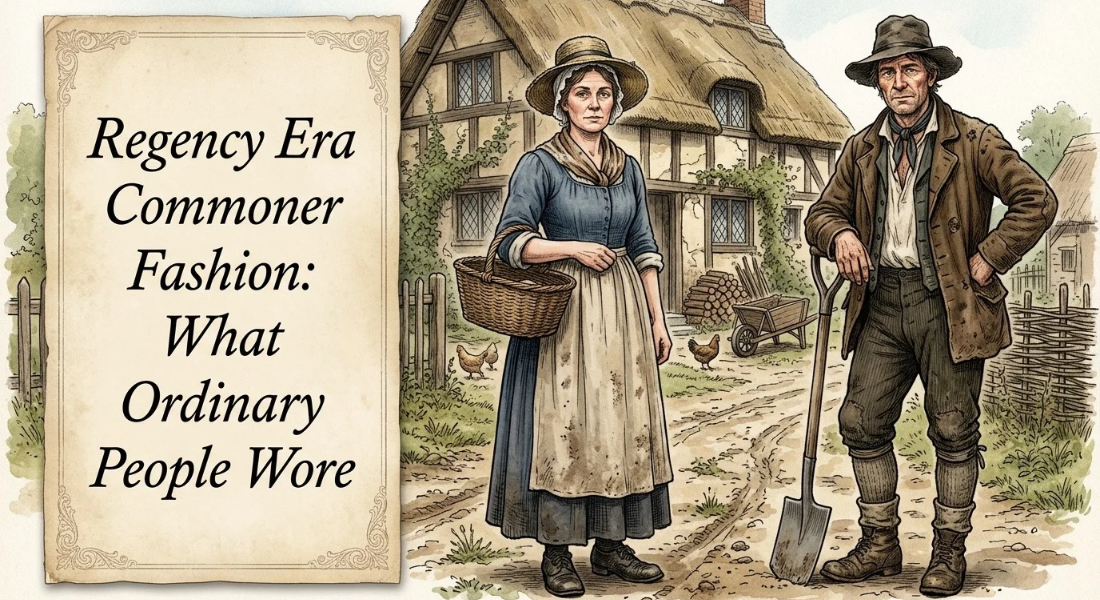
Regency Era Commoner Fashion reflected the everyday clothing of ordinary British people in the early nineteenth century. Imagine starting your day with only a few practical garments for farm work, household duties or daily errands.
From shifts and aprons to shirts and waistcoats, clothing was shaped by occupation, income and access to materials. Explore what commoners wore, which fabrics they used and how they kept their garments in service.
Regency commoner clothing varied by occupation, income, location and available materials.
Women's everyday garments included shifts, gowns, petticoats and aprons, depending on the task.
Men wore combinations of shirts, waistcoats, breeches or trousers, with practical layers for work.
Linen, wool and cotton appear in historical clothing records, but individual objects cannot establish universal clothing habits.
Smocks provide a useful example of protective agricultural clothing, although many surviving examples date later than the Regency.
Garment repair and reuse are relevant to understanding clothing maintenance, but specific claims need historical evidence.

Ordinary people in Britain wore practical garments suited to daily work, household duties and local conditions. Shirts, shifts, skirts, waistcoats, breeches and stockings formed part of everyday dress but clothing varied according to income, occupation, age and access to textiles.
The political Regency lasted from 1811 to 1820; evidence from nearby decades can help explain clothing provided its dates are clearly identified. Regency Fashion also covers the wider clothing culture, changing silhouettes and dress across social classes.
This article focuses specifically on the everyday clothing of ordinary people. See our complete Regency Fashion guide →
A working woman's clothing might include a shift beneath a gown or bodice with a petticoat or apron added according to the task. Men commonly wore shirts with waistcoats and breeches or trousers depending on their circumstances and the date.
Stockings and outer layers offered further coverage. These are examples not a universal uniform. Surviving garments and illustrations represent particular people, places and circumstances rather than every household in Britain.
The Metropolitan Museum of Art for example records a British dress dated 1815 to 20 made from cotton and linen. That object confirms the use of those materials in a surviving garment but it does not establish how frequently working class women owned similar dresses.
Clothing Varied Between Home, Outdoor Tasks and Social Visits
Clothing choices depended on what the wearer needed to do. A person preparing food, cleaning a room or handling farm materials might protect their main garments with an apron or an additional outer layer.
Outdoor work also made weather protection and durable construction valuable. People could adapt existing clothes rather than change into a completely different outfit for every activity.
Better garments might be kept for church, visiting or other occasions but the extent of this distinction depended on household means. There is insufficient evidence to assign one exact daily outfit to all commoners.
Ordinary women's clothing combined basic layers with garments suited to domestic work, paid employment and outdoor tasks. A shift could sit next to the skin while a gown, skirt or petticoat provided the outer shape.
Aprons and other protective layers were useful for some activities although the precise combination varied by occupation and resources.
A shift was an undergarment worn beneath outer clothing. Petticoats added a layer under a skirt or gown while gowns covered much of the body and could vary in cut, fabric and finish.
Aprons served a more practical purpose, helping protect clothing during cooking, cleaning and other messy tasks. Not every woman wore these pieces in the same combination.
A household's resources affected the number, condition and quality of its garments. Fabric type alone cannot establish whether an item belonged to a wealthy woman or a labourer's household; construction, provenance and the wider evidence matter too.
The Met's dated British dress from 1815 to 20 uses cotton and linen providing a specific example of early nineteenth century materials. It should not be treated as a typical working woman's dress without evidence of the wearer's social circumstances.
Domestic servants might need clothing that allowed them to clean, cook, carry items and work for long periods. Aprons could help protect the garments underneath while sleeves and skirts had to accommodate movement.
The surviving evidence does not justify assuming that every servant wore a standard uniform or identical colours. Rural women faced different tasks depending on their work and household.
Carrying produce, tending animals or helping with agricultural work could make protective layers practical. However an illustration of a rural worker is not automatically proof of a typical Regency outfit: its date, location and purpose should be checked before drawing conclusions.
Working men wore combinations of shirts, waistcoats, breeches or trousers and practical outer garments with substantial differences between individuals. Their clothes needed to suit manual labour, workshop duties, transport, household service or other employment.
The garments shown in fashionable portraits cannot be assumed to represent what labourers routinely wore.
A shirt formed a basic layer while a waistcoat provided an additional layer over it. Breeches remained part of men's dress in the early nineteenth century while trousers were also worn; the choice depended on date, occupation and personal circumstances.
Stockings and suitable footwear completed the practical requirements of many outfits. These garments were not necessarily made from expensive materials or tailored to fashionable standards. Wear repair and fit could matter more than decorative detail.
A surviving waistcoat or pair of breeches can demonstrate how a particular item was constructed but its ownership and use must be established before it is presented as evidence of commoner dress.
Farm labourers, craftspeople and domestic servants did not share one standard work outfit. Their clothing depended on the tasks they performed and the protection required.
A garment suitable for carrying goods might be inconvenient around machinery workshop workers also had to consider how loose sleeves or long layers affected movement.
The Museum of English Rural Life explains that agricultural smocks were worn over other clothes to protect them during outdoor work.
Its collection includes 63 smocks demonstrating the institution's substantial collection of these garments not the number owned by Regency workers. Because many surviving examples date from later in the nineteenth century they should not automatically be used as direct evidence for 1811 to 1820.

Rural workers and town labourers faced different working conditions but location alone did not determine what someone wore.
Agricultural tasks could require protection from rain, dirt and rough materials while tradespeople needed clothing that allowed movement in workshops or streets.
Domestic servants had to dress for household duties and, in some roles, meet an employer's expectations.
Agricultural labourers needed garments that could withstand outdoor work and changing weather. Shirts, sturdy outer layers and aprons could serve practical purposes, while smocks offered a protective layer over everyday clothing.
Their availability and use varied across Britain so no single garment should be presented as universal. A useful dated example is the farmer's smock held by Museum of New Zealand Te Papa Tongarewa recorded as an English object from 1811 and made of linen.
Its collection record describes smocks as protective work garments associated with male labourers in parts of rural England. This supports a period specific example but one surviving object cannot establish how common smocks were in every region.
Town workers included craftspeople, shop workers, carriers and people employed in private households. Their daily clothing needs differed.
A craft worker might prioritise freedom of movement and protection from dirt while someone serving customers or working in a household might also need a reasonably presentable appearance.
Urban employment did not automatically mean better clothing than rural work. Income employer requirements, access to second hand garments and the nature of the job all mattered.
Contemporary illustrations can help identify occupations and visible garments but an artist may have emphasised recognisable clothing or dramatic details. Treat such images as evidence of a specific representation not a complete record of ordinary urban dress.
Wool, linen and cotton were relevant materials in early nineteenth century clothing but the fabric used for a particular garment depended on its purpose, cost and availability. Footwear and headwear also varied.
The evidence supports examples of materials and objects not a single standard set of garments owned by every ordinary person.
Linen was used for garments such as shirts and underclothing while wool could provide warmth in outer layers and other clothing. Cotton appeared in early nineteenth century garments, including the British dress dated 1815 to 20 recorded by the Metropolitan Museum of Art as cotton and linen.
These records establish the materials in individual objects rather than the purchasing habits of every social group. A garment's material does not tell the whole story. Weave, weight, condition, construction and the amount of fabric needed could affect usefulness and cost.
Evidence of a costly fabric in a surviving dress should not be taken as proof that it was common among labourers. Similarly the absence of a surviving garment does not prove that a type of clothing was never worn.
Footwear protected the feet during walking and work but quality and condition could vary with household resources and the demands of a job.
Stockings offered another layer while caps bonnets and other head coverings could provide warmth, practical protection or a socially appropriate appearance. Ownership was not uniform.
Some people may have relied on a limited number of useful items while others had access to better footwear or separate pieces for different occasions.
Avoid assigning a particular style or material to all commoners unless a dated object or reliable historical source supports that claim. Weather protection also depended on local conditions and work.
A rural labourer spending hours outdoors faced different demands from someone working indoors. The most defensible account links each garment to a documented object, contemporary description or carefully qualified interpretation.

Clothing remained useful through care, repair and adaptation although the surviving evidence does not reveal the exact routine of every household. Mending a damaged seam, adjusting a garment or using a serviceable item for another task could extend its usefulness.
Such practices make sense in the context of limited resources but individual examples should be supported by historical records or textile evidence where possible.
Repair could involve stitching a tear, reinforcing a worn area, replacing a fastening or adjusting a garment to improve its fit. The condition of surviving historical textiles can reveal wear and repair though a mark or alteration does not always reveal when it happened or who carried it out.
Clothing could also be altered as needs changed. A garment might be adjusted for a different wearer or kept in use after its original purpose changed.
These are plausible forms of reuse but claims about a particular Regency household should be tied to a documented garment, household account, inventory or relevant dress history research rather than treated as universal practice.
A versatile garment could be useful across more than one daily activity. An outer layer might protect clothing during work while a gown or shirt could remain in use through ordinary household routines.
Adding or removing layers also helped people respond to changes in weather and activity. The number of garments a person owned cannot be inferred reliably from social class alone.
Household size, earnings, occupation and access to materials all influenced clothing choices. Rather than assume every commoner had a tiny wardrobe it is more accurate to ask what the available evidence reveals about a particular person, garment or household.
The strongest historical interpretation combines object records with contemporary descriptions and images. It also distinguishes evidence from reconstruction especially when surviving garments come from a later decade or lack a secure record of their original wearer.
Ordinary Regency clothing was not simply a cheaper copy of elite fashion. People dressed around work, household duties, available materials and the need to keep garments useful.
Shirts, shifts, aprons, waistcoats and protective outer layers had different roles in different settings. Surviving objects and images offer valuable evidence but their dates and origins matter.
Looking closely at everyday dress reveals a side of Regency life that fashionable portraits often leave out.
Commoners wore practical clothing such as shirts, gowns, waistcoats, breeches and stockings, depending on their work and resources.
Their clothing depended on occupation, income and available materials, so dress varied between households.
Men wore shirts, waistcoats, breeches or trousers, with practical layers suited to their work.
Women might wear shifts, gowns, petticoats and aprons, depending on their daily tasks.
Common materials included linen, wool and cotton, depending on the garment and available resources.
Yes repairing and altering garments could extend their useful life, although practices varied between households.


Reader Discussion
Leave a Reply