- by Daily Talkin Staff
- July 8, 2026
-

-
-
Loading
Loading
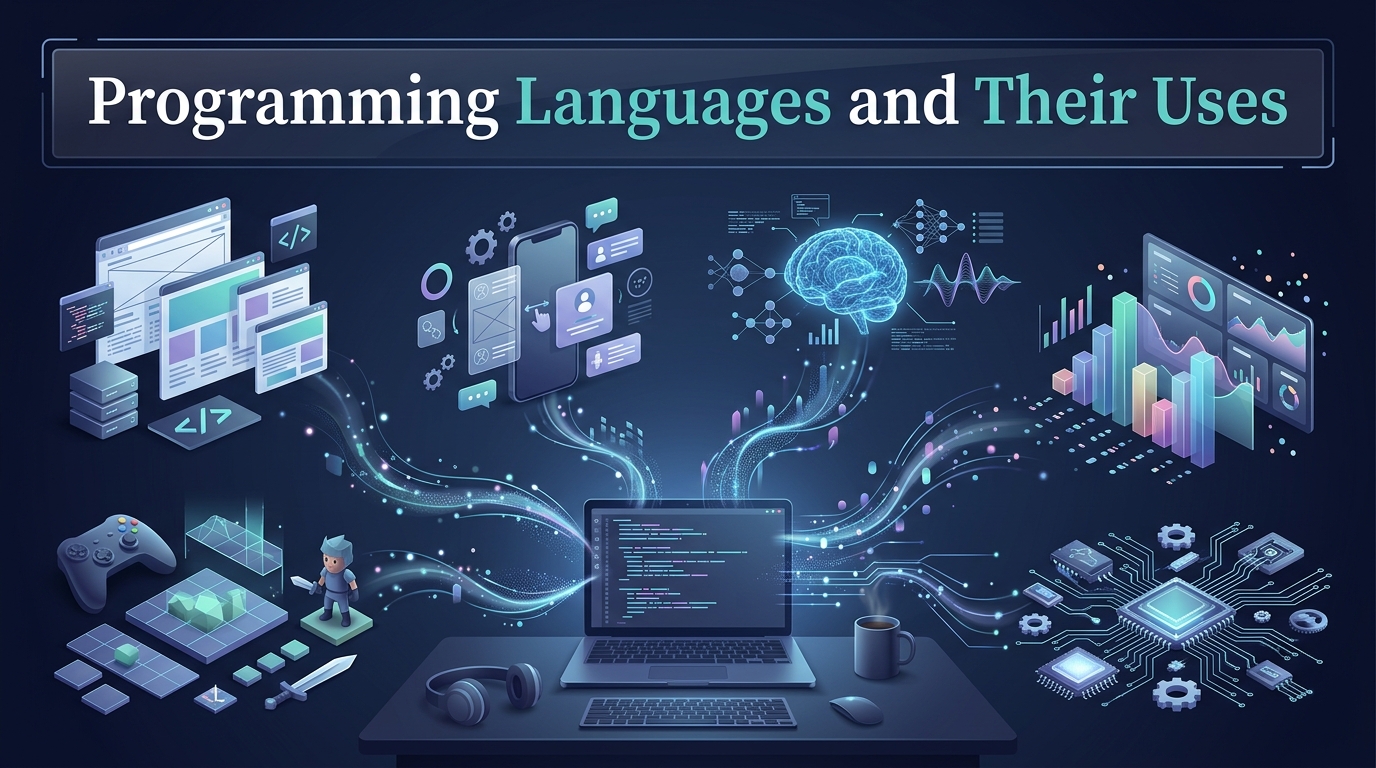
A website, a mobile banking app and an AI assistant may rely on different programming languages to perform their tasks. Programming Languages and Their Uses vary by application Python supports automation and AI, JavaScript powers interactive websites, and Swift enables Apple app development.
See our complete Programming Languages guide → for the broader overview. This article connects major languages to practical tasks and recognisable projects.
Python is commonly used for automation, data analysis and AI while JavaScript supports interactive websites and server side applications.
Swift and Kotlin are common choices for native Apple platform and Android applications respectively.
C and Rust support systems software C++ is used in game engines and performance sensitive applications.
Java, C# and PHP can support different business and backend applications.
SQL handles relational database operations, while R supports statistical analysis and visualisation.
A project can combine several languages according to its platform, architecture and requirements.
Different programming languages support different tasks although several can be used in the same application domain. Python is common in automation and data work JavaScript handles interactive web experiences, and C is used in firmware and other hardware facing software.
The quick reference table connects each language with typical applications and a concrete example. These are common uses not exclusive assignments the practical choice depends on the platform, project requirements and available ecosystem.
What Is Each Major Programming Language Used For?
The practical use of a language becomes clearer when you connect it to a task and a project. The examples below show how each language can contribute to software people use, from business reports and online shops to mobile applications and embedded devices.
Python is commonly used to automate repetitive tasks, clean datasets, generate reports and support machine learning workflows. For example a business can use Python to combine weekly sales files, check missing values and produce a report for its team.
It also supports AI applications and backend development. A document processing service might use Python to organise incoming files, classify their contents and send selected information to another system.
JavaScript supports interactive browser features, dynamic page updates, form validation and web application interfaces. On an online shop it can update product filters, respond to cart clicks and display changes without reloading the entire page.
JavaScript can also run on a server through a suitable runtime. That allows a project to use it for browser interactions and server side tasks such as processing requests or retrieving information.
Java is used in enterprise applications, financial transaction systems, backend services and distributed software. A banking platform might use Java based services to handle account operations, process transactions and exchange information between application components.
Java is also used for Android development. It is not required for every banking or enterprise project but it can be a practical option when the platform, existing codebase and team experience suit the project.
C is widely used in operating system components, embedded devices, firmware and software that interacts closely with hardware. For example a temperature monitoring device could use C code on a microcontroller to read a sensor and pass the readings to another component.
Its use is especially relevant when software must work within specific hardware or resource constraints. The exact implementation depends on the microcontroller, supported libraries and device requirements.
C++ is used in game engines, graphics software, simulations and other performance sensitive applications. In a 3D game engine, it may support complex calculations, engine systems and components that need to process demanding workloads efficiently.
It is also used in scientific and technical software where detailed control over performance matters. The language's role depends on the application architecture; not every part of a game or graphics product must be written in C++.
C# is commonly used for Unity games. NET backend services, desktop applications and business software. In an inventory application, it could handle user actions, validate stock updates and connect application logic to stored product records.
For games C# can implement gameplay behaviour in a Unity project. Its practical role depends on the engine, platform and architecture rather than a universal rule that all games use the same language.
PHP is used for server side web applications, content management systems, e commerce features and dynamically generated pages. In an online shop PHP code might process account requests, manage product information and handle order operations.
It can also communicate with a database to retrieve or update records. The browser facing interface and server side processing work together but PHP is not mandatory for every online store.
Swift is used to develop applications for Apple platforms, including iOS, iPadOS, macOS and watchOS. An iPhone fitness tracking app could use Swift for its interface, activity records and app specific behaviour with platform APIs providing access to supported device features.
The project still needs to account for the intended Apple operating systems and their capabilities. Swift's use across these platforms does not mean every Apple application must be built exclusively with it.
Kotlin is a major option for Android application development. An expense tracker could use it to record transactions, categorise spending, display monthly totals and retrieve saved information.
Kotlin is also used for server side software. The official Kotlin Android documentation explains its Android support and interoperability with Java allowing projects to combine the two where appropriate.
SQL is used to retrieve, filter, insert, update and manage data in relational databases. A retail system might query customer orders, update stock quantities and calculate sales totals from stored records.
SQL usually complements a general purpose application language rather than replacing it for an entire application.
For example JavaScript or Java might handle application logic while SQL queries read and change database records. See the PostgreSQL documentation on SELECT for a technical reference.
R is used for statistical computing, research analysis, data visualisation and modelling. A researcher working with public health observations could use R to calculate summary measures, examine patterns and create charts for a report.
Its value is particularly clear when a project centres on statistical analysis and communicating results. The dataset, analytical method and reporting requirements determine which R packages and techniques are suitable.
Rust is used for systems software, command line utilities and applications where performance and memory safety matter. For example a file processing utility could use Rust to handle large collections of files while benefiting from safeguards against common memory related errors.
It can also support components that need efficient execution. Suitability still depends on the target platform, available libraries, integration needs and the experience of the team maintaining the software.
Project domains often use several languages because different components perform different jobs. JavaScript is common in browser interfaces, Swift and Kotlin support platform specific mobile development, and Python, R and SQL often contribute to data workflows.
These groupings are useful starting points not rankings or universal recommendations. The project architecture and requirements determine which languages fit the work.
JavaScript handles browser interactions while Python, PHP, Java and C# can support different backend implementations. On a booking website JavaScript might update available dates on the page while server side code checks requests and retrieves booking information.
The interface is the part the visitor interacts with; the backend handles server side operations. The languages can vary by project, and no single backend language is required for every website.
Swift is commonly used for native Apple platform apps while Kotlin is a major choice for Android development. For example an iPhone productivity app might use Swift while an Android expense tracker could use Kotlin for its interface and app logic.
Java also remains relevant in Android and other application environments. The target operating system and existing application code influence which approach is practical.
Python supports data processing, machine learning workflows and AI applications; R is used for statistical analysis and visualisation SQL retrieves structured data for analysis.
In a sales forecasting workflow, SQL could retrieve past sales, Python could prepare data for a model, and R or Python could help present results. Each language contributes a different task rather than needing to handle the entire workflow alone.
C++ is used for performance sensitive game systems and engine components while C# is commonly used for gameplay logic in Unity projects. In a 3D game engine level systems may manage demanding processing while C# scripts control a character's actions or game events.
The division depends on the engine and project architecture; these languages are not interchangeable requirements for every game.
C is widely used in firmware and hardware facing software Rust supports systems software, and C++ can contribute performance sensitive components.
In a sensor controlled device, firmware reads hardware signals and passes data to the software responsible for monitoring or responding to them.
Firmware is software designed to operate a device while systems software can include lower level components that support the wider computing environment. Hardware constraints shape the practical language choice.
Java and C# can support business application services, PHP can power web based commerce, and SQL manages relational data operations.
An order management system might use Java or C# to process an order PHP for a web shop's server side features, and SQL to store customer and inventory records.
A project may use only some of these languages. The components need to exchange information reliably but one specific combination is not mandatory.
A language can support several application domains because it can be combined with different libraries, platform support and existing software. Python for example can automate file handling, process data and support AI workflows; its use changes with the task and the surrounding tools.
Python can automate routine file operations and reporting while also supporting data preparation and machine learning workflows. A business pipeline might use it to clean incoming sales files, generate a weekly report and prepare selected records for a predictive model.
The same language supports each stage but the libraries and operations used for reporting may differ from those used for modelling.
JavaScript can run in a browser to manage interactions and on a server through a suitable runtime to process requests. In a shopping application browser code might update the cart display while server side JavaScript validates a request and retrieves product information.
Using JavaScript in both places can support a shared language across components but it does not remove the need to design clear boundaries between them.
Yes. A data driven website might use JavaScript for its interface, Python for data processing and SQL for database queries. Each language handles a specific part of the application, and the components exchange information through defined interfaces.
This arrangement lets a project use different tools for different tasks instead of forcing one language to handle every requirement.
A real project connects languages to distinct responsibilities. A website may need interface interactions, server side processing and database queries while a reporting system may combine data retrieval with analysis.
The examples below show how these components can work together without prescribing a single required technology stack.
JavaScript could manage product page interactions, PHP or Java could process orders on the server, and SQL could retrieve customer, inventory and transaction records.
Each component serves a different role, from the customer's interface to order handling and stored data.
These three languages are one possible combination not a requirement. A different project might use another backend language or database technology.
Python could collect files and clean inconsistent records, while SQL retrieves structured business data. Python or R could then analyse the results and produce charts for a weekly report.
The important distinction is the task each component performs: retrieving data, preparing it, analysing it and presenting the findings. The system does not need to use both Python and R.
A platform specific mobile app might use Swift for iOS or Kotlin for Android. By contrast, a sensor based embedded device might use C or Rust for suitable firmware or system level components.
The practical choice depends on the operating platform, hardware, supported libraries and device constraints. These examples represent different development environments rather than a single workflow.
C++ may support engine level or performance sensitive systems, while C# can implement gameplay logic in a Unity project. In a 3D game, engine components might handle demanding processing, while scripts control character movement, interactions or game events.
The exact division depends on the engine and architecture. Not every game requires both languages, and the example is not a ranking of their capabilities.
A language's practical uses depend on more than its name. The target platform, performance requirements, libraries, existing codebase and constraints of the application all influence which implementations are realistic.
Hardware constraints, supported platforms, security needs and performance requirements can affect suitability. A small embedded device may need software designed around its hardware limits, while a browser based application must work within the browser environment.
No language is always the fastest, safest or best for every task. The implementation and project requirements matter.
No Python supports automation, data analysis and AI workflows; JavaScript can handle browser interactions and server side tasks; and C++ is used in games, graphics and performance sensitive software.
Their actual uses depend on the implementation, runtime environment, libraries and project context not on a single fixed purpose.
Programming languages support different tasks across websites, mobile applications, AI, data analysis, games, databases and embedded software. Their uses can overlap, and the examples in this article represent common applications rather than rigid boundaries.
The most useful way to understand a language is to connect it to the job it performs in a real project, from updating a shopping cart to processing data or controlling a device.
Programming languages are used to build websites, mobile apps, automate tasks, analyse data and develop software systems.
Python is mainly used for automation, data analysis, AI and machine learning.
JavaScript powers website interactions while Python, PHP, Java and C# support backend development.
Swift is commonly used for Apple apps while Kotlin and Java are used for Android development.
Python supports AI and data analysis, R handles statistical analysis, and SQL retrieves structured data.
Yes Languages such as Python and JavaScript support multiple tasks depending on project requirements and available tools.


Reader Discussion
Leave a Reply