- by Daily Talkin Staff
- July 8, 2026
-

-
-
Loading
Loading
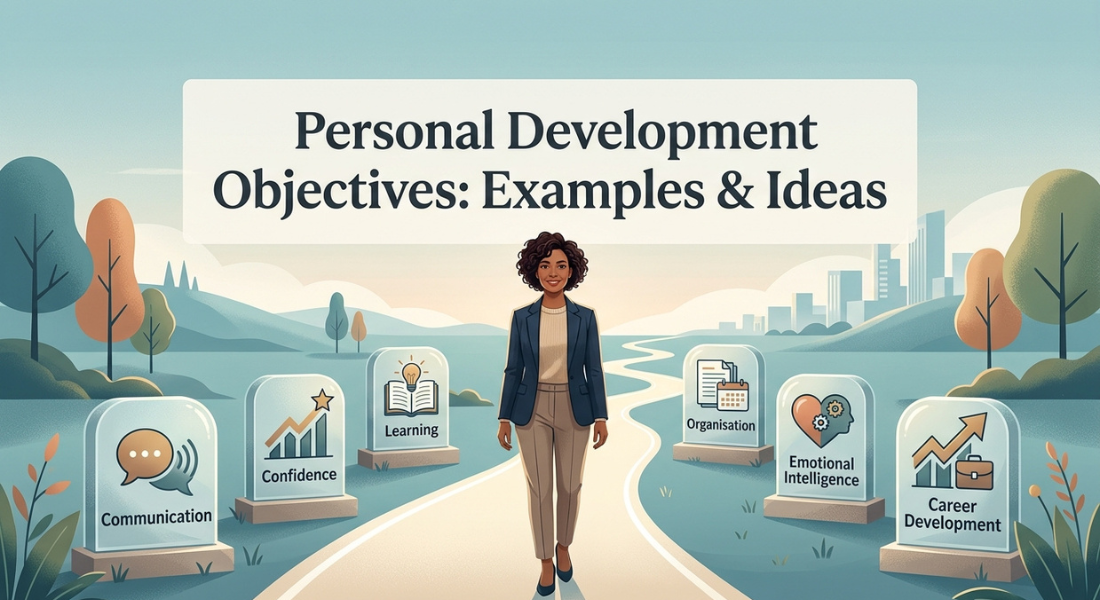
Wanting to improve is easy choosing exactly what to improve is harder. Personal development objectives are specific targets for improving a skill, behaviour, knowledge area or capability.
This guide gives practical examples for personal, interpersonal, learning, organisational and professional development with wording you can actually use in everyday life too.
Personal development objectives define specific areas of improvement rather than broad wishes.
A goal gives broader direction an objective makes the desired improvement more specific.
Strong objectives identify observable evidence of progress.
Useful examples can target communication, confidence, learning, organisation, adaptability and career related capabilities.
Vague intentions become stronger when the desired improvement, evidence and timeframe are clearer.

Personal development objectives are specific targets that describe an area you want to improve. They can relate to a skill, behaviour, knowledge area, capability or personal quality.
The difference is precision. “I want to grow” expresses a desire while “I want to contribute at least once in every team discussion” identifies an observable improvement.
The broader Personal Development topic explains the wider process of self-improvement; this article focuses specifically on the objectives you can choose, define, measure, review, and refine within that process. See our complete Personal Development guide →
An objective can focus on communication, confidence, organisation, learning, emotional responses, adaptability or another defined capability.
This makes terms such as personal objectives, self development goals and self improvement goals useful when they describe a concrete improvement rather than a general wish.
For example “develop better listening” can become an objective focused on using active listening during three conversations each week.
A general intention describes what you would like to change but it often gives no clear indication of what improvement would look like.
“Be more confident” is therefore an intention. “Contribute one question or comment during each weekly discussion” is more objective because the behaviour provides visible evidence of progress.
The stronger wording gives you something specific to recognise rather than relying on a vague feeling of improvement.
A goal describes a broader desired outcome whereas an objective expresses a more specific target that helps define what improvement should occur. The terms are often used interchangeably in everyday language but separating them can make development targets easier to write and evaluate.
For example “improve communication” can work as a broad goal. An objective could be “give clearer explanations by organising the main point and two supporting details before important presentations.”
This distinction does not mean every objective needs complicated wording. Its purpose is simply to move from a broad direction towards a defined target.
The American Psychological Association describes goal setting as establishing specific, measurable and time based behaviour targets that are achievable and realistic.
Goal and Objective Examples
Goal | More specific objective |
Improve communication | Practise active listening in three conversations each week |
Build confidence | Speak at least once during every weekly group discussion |
Learn a new skill | Complete a recognised beginner course and its final project |
Become more organised | Review and prioritise the next day's tasks each evening |
The goal gives direction the objective makes the intended improvement easier to observe.
“Improve my career”, “be healthier” and “learn more” are useful directions but they are too broad to function well as development objectives. They cover large outcomes without identifying the particular improvement being targeted.
A stronger version narrows the focus: “develop presentation skills for a future role” or “complete one structured course in a subject I need to understand better.”
A useful objective identifies what should improve gives some evidence that progress has occurred and uses a realistic target or timeframe where appropriate.
Specificity matters because two people can interpret “improve communication” very differently. A defined objective reduces that ambiguity.
Measurability does not always require a score. Progress can be shown through completed learning, frequency of a behaviour, milestones reached, feedback received or observable performance.
The target should also be relevant to a genuine development need. An impressive sounding objective has little value if it does not address something you actually want or need to develop.
“Improve communication” is difficult to assess because it does not say what communication behaviour should change. A stronger objective might be: “Practise summarising the other person's main point before responding in three important conversations each week.”
Evidence could come from frequency, completed activities, milestones, feedback or a visible change in performance. The APA similarly describes goal setting in terms of specific, measurable and time based targets.
A good objective should match your actual circumstances, available time and current level of ability. For example “complete a 12 week advanced course alongside a full time workload” may be unrealistic if you can only study for an hour each weekend.
Useful personal goal setting examples therefore start with genuine needs and manageable targets rather than ambitious wording for its own sake.
Strong objectives describe a particular improvement rather than simply naming a desirable quality. You might target how you communicate, how confidently you participate, how you respond to others or how effectively you adapt.
The best examples are specific enough to show what would change. They can be small such as contributing more often to conversations or larger such as reaching a defined learning milestone.
The categories below provide personal growth and development goals that can be adapted to different circumstances without turning every objective into a rigid formula.
Practise active listening in three meaningful conversations each week.
Contribute at least one relevant point during every group discussion.
Deliver one five minute presentation each month to build public speaking confidence.
Improve clarity by summarising the main point before giving supporting details.
Ask one follow up question in important conversations to strengthen interpersonal awareness.
These examples turn broad personal growth and development goals into behaviours that can actually be observed.
Record and identify the emotional response behind three challenging situations each week.
Pause before responding to criticism and give a considered response rather than reacting immediately.
Request constructive feedback after two important interactions each month.
Practise adjusting plans when circumstances change instead of abandoning the objective entirely.
Identify one recurring trigger and choose a more constructive response to it.
The objective is not to eliminate emotions or difficult situations. It is to define a specific improvement in how you recognise, manage or respond to them.

Learning and organisation objectives are useful when the development target involves gaining knowledge, practising a capability or managing responsibilities more effectively.
Unlike a broad statement such as “be more productive” a useful objective identifies what you will learn or what organisational behaviour should improve.
These objectives can apply outside formal education or employment. Reading a structured course, practising a practical skill or improving how you prepare for recurring responsibilities can all provide clear development targets.
Complete one structured course in a chosen subject within eight weeks.
Read and summarise two reliable sources on a new topic each month.
Practise a newly learned skill for 30 minutes three times a week.
Complete a defined beginner project that demonstrates a newly acquired capability.
Explain a new concept in your own words after completing each learning module.
These are developmental goals because they identify a knowledge or capability target rather than simply saying “learn more”.
Review and prioritise tomorrow's three most important tasks each evening.
Complete recurring responsibilities before their agreed deadlines for four consecutive weeks.
Use one weekly planning session to organise upcoming commitments.
Remove one recurring source of avoidable distraction during focused work periods.
Keep a single organised list for recurring responsibilities instead of tracking them across multiple places.
The focus remains on the development target itself not on turning the article into a general time management guide.
Professional development can form one part of personal objectives when the focus remains on capabilities that the individual wants to develop.
For example someone preparing for greater responsibility might target presentation ability, technical knowledge, professional communication or confidence with a particular responsibility.
The distinction matters because the objective belongs to the individual's development rather than becoming a broader guide to employee development, workplace training or organisational performance.
Improve presentation ability by delivering one structured presentation each month.
Complete a course covering a job relevant skill within three months.
Practise professional communication by writing and reviewing one formal update each week.
Build confidence in a specific responsibility by completing it independently on three occasions.
Request feedback on one professional capability after completing a significant task.
These professional growth and development goals describe capabilities the individual can personally strengthen.
Develop one capability required for a target role before applying for relevant positions.
Complete a recognised learning milestone connected to a desired career direction.
Expand knowledge of a specific field by completing one focused course within 12 weeks.
Prepare for greater responsibility by independently handling a defined task or project.
Build evidence of career readiness by completing two relevant practical projects.
Career growth examples work best when they identify the capability or knowledge needed for the next stage rather than simply stating “advance my career”.

Start with the broad improvement you have in mind, then identify the particular behaviour, capability or knowledge area that should change. Finally define evidence that would show progress and where useful a timeframe for reviewing it.
For example “improve communication” does not reveal what should change. “Practise active listening in three important conversations each week for the next month” gives the intention a clearer target.
The same principle works across confidence, organisation, learning and professional growth without requiring a complicated development plan.
Improve communication → Practise active listening in three meaningful conversations each week.
Become more organised → Review and prioritise the next day's three key tasks every evening for four weeks.
Build confidence → Contribute at least one relevant point during each weekly group discussion.
Learn a new skill → Complete a beginner course and finish its final practical project within eight weeks.
Each version identifies the improvement more precisely and provides evidence that can be checked.
Ask three questions: What exactly should improve? What evidence will demonstrate progress? When will the target be reviewed? If the wording cannot answer those questions it probably remains too broad.
This is where SMART goals for personal development can be useful as a reference. The APA definition of goal setting also emphasises specific, measurable and time based targets while recognising that targets should remain achievable and realistic.
Effective personal development objectives turn broad intentions into specific targets that you can recognise and evaluate. Strong objectives focus on a defined improvement, use meaningful evidence and remain realistic for your circumstances.
They can cover communication, confidence, learning, organisation, interpersonal development or professional growth. The most useful objective is not the most complicated one; it is the one that clearly describes the improvement you want to make.
Examples include improving active listening, building confidence, completing a course, improving organisation, or developing a job relevant skill.
A goal is a broader outcome while an objective is a specific target that defines the desired improvement.
It should be specific, measurable, relevant and realistic with a clear timeframe where appropriate.
Define what you want to improve, how progress will be measured and when you will review it.
Yes They can focus on developing skills, knowledge or capabilities needed for career growth.
No Objectives can use SMART principles but the two terms are not identical.





Reader Discussion
Leave a Reply