- by Daily Talkin Staff
- July 8, 2026
-

-
-
Loading
Loading
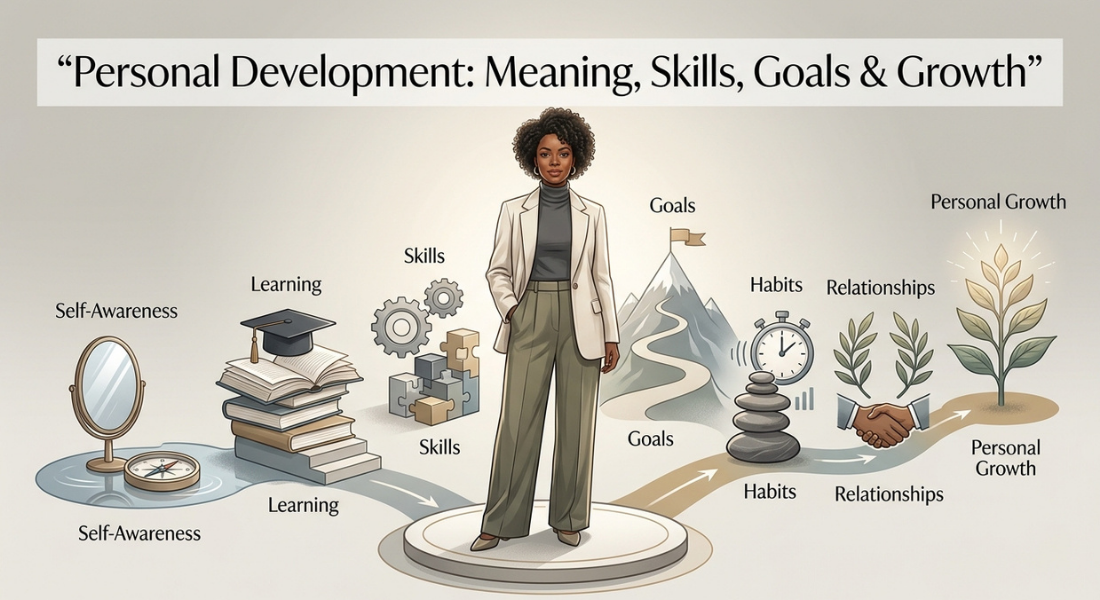
Personal development is the ongoing process of improving your knowledge, abilities, behaviours, self awareness and capacity to act purposefully. It involves learning, reflection, goal setting and practical change rather than a one time transformation.
Personal development is broader than career advancement and can include personal growth, self development, self improvement, relationships, habits, confidence and everyday life skills.
This personal development guide explains its meaning, importance, core components, skills, methods, activities, goals, progress measurement and sustainable application.
Personal development is a continuous process rather than a one time transformation.
Personal growth, self development and self improvement overlap with the broader concept.
Effective development connects self awareness, priorities, goals, practice and review.
Specific actions make personal development goals more practical and measurable.
Sustainable progress depends on realistic expectations, consistency, feedback and adaptation.
Different personal development areas and skills can be explored through dedicated cluster guides.

Personal development means intentionally working to improve aspects of yourself, such as your knowledge, abilities, behaviour, habits, self awareness and decision making.
The personal development definition therefore focuses on purposeful improvement rather than simply getting older or experiencing change.
It is an ongoing process. You may identify a weakness, learn a new skill, practise a different behaviour, review the result and adjust your approach.
The American Psychological Association's definition of self development similarly describes it as growth or improvement in a person's qualities and abilities.
Personal growth generally describes the broader process of becoming more capable, aware or mature through learning and experience. Personal development is often more intentional because it usually involves identifying an area to improve and taking deliberate action.
The two terms overlap considerably. Personal growth can happen through life experiences while personal development commonly adds structured reflection, goals, learning and practice.
Self development and self improvement are closely related expressions. They generally describe deliberate efforts to develop qualities, abilities, knowledge, habits or behaviours.
Personal improvement can be viewed in the same way. Rather than treating these as completely separate concepts it is more useful to understand personal development as the broader umbrella that can include self development, self improvement and personal growth.
No Personality development is a related but narrower concept concerned with characteristics and behaviours that influence how a person communicates and interacts with others.
It may involve confidence, communication, emotional expression and interpersonal behaviour. Personality growth and personality growth and development can therefore form part of personal development but personal development also includes goals, knowledge, habits, practical skills, values and broader life capabilities.
Personal development matters because deliberate improvement can help people understand themselves, make more considered decisions, develop useful capabilities and respond more effectively to changing circumstances.
It can also provide a clearer connection between personal values, priorities and everyday actions. The benefits are not guaranteed outcomes. Personal development is not a promise of constant confidence, career success or improved wellbeing.
Its value comes from creating a structured opportunity to learn, reflect, practise and make more intentional choices.
Common benefits can include:
greater self awareness and clearer priorities
stronger communication and practical skills
improved decision making and problem solving
greater confidence in specific capabilities
healthier routines and more consistent habits
stronger relationships and adaptability
a clearer sense of purpose and direction
The value depends on what a person is trying to develop. Someone improving communication may focus on listening and feedback while someone working on time management may focus on planning and reducing distractions.
Personal growth matters because development is not limited to acquiring individual skills. Reflection, learning and experience can change how people understand themselves respond to challenges and choose future priorities.
Growth is therefore broader than collecting achievements. It can involve becoming more aware of patterns, reassessing assumptions and adapting behaviour when circumstances change.
Self improvement is one practical expression of personal development. It turns a general desire to improve into a specific area of attention, such as communication, organisation, learning or emotional self management.
The useful standard is sustainable progress rather than perfection. A small improvement that can be maintained is generally more meaningful than an ambitious change that cannot fit realistically into everyday life.

The core components of personal development connect self understanding with purposeful action. A useful foundation is to understand yourself, identify what matters, choose priorities, set meaningful goals and develop the capabilities and behaviours needed to act on them.
Without this connection development can become a collection of disconnected activities. Reading a book, setting goals or learning a skill becomes more useful when each activity supports a clearly identified need or priority.
Self awareness involves recognising your strengths, weaknesses, values, behaviours and recurring patterns. Reflection helps turn experiences into information that can guide future decisions.
For example repeatedly missing deadlines may reveal more than a time management problem. Reflection might identify unclear priorities, unrealistic planning or frequent interruptions as the underlying issue.
Personal values influence what you consider important and can help shape priorities. Understanding them can make development more meaningful because goals become connected to something you actually value.
Purpose does not have to mean finding one grand life mission. It can simply provide direction for decisions about relationships, learning, work, contribution or personal priorities.
Personal development goals give improvement a specific direction. Personal growth goals can similarly describe what you want to learn, change or achieve over a defined period.
Prioritisation matters because trying to improve everything simultaneously creates competing demands. Choosing one or two meaningful priorities makes action easier to organise and evaluate.
Knowing what needs to change is not enough. Development requires practice, repetition and behavioural adjustment. A useful sequence is knowledge → practice → repetition → feedback → progress.
This explains why reading about communication for example is different from repeatedly practising active listening and reviewing how conversations develop.
Personal development skills are capabilities that help people manage themselves, interact with others, learn effectively, solve problems and pursue meaningful goals.
Examples include communication, self awareness, emotional intelligence, time management, decision making, problem solving, adaptability, critical thinking and goal setting.
These skills develop through learning, practice, feedback and repeated application rather than simply memorising information. For a complete breakdown of personal development skills and how to develop them see our full guide on Personal Development Skills →
Personal development becomes meaningful when reflection is translated into deliberate action. A practical framework is Understand → Prioritise → Set → Practise → Review → Adjust.
This process is iterative rather than linear. You may discover new information during practice change a goal after reviewing progress or return to self assessment when circumstances shift.
Start by assessing current behaviours, skills, habits and priorities. Look for a specific gap rather than deciding that everything about yourself needs improvement.
A useful question is: “What change would make the greatest practical difference right now?” This keeps development focused and manageable.
Trying to transform every area at once often creates unnecessary pressure. Choose one or two priorities that are relevant to your current circumstances.
For example someone preparing for university might prioritise time management and communication rather than simultaneously attempting to redesign every personal habit.
Separate the desired outcome from the behaviour needed to reach it. “Become better at communication” is an outcome direction; practising active listening during one conversation each day is a concrete action.
The American Psychological Association describes goal setting in terms of specific time based behaviour targets that can be measurable, achievable and realistic.
Repeated practice turns an intention into a behaviour that can be evaluated. Feedback from trusted people can reveal problems you may not notice yourself. Environmental support also matters. Making a desired behaviour easier to perform can reduce unnecessary friction.
Reviewing progress helps determine whether an approach is actually working. Track useful indicators such as completed actions, milestones, frequency or periodic self assessments. The aim is not perfect performance. It is to identify patterns and make informed adjustments.
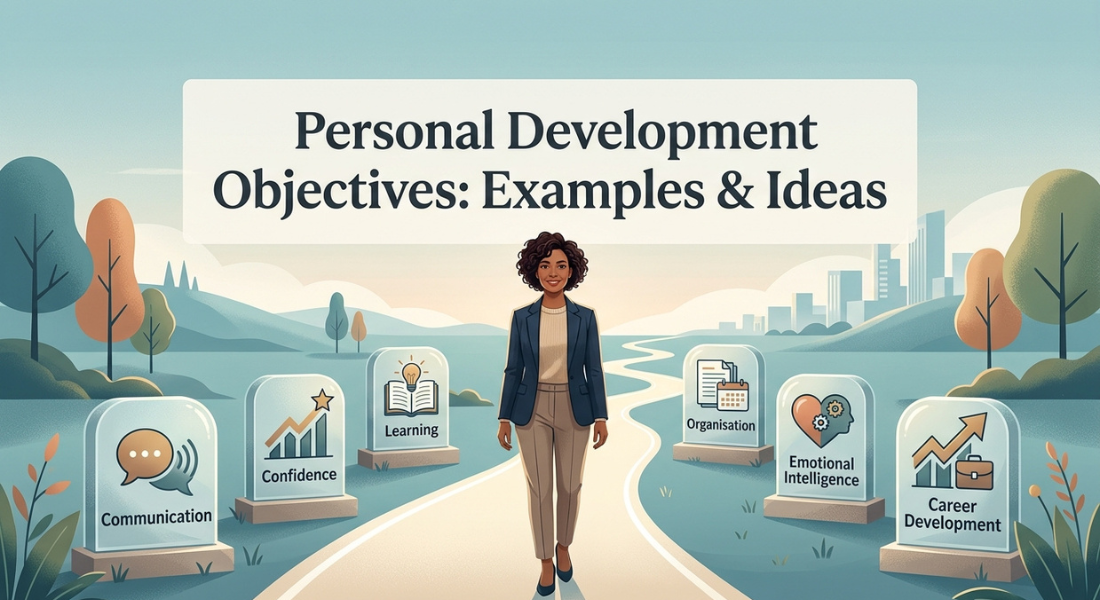
Personal development objectives turn broad aspirations into defined areas of improvement. An objective describes what should improve, a goal provides a target, an action describes what you will do, and a measurable outcome shows how progress can be reviewed.
For example “improve communication” can become an objective while practising active listening three times a week provides a more concrete action.
“For a complete guide to setting meaningful personal development objectives see our full guide on Personal Development Objectives →”
Personal development methods are practical approaches for building awareness, learning, changing behaviour and reviewing progress. No single personal development technique works universally the appropriate method depends on the individual's objective, circumstances and available support.
Effective approaches usually connect reflection with action. A method becomes more useful when it helps answer what needs to change what action will be taken and how progress will be reviewed.
Journalling, reflective questions and strengths and weaknesses reviews can help identify patterns. A short weekly review can be enough to notice recurring problems without turning reflection into excessive self analysis.
Reading, structured learning, feedback and targeted practice can build knowledge and capability. Deliberate practice is most useful when the skill being developed is clearly defined and performance can be reviewed.
Convert intentions into specific actions and divide larger goals into manageable steps. Action planning creates a bridge between wanting an outcome and knowing what to do next.
Trusted feedback can reveal blind spots and provide useful perspective. Depending on the situation, support may come from mentors, coaches, peers, educators or other appropriate professionals.
Make desired behaviours easier by reducing friction and creating consistent cues. NIH guidance on behaviour change similarly highlights planning, small reasonable goals, tracking progress, environmental changes, support and patience.
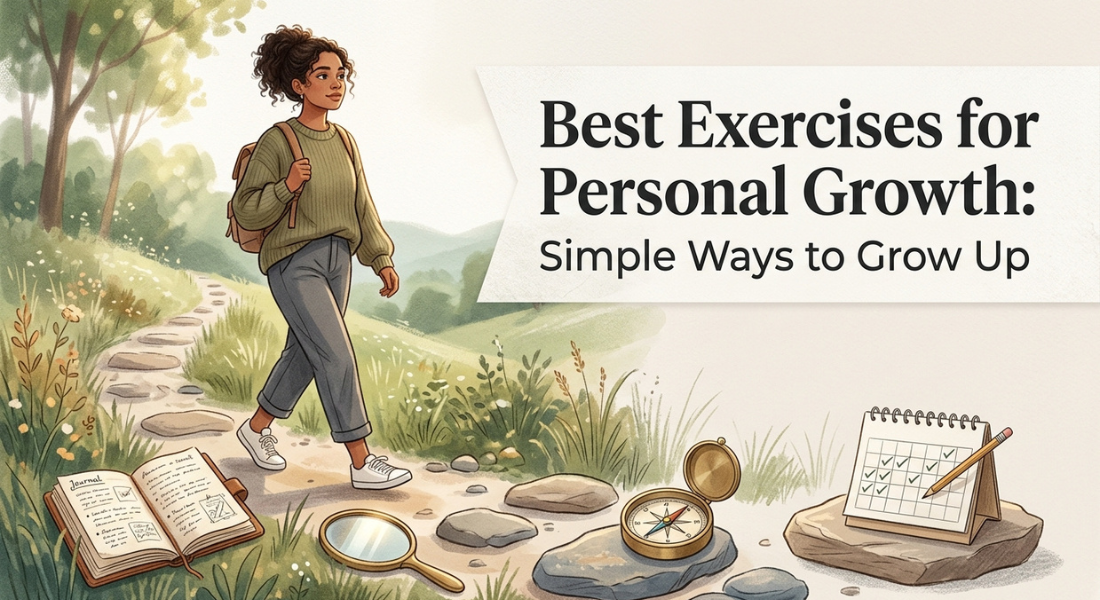
Personal growth exercises are structured activities that encourage reflection, awareness, learning or behavioural practice. Useful examples include reflective journalling, strengths assessment, values clarification, goal review and focused skill practice activities.
The best exercise depends on the area being developed. An exercise should ideally produce insight or practice that can be connected to a real life behaviour.
“For practical exercises you can use for personal growth see our full guide on Best Exercises for Personal Growth →
Personal development goals turn broad aspirations into actionable targets. A useful goal should be specific enough to guide behaviour and measurable enough to review rather than simply expressing a desire to “be better.”
Measurement does not always require numbers. Depending on the objective progress can be evaluated through completed actions, milestones, frequency, quality of performance or structured self assessment.
Make the intended improvement concrete. For example change “Improve communication” into “Practise active listening during one conversation each day.” The second version identifies a behaviour that can actually be performed and reviewed.
A goal describes where you want to go; an action describes what you will do. This distinction matters because intention alone does not guarantee behaviour.
Action planning can therefore make a goal more practical by specifying when, where and how the desired behaviour will occur.
Use milestones, completed actions, habits or periodic self assessments to identify trends. A single missed day does not necessarily indicate failure.
Tracking should provide useful information rather than create unnecessary pressure. The purpose is to see whether the overall direction is improving.
Change a goal when circumstances, priorities or original assumptions have materially changed. A goal may also need adjustment if repeated review shows that the target or action is unrealistic.
Do not change goals simply because progress feels slower than expected. Review the evidence first, then decide whether the goal, action or environment needs modification.
Personal development for students can include study and learning skills, communication, confidence, time management, goal setting and self awareness. It also involves adapting to new responsibilities and learning how to make decisions independently.
Student development should not be reduced to academic performance. Building practical skills, relationships and self management can also support a student's broader transition into adult life.
“For a complete guide to personal development for students see our full guide on Personal Development for Students →
Personal development for teens can involve self awareness, communication, emotional skills, independence, healthy routines, decision making, confidence and responsible goal setting. Development should reflect a teenager's age, circumstances and growing independence.
Adult oriented self help frameworks should not automatically be treated as universal solutions for teenagers. Supportive adults, education and appropriate guidance can provide important context.
For a complete guide to personal development for teens see our full guide on Personal Development for Teens →

Sustainable personal development depends on realistic expectations, consistency, reflection and adaptation. Instead of relying on motivation alone build changes around behaviours that can realistically fit your circumstances.
The goal is not to maintain a perfect routine indefinitely. It is to create a development process that can survive busy periods, setbacks and changing priorities.
Choose changes that are specific and practical. Attempting too many improvements simultaneously can make it difficult to determine what is actually helping. A manageable behaviour provides a clearer opportunity to practise, measure and refine the approach.
Connect development to routines that already exist. For example reviewing tomorrow's priorities after dinner may be easier to sustain than creating an entirely separate productivity routine. Environment can also support consistency by making useful behaviours more convenient.
Setbacks are information rather than automatic evidence of failure. Review what happened, including the behaviour, environment, timing and expectations.
NIH guidance similarly recommends planning for obstacles, tracking progress, being patient and treating change as a process.
Compare current behaviour with your starting point rather than judging progress from one difficult day. Quantitative measures can help when appropriate while qualitative reflection can capture changes that numbers miss.
Regular reviews can reveal gradual improvements that are easy to overlook.
Mentors, educators, coaches or qualified professionals can provide perspective, accountability or specialised support when appropriate. External support is not automatically necessary for ordinary personal development.
If a difficulty involves significant psychological distress or another serious concern an appropriately qualified professional is more suitable than general self help advice.
Personal development is an ongoing process of improving knowledge, skills, behaviours, self awareness and purposeful action. It connects awareness with priorities, goals, practice, feedback and review.
The most useful approach is progress rather than perfection. Identify what matters, choose manageable changes, practise consistently and adjust based on what you learn.
Readers can then move into the relevant dedicated guides on personal development objectives, skills, exercises, areas, students or teens depending on their specific development goal.
Personal development is the ongoing process of improving your skills, knowledge, behaviours and self awareness through learning, practice and reflection.
It can improve self awareness, skills, decision making, habits, confidence, adaptability and overall sense of direction.
They include emotional, intellectual, social, physical, practical, values based and purpose related development.
They are skills that help you manage yourself, interact with others and achieve goals such as communication, decision making and problem solving.
Identify one area to improve, set a specific goal, take practical action, track progress and adjust your approach.
Personal growth is broader while personal development usually involves intentional improvement through goals, learning, practice and reflection.




Reader Discussion
Leave a Reply