- by Daily Talkin Staff
- July 8, 2026
-

-
-
Loading
Loading
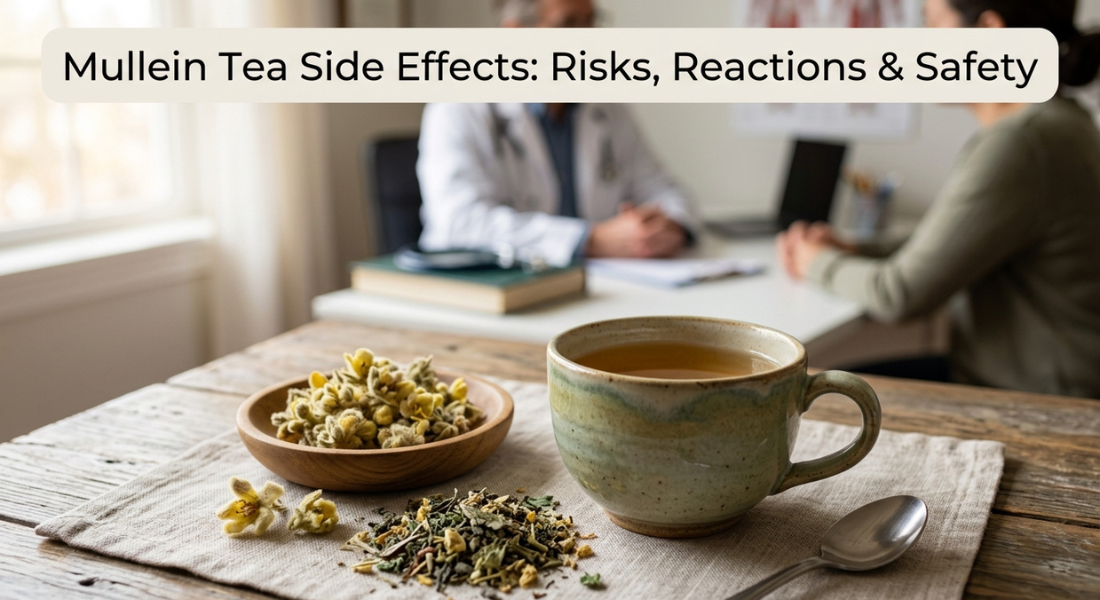
A herbal tea may seem harmless simply because it is natural but can it still cause unwanted effects? Mullein tea side effects are not well established because human safety evidence is limited, although irritation and allergic reactions remain important concerns.
This guide covers digestive symptoms, interactions, higher risk groups, regular use and warning signs. For broader information about mullein tea, including its preparation, traditional uses and evidence see our complete guide to the topic.
This is part of our complete guide on Mullein Tea → see the full guide here.
Human safety evidence for mullein preparations is limited so a long list of proven adverse effects cannot be justified.
Throat irritation and hypersensitivity are the most relevant safety concerns to distinguish clearly.
Digestive symptoms, sleepiness and palpitations are not established characteristic effects of ordinary mullein tea.
Specific mullein drug interactions have not been adequately established so theoretical concerns should not be presented as proven interactions.
Pregnancy, breastfeeding and childhood lack sufficient safety evidence for confident use recommendations.
Severe swelling, breathing difficulty, fainting or rapidly worsening symptoms require appropriate medical attention.

There is no well established catalogue of common adverse effects from ordinary mullein tea. Available safety evidence is limited so it is more accurate to separate documented information from plausible concerns and symptoms that have not been specifically established as effects of mullein.
One of the clearest practical concerns is irritation from fine plant material. Hypersensitivity is another possibility particularly for someone who has previously reacted to botanical products or related plants.
The evidence also does not justify assigning a percentage risk to these reactions. The European Medicines Agency's assessment found no clinical pharmacology data, no dose response studies and no clinical studies for the assessed mullein flower preparations.
That lack of evidence should not be interpreted as proof that adverse effects cannot occur. The form of the product matters as well.
Findings involving a concentrated extract cannot automatically be applied to a cup of tea because the composition and exposure may differ. Natural origin alone is not a safety guarantee.
Stomach upset, nausea, abdominal discomfort and changes in bowel habits are among the symptoms people may search for after drinking herbal products. However digestive problems are not well established as characteristic effects of mullein tea from the available human evidence.
The same applies to the question “Does mullein tea make you poop?” There is not enough reliable evidence to describe a predictable laxative effect.
If you develop nausea, abdominal pain, diarrhoea or another digestive symptom soon after drinking it do not automatically assume mullein is the cause. The product may contain other ingredients, and unrelated food, illness or medication can also produce similar symptoms.
Throat irritation and an allergic reaction are not the same thing. Irritation can result from fine plant material contacting the mouth or throat whereas an allergy involves an immune response and can affect other parts of the body.
This distinction matters because the appropriate response differs. Mild local irritation may stop once exposure ends while symptoms such as widespread itching, hives, swelling or breathing difficulty can indicate a more serious hypersensitivity reaction.
Mullein flower has been assessed by the European Medicines Agency, which identified hypersensitivity as a relevant precaution and also reported that clinical safety information was limited.
The assessment should therefore be read as evidence of uncertainty, rather than as proof that mullein commonly causes allergies. You should also avoid assuming that an unpleasant sensation automatically means you are allergic.
A symptom's timing, pattern and severity matter, and persistent or significant symptoms deserve medical assessment.
Local irritation is more likely to remain around the mouth or throat particularly when fine plant material is involved. An allergic reaction can produce itching, hives, facial or throat swelling, wheezing or difficulty breathing.
A mullein allergy cannot be diagnosed from one symptom alone. If symptoms spread beyond the original area or become more severe stop using the product and seek appropriate medical care.
Breathing difficulty, significant swelling, fainting or other signs of a severe allergic reaction require urgent attention. Do not continue drinking the tea to see whether the symptoms improve.
There is not enough clinical evidence to establish a reliable list of specific mullein tea drug interactions. That does not mean interactions are impossible; it means the available evidence does not support presenting theoretical concerns as confirmed clinical effects.
This distinction is especially relevant if you take prescription medicines regularly. The concentration of an active medicine can sometimes matter greatly, and uncertainty about an herbal product can make self assessment difficult.
The National Center for Complementary and Integrative Health (NCCIH) states that many herb–drug interaction concerns are based on indirect evidence, including animal studies, cellular research or theoretical mechanisms.
It also notes that well designed clinical studies of herbal supplement drug interactions remain limited. For that reason people taking medicines should tell a pharmacist or clinician about herbal products they use.
This is particularly sensible when a medicine has a narrow therapeutic range.
A useful distinction is between documented interaction, theoretical possibility and unknown effect. These categories should not be presented as though they carry the same level of evidence.
For mullein available assessments do not establish a dependable clinical interaction list. Claims that it definitely interacts with diabetes medicines, blood pressure medicines or diuretics should therefore not be repeated without specific supporting evidence.
NCCIH highlights that many herb drug interaction claims remain uncertain and that evidence can be incomplete. Its guidance also recommends telling healthcare providers about all medicines and supplements being used.
If you take several medicines have recently started a new prescription or use a medicine where small changes in drug levels could be important ask a pharmacist or clinician before adding mullein.
Extra caution makes sense when safety evidence is incomplete or when a person's circumstances could increase the consequences of an adverse reaction. This does not mean mullein is proven to be unsafe for every person in these groups.
Pregnancy and breastfeeding deserve particular caution because adequate reproductive safety information is lacking. Children also should not be treated as though adult safety information automatically applies to them.
People with known plant hypersensitivity should consider the possibility of an allergic reaction while anyone taking prescription or over the counter medicines should consider the uncertainty surrounding potential interactions.
People managing significant health conditions should also discuss herbal products with an appropriate healthcare professional. The reason is not that mullein is known to worsen every condition but that limited evidence makes individual risk harder to judge reliably.

The available evidence is not sufficient to establish safety during pregnancy or breastfeeding. The European Medicines Agency assessment reported no information on reproductive or developmental toxicity and concluded that use during pregnancy and lactation could not be recommended.
The same assessment found insufficient data for children. That means there is no sound basis for assuming that an amount tolerated by an adult has been adequately established as safe for a child.
The EMA's assessment was based on the evidence available for the evaluated mullein flower preparations so it should not be stretched into a universal claim about every mullein product.
There is no universally established daily amount that can be described as a proven safe long term intake for everyone. Limited safety evidence also means there is not enough information to claim that drinking it every day is harmless.
Regular use raises a different question from occasional exposure because longer term safety may not be adequately studied. The absence of reported problems is not the same as evidence proving that prolonged use carries no risk.
The same caution applies to taking too much. There is no well established toxic threshold that allows a precise answer such as “X cups is dangerous.” Product strength, ingredients and individual circumstances can differ.
Taking more of an herbal product does not automatically make it safer or more effective. If regular use concerns you, particularly alongside medicines or an existing health condition professional advice is more reliable than increasing or guessing the amount yourself.
Questions such as “Does mullein tea make you sleepy?” and “Can mullein cause heart palpitations?” appear in searches but neither symptom can be presented as an established characteristic effect of ordinary mullein tea based on the available evidence.
Sleepiness or palpitations after drinking a product may have several possible explanations, including another ingredient, medication, underlying illness or an unrelated event.
If a new symptom is persistent, severe or unusual for you do not assume that mullein caused it or that it is harmless. Stop using the product while you seek appropriate advice particularly if the symptom is worsening.

Not every unpleasant symptom represents an emergency but certain reactions should not be managed by repeatedly testing the same product. Significant swelling, difficulty breathing, fainting or rapidly worsening symptoms require prompt medical attention.
A suspected severe allergic reaction is especially important because symptoms can progress beyond the original point of contact. Do not continue drinking the tea in an attempt to determine whether the reaction settles.
Other serious or unexpected symptoms also deserve appropriate evaluation, particularly when you take medicines or have an existing health condition. The cause may not be mullein at all, and identifying the cause safely may require a clinician.
For mild, uncertain symptoms, stopping exposure and monitoring what happens can provide useful information for a healthcare professional. For severe symptoms seek urgent medical care rather than relying on an online article.
The main concern with mullein tea is not a long list of proven side effects but how little high quality human safety evidence is available. Irritation and possible hypersensitivity deserve attention while medication interactions and long term use remain uncertain.
Pregnancy breastfeeding and childhood also lack sufficient safety evidence. Serious or unexpected symptoms should be assessed medically.
Evidence on mullein tea side effects is limited. Throat irritation and hypersensitivity are important concerns while many other commonly searched symptoms are not well established.
Digestive symptoms can occur after drinking herbal products but stomach upset is not well established as a characteristic mullein tea side effect.
A reaction is possible in someone with hypersensitivity although the frequency and clinical risk are not well established. Severe symptoms need prompt medical attention.
Specific clinical interaction evidence is limited. Anyone taking prescription or over the counter medicines should discuss mullein use with a pharmacist or healthcare professional.
There is not enough evidence to establish that long term daily use is universally safe. Regular use should be considered cautiously especially with medicines or health conditions.
A universally established toxic amount has not been established from the available evidence. Taking more does not automatically mean greater safety or benefit.





Reader Discussion
Leave a Reply