- by Daily Talkin Staff
- July 8, 2026
-

-
-
Loading
Loading
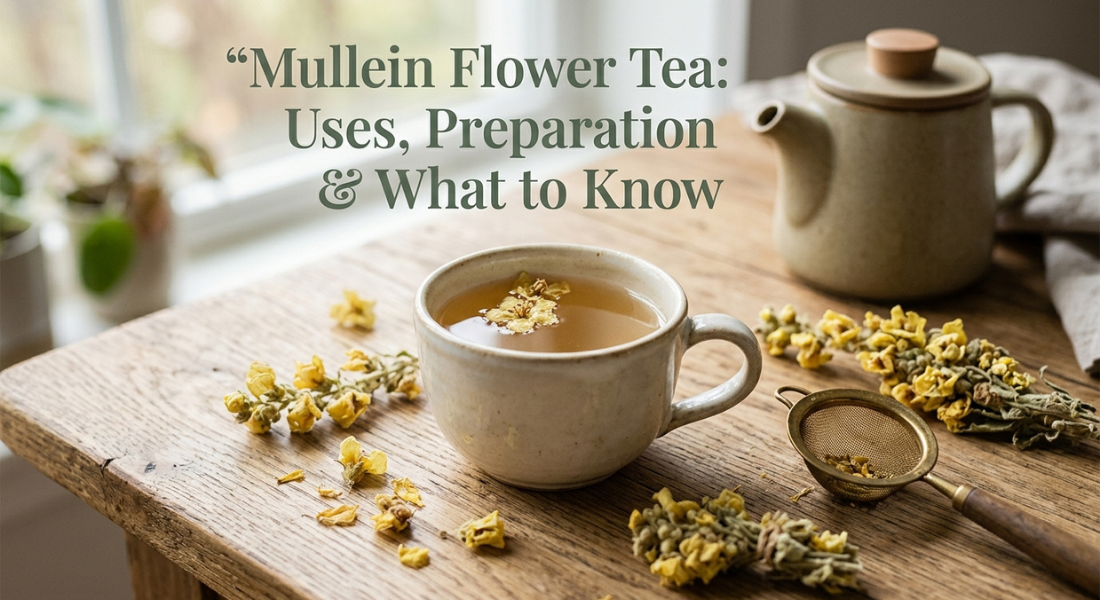
Not all mullein tea comes from the same part of the plant. Mullein flower tea is an herbal infusion made specifically from dried mullein flowers including flowers from certain Verbascum species recognised in herbal monographs.
The flower material can affect how the tea is identified, prepared and used. Here is how to recognise dried mullein flowers, prepare the infusion, strain it carefully and understand its traditional uses.
Mullein flower tea is made specifically from dried mullein flowers.
Verbasci flos is the EMA designation for mullein flower.
The EMA monograph covers Verbascum thapsus, V. densiflorum and V. phlomoides.
Preparation directions can vary, while one EMA-documented traditional preparation uses a 10–15 minute steep followed by straining.
Mullein flower has a traditional association with dry cough and cold-related sore-throat symptoms.
Traditional use should not be presented as proof that ordinary flower tea treats disease.

Mullein flower tea is prepared from dried flowers of specified Verbascum species rather than from the plant's leaves or a concentrated extract. The European Medicines Agency (EMA) recognises the herbal material under the name Verbasci flos, or mullein flower.
The EMA monograph covers Verbascum thapsus, Verbascum densiflorum and Verbascum phlomoides. The recognised material is therefore more specific than simply seeing the word "mullein" on a tea label.
For broader context on mullein tea including topics outside flower specific preparation refer to the parent guide those broader subjects are intentionally outside this cluster so this page can focus on the flower material itself.
The EMA's Verbasci flos monograph covers flowers from Verbascum thapsus, V. densiflorum and V. phlomoides. When buying dried material look for a clearly stated botanical name or ingredient such as "mullein flower."
This gives you more useful information than a label that identifies only the plant genus or common name.
"Dried mullein flower" refers to botanical flower material prepared for use as an herbal ingredient. It is not the same thing as mullein flower oil, tincture, concentrated extract or powdered supplement.
That distinction matters because different preparations can have different concentrations, compositions and directions for use. Evidence relating to one form should not automatically be transferred to another.
The practical difference starts with the plant part used. Flower based preparations use mullein flowers whereas leaf based preparations use leaves so the raw botanical material is not identical.
This article concerns flower material specifically. That does not mean flowers are automatically better than leaves; it simply means the ingredient, preparation and resulting infusion need to be understood according to the plant part actually used.
The EMA's assessment describes dried mullein flowers as the herbal substance used for traditional herbal tea preparations.
Processing also matters. Drying, cutting, storage and the way the material is infused can affect what ends up in the finished cup. For that reason, comparing flower and leaf tea solely by their names can oversimplify the preparation.
Yes but the useful distinction is the ingredient identity and infusion characteristics not a claim that one part produces superior effects.
Flowers and leaves are different botanical materials and can differ in appearance, texture and how they behave during infusion. The final character can also change with the amount used, particle size, water temperature and steeping time.
Check the ingredient panel for terms such as "mullein flower," "Verbasci flos," or a clearly identified Verbascum flower ingredient. The EMA specifically identifies Verbasci flos as mullein flower and names the three species covered by its monograph.

Preparing dried flowers is straightforward but the fine botanical material deserves careful handling. Start with dried mullein flowers intended for infusion then use the preparation directions supplied by the product when they are available.
Place the specified amount of dried material into a suitable cup or teapot and add hot water. Allow the flowers to infuse for the time recommended by the reliable source or product label rather than assuming that every dried flower preparation requires the same treatment.
The EMA assessment report documents a traditional herbal tea preparation in which boiling water is poured over finely cut dried mullein flowers followed by a 10 to 15 minute steep and straining.
Once steeped, filter the liquid through a fine strainer. This is particularly useful when the dried flowers are finely cut and small botanical particles remain suspended in the infusion.
The essentials are dried mullein flowers, hot water, a suitable cup or teapot and a fine strainer.
Choose botanical material intended for infusion and check its preparation directions first. There is no need to add extra ingredients simply to make the basic flower infusion.
Preparation time can vary by product and preparation method. Where reliable directions are supplied follow those instructions rather than applying a generic steeping time.
The EMA assessment report records 10 15 minutes for one traditional tea preparation using finely cut dried mullein flowers.
Fine straining removes small pieces of dried botanical material that may remain in the finished infusion.
This is especially useful with finely cut flowers because tiny particles can pass through a standard tea infuser. A fine mesh strainer can produce a cleaner liquid without changing the basic preparation.
The drinking experience depends partly on the dried flowers themselves and partly on how strongly they are infused. Flower material can produce a different cup from a preparation made from another plant part so it is better not to treat one fixed flavour description as universal.
A stronger or longer infusion may taste more pronounced than a lightly prepared cup. Storage and the condition of the dried material can also influence the finished drink.
For someone trying the flower preparation for the first time the most useful expectation is that the flavour is variable rather than fixed. Product composition and preparation strength matter.
It can be relatively mild but bitterness is not a reliable universal characteristic of dried mullein flowers. The strength of the infusion, quantity of material, steeping time and individual perception can all affect the result. A particularly strong cup may taste more pronounced than a lighter preparation.
The EMA recognises a traditional use indication for mullein flower preparations involving relief of sore throat symptoms associated with dry cough and cold. This is a traditional medicinal use conclusion not evidence that an ordinary cup of tea treats an infection or respiratory disease.
The wording matters because traditional use and modern clinical evidence are not interchangeable. The EMA states that its indication is based exclusively on long standing use while the broader scientific literature includes experimental research on Verbascum thapsus and different preparations.
Therefore flower tea can be discussed in the context of its traditional association without presenting that history as proof of a therapeutic effect.
A 2022 review indexed by PubMed discusses Verbascum thapsus and reports that dried leaves, flowers, extracts and flower oil have been used in traditional formulations. It also reviews experimental biological activity.
That does not establish ordinary flower tea as clinically proven for a particular condition. Research involving extracts or laboratory models should be distinguished from evidence involving a typical homemade infusion.
Mullein flower has a traditional association with dry cough and cold related sore throat symptoms reflected in the EMA monograph.
That wording should not be expanded into a claim that ordinary tea treats infection, clears the lungs or cures respiratory disease. Traditional use information describes historical medicinal use not proof of treatment effectiveness.
Start by confirming that the product actually contains dried mullein flowers and checking its preparation instructions. Clear botanical identification is particularly useful when different plant parts or preparation forms are sold under similar common names.
Straining also deserves attention because dried botanical material can leave fine particles in the finished drink. A fine strainer is a simple preparation measure that helps separate the liquid from remaining plant material.
Finally keep traditional use information in perspective. The EMA's recognised indication concerns a traditional herbal medicinal product and long standing use; it should not be treated as equivalent to established clinical treatment for disease.
If you are pregnant or breastfeeding, take medicines, manage a health condition or are unsure about a particular herbal product professional advice is more appropriate than assuming a flower infusion is automatically suitable.
No A flower infusion uses dried botanical material steeped in water while an extract is produced through a separate extraction process and may be more concentrated.
Evidence, composition or serving information for an extract should therefore not automatically be applied to an ordinary cup of flower tea.

People who are pregnant or breastfeeding, taking medicines, managing health conditions or uncertain about the identity or quality of a product should seek professional advice before using it.
The same caution applies when product instructions are unclear or when a preparation is being considered as an alternative to medical treatment.
Mullein flower tea specifically means an infusion prepared from dried mullein flowers not simply any product labelled "mullein." Clear botanical identification appropriate flower specific preparation and careful straining help you understand what is actually in the cup.
Its traditional association with dry cough and cold related sore throat symptoms should remain clearly separated from claims of proven treatment.
Yes Dried mullein flowers can be used to make an herbal infusion.
No They use different parts of the plant and may produce different infusions.
Follow the product instructions. Traditional preparation may steep for 10 to 15 minutes before straining.
It can The flavour varies with the strength and steeping time.
Mullein flowers have traditional use for dry cough and sore throat symptoms but this does not prove tea is an effective treatment.
Yes Straining removes small pieces of dried flowers and fine particles.


Reader Discussion
Leave a Reply