- by Daily Talkin Staff
- July 8, 2026
-

-
-
Loading
Loading
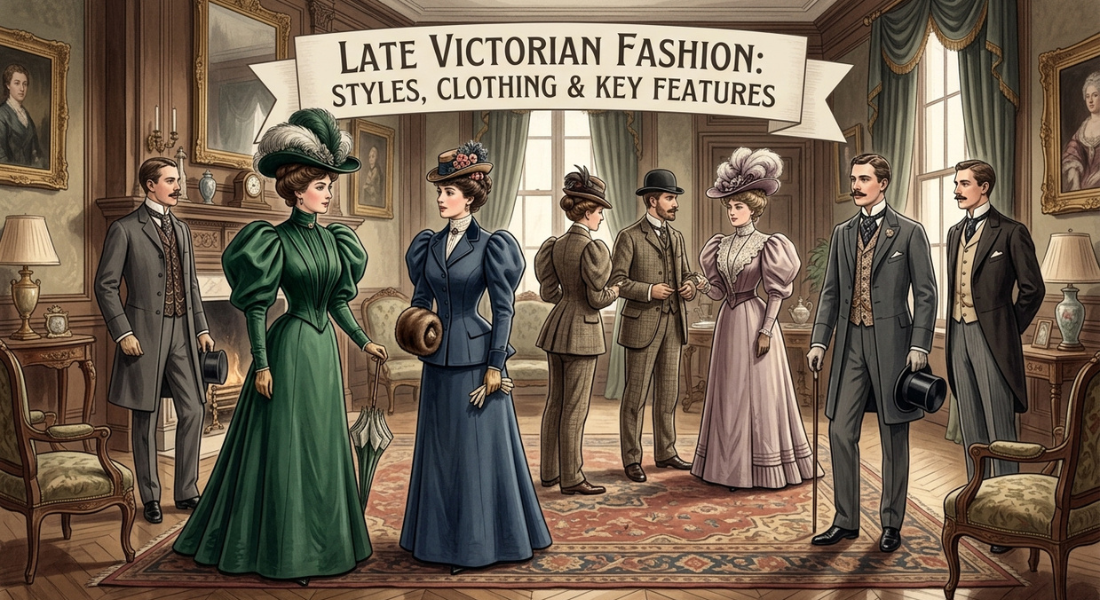
Late Victorian Fashion marked a shift from the pronounced bustle towards more controlled skirts and dramatically enlarged sleeves. It refers to the later years of Queen Victoria’s reign particularly the 1880s and 1890s.
This guide explores the period’s distinctive silhouettes, key garments and menswear, along with everyday dress, class differences and finishing accessories. It also highlights how fashion changed across different occasions.
Late Victorian dress is especially associated with the 1880s and 1890s with the 1890s providing its clearest visual identity.
Women’s clothing combined fitted waists and bodices with controlled skirts and increasingly dramatic upper sleeves.
Shirtwaists, tailored jackets and practical combinations were important alongside formal dresses and evening gowns.
Late Victorian menswear relied on restrained tailoring, coats, waistcoats, trousers, shirts and occasion appropriate hats.
Everyday clothing varied considerably according to occupation, income, social class and practical requirements.
Hats, gloves, jewellery, footwear and other accessories helped complete the period silhouette.

Late Victorian fashion was defined by fitted waists, structured bodices, changing skirt proportions and dramatic sleeves. The 1890s silhouette is especially recognisable for its corseted waist, voluminous skirts and oversized leg of mutton sleeves.
Clothing varied by occasion. Formal evening gowns were often highly decorative, while daytime outfits could include a shirtwaist, skirt and tailored jacket.
Victorian Fashion covers the wider clothing culture of Queen Victoria’s reign while this guide focuses on late Victorian silhouettes, garments and style characteristics. For the broader history see our complete guide to Victorian Fashion → see the full guide here.
Late Victorian fashion refers to the later part of Queen Victoria’s reign, particularly the 1880s and 1890s. The 1890s are especially notable for their fitted silhouettes and dramatic sleeves.
The bustle became less dominant while skirts developed a simpler, more controlled shape. Fashionable volume shifted towards the upper sleeves, balanced by a fitted waist and structured bodice.
Late Victorian women’s clothing was worn as coordinated ensembles, often combining a fitted bodice or shirtwaist, skirt, outer layer and undergarments. Daywear was generally more practical while evening gowns used richer fabrics and decorative details.
The 1890s featured a fitted waist controlled skirts and dramatically enlarged upper sleeves. Gigot or leg of mutton sleeves became one of the era’s most recognisable features.
Shirtwaists, bodices, skirts, tailored jackets, day dresses, evening gowns and outerwear were key garments. Shirtwaists and tailored jackets were particularly useful for practical daytime dressing while evening gowns were more decorative.
Walking and cycling outfits offered more practical alternatives to formal dress. Women also increasingly appeared in fashionable sporting activities such as tennis, golf and horseback riding.
The Gibson Girl represented an influential ideal of fashionable active femininity rather than a universal record of women’s clothing.
Late Victorian menswear generally presented a controlled tailored appearance. The key distinction was less about dramatic silhouette changes and more about how coats, waistcoats, trousers, shirts and neckwear were combined for different levels of formality.
Formal clothing maintained a structured appearance while less formal dress allowed more practical combinations. Fit, fabric and the type of coat helped establish whether an outfit was intended for business, daytime social activity or a formal occasion.
This made late century menswear comparatively restrained beside the striking shapes of women’s fashion. The overall effect relied on clean tailoring and coordinated layers rather than exaggerated volume.
Men could wear suits, frock coats, morning coats, waistcoats, trousers, shirts and neckwear, with combinations changing according to occasion. A formal daytime outfit required different tailoring from less formal everyday clothing.
The waistcoat remained an important visual layer while trousers generally created a straight orderly lower silhouette. Coats supplied much of the outfit’s formal character particularly when paired with polished accessories and appropriate headwear.
Top hats were strongly associated with formal dress while bowlers offered a less formal alternative. Headwear therefore helped distinguish social setting and occasion rather than functioning as a purely decorative addition.
A complete late period outfit depended on these combinations. Coat, waistcoat, trousers, shirt, neckwear and hat worked together to communicate formality, respectability and the expected dress standard for the occasion.

Late century clothing could combine substantial wool and cotton with more luxurious silk and velvet. Lace, ribbons, embroidery and other trims supplied additional surface interest especially in garments designed for formal or fashionable settings.
The visual language of the 1890s could be surprisingly bold. Large scale ornament and strong colour contrasts appeared alongside more restrained daytime clothing making fashionable dress far less uniformly sombre than the stereotypical image of Victorian clothing suggests.
Surviving museum garments provide useful evidence because they show actual construction and materials rather than relying solely on fashion illustrations. A late 1890s dress at the Met for example is recorded in cotton and silk.
Silk and velvet suited elaborate formal garments because they could provide richness depth and a strong decorative effect. Wool and cotton were valuable for practical clothing and everyday combinations.
Lace ribbons and similar trims added detail without changing the basic silhouette. Their placement could emphasise collars, cuffs, bodices or other visible areas of an outfit.
Fashionable 1890s clothing could use strong colours, large scale patterns, contrasting trims and graphic decorative motifs. The Metropolitan Museum of Art notes that a House of Worth evening dress from 1898–1900 used large scale ornament and stylised rose designs.
Black also remained important, particularly for mourning and other formal contexts. The wider colour range of fashionable clothing however shows why late Victorian attire should not be reduced to black dresses and dark suits.
The fashionable ideal did not represent every person's wardrobe. Upper class Victorian fashion offered greater access to expensive fabrics, skilled tailoring and frequent changes in style while middle class Victorian clothing balanced respectability with cost and practicality.
Working class Victorian clothing generally placed greater emphasis on durability usefulness and garments that could withstand daily work.
The difference was not simply aesthetic income, occupation, garment quantity and access to professional dressmaking all affected what someone could realistically wear.
This distinction is especially useful when interpreting surviving images. A fashion plate or elite portrait can show the period's fashionable possibilities without representing everyday Victorian fashion for the wider population.
Everyday 1890s fashion could be noticeably simpler than formal gowns presented in fashionable imagery. Durable fabrics, practical combinations and less elaborate decoration made clothing more suitable for ordinary routines.
A person’s occupation and financial circumstances mattered greatly. Everyday Victorian fashion therefore covered a broad range from carefully tailored middle class outfits to hard wearing working clothing.
Upper class Victorian fashion could support expensive materials, elaborate decoration and more frequent wardrobe changes. Middle class Victorian clothing often sought a polished respectable appearance while balancing household budgets.
Working class Victorian clothing prioritised durability, practicality and suitability for labour. The three groups could share basic garment forms but material quality, decoration, tailoring and the number of available outfits often differed considerably.
Accessories helped balance the strong proportions of late century clothing. Hats could add height or width around the head while gloves, jewellery, parasols, bags and footwear supplied smaller points of colour and texture.
Their importance was visual as well as practical. A restrained daytime outfit could gain character from a carefully chosen hat or brooch while formal dress could support more elaborate accessories without disrupting the central silhouette.
Rather than treating accessories as a separate costume category it is more useful to see them as finishing elements that completed a coordinated late period ensemble.
Late century women’s hats could be highly shaped and decorated complementing the proportions of the outfit. Gloves added refinement while parasols, brooches, jewellery and carried bags supplied practical and decorative details.
Scale mattered. Accessories helped frame the face and upper body particularly when large sleeves already created considerable visual width below the shoulders.
Boots and shoes provided a practical foundation beneath the long skirts while small finishing details helped unify the entire outfit. Material, trim and shape could reinforce whether an ensemble was intended for ordinary daytime use or a more formal setting.
These details matter when recognising late Victorian clothing because an authentic looking silhouette can still appear incomplete without appropriate accessories and footwear.
The easiest distinction is the location of visual volume. Earlier Victorian silhouettes often emphasised broad skirt structures whereas late Victorian clothing increasingly controlled the skirt while directing attention towards the waist, upper body and sleeves.
This does not mean every late period garment followed one formula. Fashion changed continuously, and surviving examples show considerable variation. The key is to recognise the dominant visual tendencies rather than treating them as rigid rules.
The 1890s are particularly distinctive because strong tailoring fitted bodices and dramatic sleeves could appear together within the same ensemble.
Earlier Victorian dress commonly used broad skirt structures such as crinolines to create volume around the lower body. Later styles placed greater emphasis on controlled skirts, fitted waists and prominent sleeves producing a noticeably different distribution of visual weight.
The comparison is about recognition not a complete history of how each silhouette developed.

The 1890s combine several strong visual cues: enlarged upper sleeves, fitted bodices, defined waists and comparatively controlled skirts. Together these features create a silhouette that is easy to distinguish from the broadest earlier Victorian shapes.
That combination rather than any single garment is what makes late 1890s dress so recognisable.
Late Victorian Fashion is best recognised through its distinctive distribution of shape: a fitted waist, controlled skirt, dramatic sleeves and carefully tailored garments. Women’s dress varied by occasion and activity while menswear remained more restrained.
Everyday clothing also differed sharply by social class showing that the surviving Victorian image represents only part of the period’s actual wardrobe.
Late Victorian fashion refers mainly to 1880s and 1890s clothing, known for fitted waists, controlled skirts and dramatic sleeves.
Women wore fitted bodices, skirts, shirtwaists, dresses and tailored jackets with outfits varying by occasion.
Men wore suits, coats, waistcoats, trousers, shirts and neckwear, often completed with top hats or bowlers.
Everyday 1890s clothing was simpler and more practical than formal dress, varying by occupation, income and social class.
Late Victorian styles emphasised controlled skirts, fitted waists and dramatic sleeves rather than broad lower body volume.
Large gigot or leg of mutton sleeves became a defining feature of fashionable 1890s women's dress.




Reader Discussion
Leave a Reply