- by Daily Talkin Staff
- July 8, 2026
-

-
-
Loading
Loading
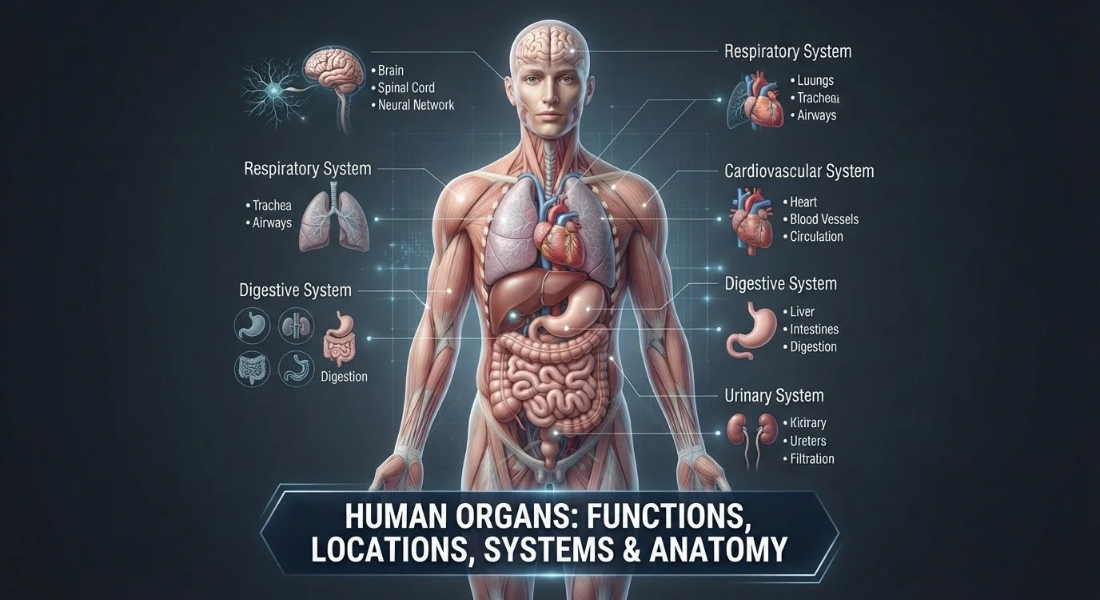
Human organs are specialised body structures made from multiple tissue types that perform specific physiological functions. Together, human organs support processes such as breathing, circulation, digestion, movement, waste removal and coordination.
This guide explains what organs are, how they relate to tissues and organ systems where major organs are located, what they do, and why commonly cited organ counts can differ. It also covers vital organs, how organs work together, and the largest organ in the body.
Human organs are specialised structures made from multiple tissue types.
The body's organisation progresses from cells to tissues, organs, organ systems and the organism.
There is no single universally fixed organ count across every anatomical classification.
The brain, heart, lungs, liver and kidneys are commonly described as vital organs.
Skin is the largest organ overall, while the liver is the largest internal organ.
Organ systems work together through processes such as circulation, signalling and homeostasis.

A human organ is an anatomically distinct body structure made from two or more tissue types that performs one or more specific physiological functions. The heart, lungs, liver, kidneys and brain are examples of organs with specialised roles.
Organs do not function as isolated parts. They fit into a larger biological hierarchy in which cells form tissues, tissues form organs, and organs work together within organ systems. OpenStax describes this progression as part of the body's structural organisation.
The basic sequence is:
Cells → tissues → organs → organ systems → organism
Cells are the smallest independently functioning units of the body. Groups of similar or related cells form tissues while organs contain multiple tissue types arranged to perform particular functions.
Organ systems then bring multiple organs and structures together. For example the urinary system includes the kidneys, ureters, bladder and urethra which cooperate to regulate fluid balance and remove waste.
An organ generally has three defining characteristics:
It has a distinct anatomical structure.
It contains at least two tissue types.
It performs one or more specialised physiological functions.
Some biological classifications are less straightforward than others. Certain structures may have functions spanning different systems which is why anatomical classification does not always produce perfectly rigid categories.
An organ is an individual functional structure such as the heart or kidney. An organ system is a group of organs and related structures that work together to perform broader physiological functions.
For example the heart is an organ within the cardiovascular system while the kidneys are major organs of the urinary system. The pancreas illustrates why boundaries can overlap because it contributes to both digestive and endocrine functions.
There is no single universally fixed number of human organs accepted across every anatomical classification. Counts commonly cited in reference sources can differ because researchers and educators do not always classify every structure in exactly the same way.
The variation does not mean that the body contains an unknown or constantly changing number of organs. Instead it reflects differences in what is counted as an individual organ, how specialised structures are classified, and whether certain paired or related structures are treated separately.
The main reasons include:
Different definitions of an organ.
Different anatomical classification systems.
Different treatment of specialised structures.
Differences in whether particular glands or related structures are counted independently.
Differences in how paired structures are represented.
A commonly cited figure should therefore be treated as a classification based count rather than an absolute biological constant.
Common organ lists include major internal organs such as the brain, heart, lungs, liver, kidneys, stomach and intestines. They may also include the skin, reproductive organs, glands and other specialised structures.
The exact list depends on the anatomical framework being used. This is why two reputable educational sources can provide slightly different counts without necessarily contradicting the underlying anatomy.
There is no single number that should be presented as the universal official count for every anatomical classification. A figure such as 78 can represent one accepted way of organising and counting structures while another reference may use different criteria.
For that reason the more useful question is often not simply “how many?” but also which structures are being counted and why?
Major human organs perform essential or specialised functions that keep the body operating. Their functions become easier to understand when considered alongside their location and the organ system to which they contribute.
The table below provides a quick reference before looking at several major organs individually.
Organ | General Location | Main Function | Main System |
Brain | Skull | Controls and coordinates nervous system activity | Nervous |
Heart | Chest | Pumps blood | Cardiovascular |
Lungs | Chest | Exchange oxygen and carbon dioxide | Respiratory |
Liver | Upper right abdomen | Metabolism, processing substances and bile production | Digestive/metabolic |
Kidneys | Posterior abdomen | Filter blood and regulate fluid balance | Urinary |
Stomach | Upper abdomen | Begins digestion of food | Digestive |
Pancreas | Upper abdomen | Produces digestive enzymes and hormones | Digestive/endocrine |
Spleen | Upper left abdomen | Supports immune and blood related functions | Lymphatic |
Skin | Body surface | Protection, sensation and temperature regulation | Integumentary |
The brain is located inside the skull and serves as the central control organ of the nervous system. It processes sensory information, coordinates responses and supports functions including movement, communication, memory and other forms of cognition.
It works continuously with the spinal cord, peripheral nerves and endocrine signals to coordinate activities throughout the body.
The heart is a muscular organ in the chest that pumps blood through the cardiovascular system. Its contractions maintain circulation so oxygen, nutrients, hormones and other substances can be transported around the body.
The heart also receives blood carrying carbon dioxide and metabolic waste allowing circulation to connect organ function with gas exchange and waste removal.
The lungs are located in the chest and are the primary organs of the respiratory system. Their central role is gas exchange oxygen enters the blood while carbon dioxide moves from the blood into exhaled air.
Their function is closely linked to the cardiovascular system because blood circulation distributes oxygen after it has been transferred from the lungs.
The liver is located mainly in the upper right portion of the abdomen. It performs numerous functions involving metabolism, processing substances, nutrient handling and bile production.
Because of its broad physiological role the liver is an important example of why an organ cannot always be understood through a single simple function.
The kidneys are paired organs positioned toward the back of the abdominal region. They filter the blood and help regulate water, electrolytes and other components of the body's internal environment.
They also produce urine making them central to the urinary system and to the body's waste management processes.
Other important organs include the stomach, small intestine, large intestine, pancreas, spleen, gallbladder, urinary bladder, skin and reproductive organs. Each has specialised functions and participates in one or more broader physiological processes.
Organ systems are groups of organs and related structures that cooperate to perform major physiological functions. The human body is commonly described using 11 major organ systems, including the nervous, cardiovascular, respiratory, digestive, urinary and reproductive systems.
These systems are interconnected rather than completely independent. OpenStax notes that assigning organs to one system can be imprecise because many organs contribute to more than one system.
The major organ systems are:
Integumentary system
Skeletal system
Muscular system
Nervous system
Endocrine system
Cardiovascular system
Lymphatic/immune system
Respiratory system
Digestive system
Urinary system
Reproductive system
Together these systems support protection, movement, communication, circulation, respiration, digestion, waste removal, reproduction and internal regulation.
Organ systems constantly exchange information and materials. The respiratory and cardiovascular systems cooperate to move oxygen into tissues and return carbon dioxide to the lungs.
The digestive system supplies nutrients that circulation distributes throughout the body. The nervous and endocrine systems coordinate many body functions while the urinary and cardiovascular systems interact to regulate fluid and chemical balance.
Immune and lymphatic functions also interact closely with circulation and tissue systems.
Some organs perform different functions that connect them to multiple systems. The pancreas is a clear example: it contributes digestive enzymes to the digestive process and produces hormones involved in endocrine regulation.
This overlap is normal in human physiology and is one reason organ system classifications should be viewed as useful frameworks rather than completely isolated compartments.

Major human organs are distributed throughout the head, chest, abdomen and pelvis with each region containing structures adapted to particular functions. Their positions also reflect relationships with surrounding bones, muscles, blood vessels and other organs.
Some organs are paired, such as the kidneys and lungs while others are single or centrally positioned. The body's internal arrangement is organised but not perfectly symmetrical, so right and left sides can contain different structures or proportions.
The head contains the brain and major sensory structures, including the eyes and ears. The brain occupies the cranial cavity and is protected by the skull.
The head also contains structures involved in breathing, digestion, communication and sensory processing making it an important anatomical region rather than simply the location of the brain.
The chest contains the heart and lungs which are protected partly by the rib cage. The heart occupies the central chest region with a slight leftward position while the lungs occupy the right and left sides of the thoracic cavity. These organs are closely connected through circulation and respiration.
Major abdominal organs include:
Liver
Stomach
Pancreas
Spleen
Small intestine
Large intestine
Kidneys
Gallbladder
These structures contribute to digestion, metabolism, immune activity, blood regulation and waste management.
The pelvis contains the urinary bladder and internal reproductive organs along with lower portions of the digestive tract.
Exact positioning differs between individuals and between typical male and female reproductive anatomy but the pelvic region generally contains structures associated with urinary storage, reproduction and the lower digestive system.
No The human body has many paired structures but internal organs are not arranged as perfect mirror images. For example the liver occupies much of the upper right abdomen while the spleen lies toward the upper left.
The heart is also positioned slightly left of the body's midline. For a detailed anatomical location reference see our guide to Organ Locations in the Body.
“Vital organs” is a practical term for organs whose complete loss or failure is generally incompatible with sustained life without replacement, intensive medical support or other exceptional circumstances. The brain, heart, lungs, liver and kidneys are commonly placed in this category.
By contrast calling an organ “non vital” does not mean it is useless. Some organs can be removed because other structures can compensate for part or all of their functions.
The five commonly recognised vital organs are:
Brain: coordinates nervous system activity and essential body functions.
Heart: maintains blood circulation.
Lungs: provide essential gas exchange.
Liver: performs numerous metabolic and processing functions.
Kidneys: regulate fluid and chemical balance while removing waste.
The kidneys and lungs are paired organs so losing one does not necessarily mean losing the entire function provided by that organ pair.
Some people can live with one functioning kidney or one functioning lung because the remaining organ can provide sufficient capacity for essential functions. However this does not mean the missing organ was unnecessary.
Individual circumstances, overall health and remaining organ function matter so decisions about organ removal are medical rather than general lifestyle choices.
People can live without some organs, including the appendix, gallbladder or spleen because other body processes can compensate for their loss.
The same principle does not apply equally to every organ. Whether someone can live without a particular organ depends on its function, what replaces that function and the person's medical circumstances.
No major organ operates entirely in isolation. The body depends on continuous communication and material exchange between organs and organ systems to maintain conditions compatible with life.
This coordination is closely related to homeostasis the process through which biological systems maintain internal stability while adapting to changing conditions.
The lungs transfer oxygen into the blood while the heart and blood vessels circulate it throughout the body. The digestive organs break food into usable nutrients which can then enter circulation and reach cells and tissues.
These relationships show why respiratory, cardiovascular and digestive functions cannot be viewed independently.
Different organs handle different forms of waste. The lungs remove carbon dioxide through exhalation while the kidneys filter blood and remove metabolic wastes through urine. The digestive tract eliminates material that remains after digestion and absorption.
The nervous system provides rapid electrical and chemical communication while endocrine signalling uses hormones to regulate processes over longer periods.
The circulatory system provides another major connection by transporting hormones, nutrients, gases, immune components and metabolic products between organs.
Homeostasis keeps internal conditions within ranges that allow cells, tissues and organs to function effectively. It depends on coordinated feedback and regulation rather than the action of one organ alone.
The National Library of Medicine explains that homeostatic regulation involves cooperation among organ systems to maintain internal balance.

The skin is generally recognised as the largest organ of the human body because it covers the body's entire external surface and has substantial surface area and mass. It is not simply an outer covering; it is a complex organ with protective, sensory and regulatory functions.
The term “largest” can become confusing when comparing all organs with internal organs only. The liver is generally regarded as the largest internal organ so these two descriptions answer slightly different questions.
Skin qualifies as an organ because it contains multiple tissue types organised into a distinct structure with several physiological roles.
Its functions include protecting deeper tissues, providing sensory information, helping regulate body temperature and limiting excessive water loss. It also participates in immune defence and other physiological processes.
The liver is generally described as the largest internal organ. It occupies a substantial portion of the upper abdomen and performs numerous metabolic and processing functions.
This distinction matters because saying simply “the liver is the largest organ” would conflict with the broader classification in which skin is considered the largest organ.
“Largest” can refer to different measurements, including surface area, mass or internal volume. Comparisons can also differ depending on whether external structures such as skin are included.
For that reason the clearest answer is: skin is the largest organ overall, while the liver is the largest internal organ.
An organ system is a group of organs and related structures that work together to perform major physiological functions. The nervous, cardiovascular, respiratory, digestive and urinary systems are examples.
Organs can also contribute to more than one system because their functions may overlap. For a complete breakdown of organ systems see our full guide on Organ System →
Human organs occupy organised anatomical regions including the head, chest, abdomen and pelvis. Some organs occur as pairs, while others are single structures, and their positions allow them to work with nearby organs, vessels and tissues.
Understanding location helps explain relationships between organs such as the close functional connection between the lungs and heart within the chest. For a complete breakdown of organ locations see our full guide on Organ Locations in the Body →
A body organ diagram provides a visual way to identify major organs and understand their approximate positions within the body. Labelled front view diagrams are especially useful for connecting organ names with anatomical regions.
Visual references can make anatomy easier to recognise but they should complement rather than replace explanations of organ function and system relationships. For a complete visual reference see our full guide on Body Organ Diagram →
Labelled organ references identify structures by name and position making them useful for anatomy learning, revision and quick identification. They focus primarily on recognising structures rather than providing extensive explanations of physiology.
A labelled reference can therefore work alongside a broader Human Organs article by helping readers connect anatomical names with their physical locations. For a complete labelled anatomy reference see our full guide on Labelled Organs →
Commonly cited organ counts can vary because anatomical sources do not always classify every structure in the same way. Some lists include particular glands or specialised structures separately while others group or classify them differently.
The important point is that a numerical count depends on the classification system being used rather than representing a single universally fixed biological number. For a complete explanation of organ counts and why they vary see our full guide on How Many Organs Are in the Human Body →
Human organs are specialised structures that perform essential or supporting functions throughout the body. They are built from tissues, organised into interacting systems and positioned in ways that allow those systems to work together.
Understanding organs therefore requires more than memorising a list. Their functions, locations, system relationships and classifications provide the clearest picture of human anatomy.
Because organ counts can vary by classification, the most useful approach is to understand how individual structures fit into the body's larger biological organisation.
Human organs perform specialised functions such as circulation, breathing, digestion, waste removal, regulation, movement, protection and reproduction.
Counts vary because anatomical classifications differ in how they define and separate certain structures, glands and specialised organs.
No Skin is an organ located at the body's external surface while most commonly discussed organs are internal structures.
No Some organs contribute to multiple systems. The pancreas, for example, has both digestive and endocrine functions.
Skin is an organ because it contains multiple tissue types organised into a distinct structure that performs functions including protection, sensation and temperature regulation.
Organ systems show how individual organs cooperate to perform larger physiological functions and maintain the body's internal balance.


Reader Discussion
Leave a Reply