- by Daily Talkin Staff
- July 8, 2026
-

-
-
Loading
Loading
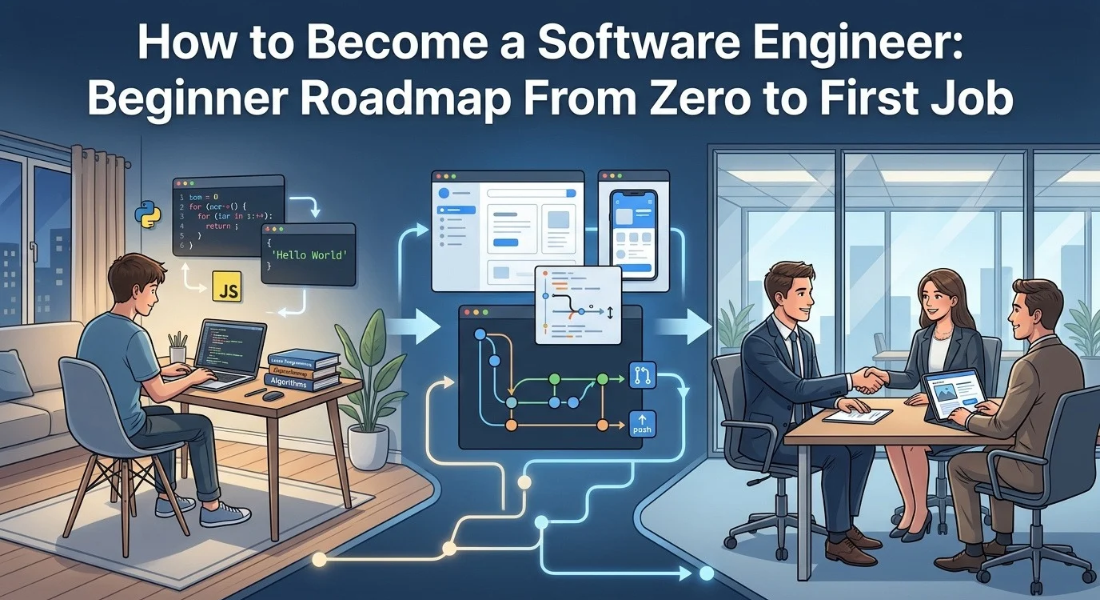
Many aspiring developers know they want a software engineering career but do not know where to begin. How to Become a Software Engineer starts with a structured path of learning programming, building practical projects, creating proof of skills, and preparing for employment.
This guide explains the steps from beginner level to your first role. Software engineering is a broad technology profession covering roles, skills, tools, and career paths.
This roadmap focuses only on how to become a software engineer and enter the field. This is part of our complete guide on Software Engineer: Complete Skills & Career Guide → see the full guide here.
Choose one realistic learning route based on your circumstances.
Learn one programming language before collecting technologies.
Build progressively harder projects instead of relying on tutorials.
Use GitHub to document and demonstrate practical work.
Prepare your CV, coding skills and interview answers before applying.
Focus on consistent practice rather than trying to become job ready overnight.

The clearest route is to choose a learning path, develop programming fundamentals, practise with real projects, build a visible portfolio, and prepare for entry level applications.
You do not need to learn every technology before applying. The goal is to build enough practical ability to solve problems explain your work and demonstrate consistent learning.
There is no single route that works for everyone. Your choice should depend on your available time, budget, learning style and whether you need a structured academic environment.
A degree can provide formal study and broader foundations while self learning offers flexibility. A bootcamp can provide an intensive focused programme for learners who prefer a defined schedule.
Route | Best suited to |
Degree | Learners wanting structured computer science education |
Self learning | People needing flexibility and lower costs |
Bootcamp | Learners wanting intensive, focused training |
The route matters less than what you can actually build and demonstrate.
A full time learner may reach an entry level skill level in roughly 6 to 12 months while part time learners may need longer. There is no guaranteed timeline. Consistent practice, project work and previous technical experience can significantly change the pace.
Avoid jumping between frameworks languages and tutorials. Start with programming logic then add core concepts that help you understand how software works.
A structured sequence makes learning easier because each stage builds on the previous one instead of creating disconnected knowledge.
Python is a practical starting point for beginners because its syntax is relatively accessible. JavaScript is another strong choice if your goal is web development.
Choose one language and learn variables, conditions, loops, functions, data structures and debugging before switching between languages.
Once programming feels comfortable, add data structures, algorithms, databases, version control and basic development concepts. You do not need advanced theory immediately. Learn each concept well enough to use it while solving practical programming problems.

Projects turn passive learning into evidence. A working application can show how you approach requirements, write code, debug problems and improve a solution.
Aim for projects that become progressively more challenging rather than creating several nearly identical tutorial applications.
Start with simple applications such as a calculator task tracker or small personal tool. Move towards CRUD applications that create, read, update and delete stored information.
Next build an API based application that retrieves or sends data. Your strongest project should combine several concepts and be polished enough to demonstrate independent work.
Upload finished projects to GitHub and give each repository a useful README explaining what the project does how to run it and what you learned.
Document meaningful decisions improvements and challenges rather than uploading unfinished tutorial code. GitHub's learning resources can also help beginners practise repository and collaboration workflows.
The transition from learning to employment requires more than completing courses. You need clear evidence that you can apply what you have learned.
Your projects GitHub repositories CV and interview preparation should tell one consistent story: you can understand a problem, build a solution and explain your technical decisions.
Choose two or three strong projects instead of filling your portfolio with unfinished work. Be ready to explain the problem, your approach, technical choices, challenges and improvements.
Your CV should align with the roles you apply for and highlight relevant projects. Practise explaining your problem solving process without relying on memorised technical phrases.
Practise coding problems regularly and prepare concise answers for behavioural questions about teamwork, mistakes, learning and problem solving.
Then apply consistently rather than waiting until you feel completely ready. Track applications and use interview feedback to identify gaps and adjust your preparation.

Progress often slows because beginners confuse activity with learning. Watching another course can feel productive but it does not necessarily improve your ability to build software independently.
A better approach is to spend substantial time writing, debugging, testing and improving code.
Trying Python, JavaScript, Java, several frameworks and cloud platforms at the same time creates shallow knowledge.
Choose one primary language and a focused project path. Once your fundamentals are solid adding another technology becomes much easier because you already understand the underlying concepts.
Tutorials can explain concepts but projects force you to make decisions without someone providing every answer.
When your code breaks you must investigate the error test possible solutions and decide what to change. That active problem solving is much closer to the work involved in becoming job ready.
Becoming a software engineer does not require one fixed route. The strongest approach is to learn fundamentals in a sensible order, practise through increasingly useful projects, make your work visible, and prepare deliberately for applications.
Build evidence of what you can do rather than measuring progress only by courses completed. Consistent practice is what turns beginner knowledge into practical ability.
Yes Self learning, projects and practical experience can provide an alternative route.
Full time learners may reach entry level readiness in 6 to 12 months while part time study often takes longer.
Python is beginner friendly while JavaScript suits web development. Start with one language and learn the fundamentals first.
Start with simple applications then move to CRUD and API based projects that demonstrate practical problem solving.
Not necessarily. Certifications can support learning but practical projects and demonstrable skills matter more.
Build a small portfolio, organise your GitHub, prepare your CV, practise coding problems and prepare behavioural interview answers.



Reader Discussion
Leave a Reply