- by Daily Talkin Staff
- July 8, 2026
-

-
-
Loading
Loading
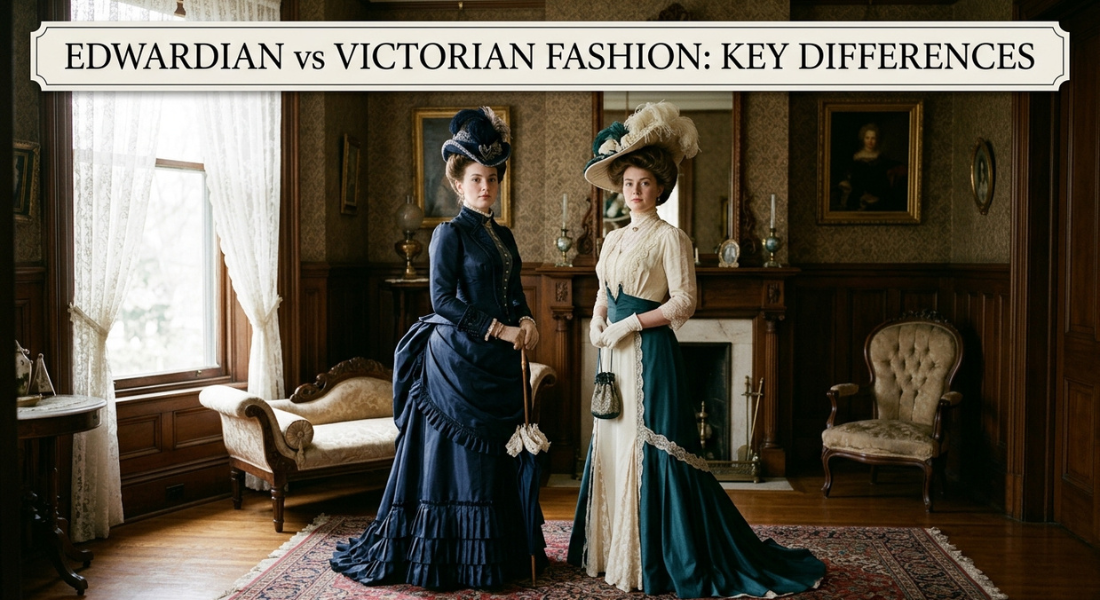
It can be surprisingly difficult to tell where Victorian fashion ends and Edwardian style begins. Edwardian vs Victorian Fashion differs mainly in silhouette, proportions and garment construction with Victorian styles changing across a much longer period.
Edwardian dress became associated with the S bend shape and a different visual balance. This comparison explains the key differences in silhouettes, waistlines, garments, decoration and the gradual transition between the two periods.
Victorian fashion covered a much longer period and included several changing silhouettes rather than one fixed shape.
Edwardian clothing became strongly associated with the S bend or S shaped silhouette.
Corsetry remained relevant in both periods although fashionable body shaping changed.
Women's clothing showed a more obvious silhouette transition than men's tailoring.
Late Victorian developments helped create the gradual transition into Edwardian style.
Social class, occupation and occasion could significantly alter what people actually wore.

The main difference is not simply that Victorian clothing was restrictive while Edwardian clothing was lighter. Victorian fashion covered several decades and changing silhouettes whereas Edwardian fashion developed a recognisable early 20th century shape with different proportions.
For broader context on Edwardian clothing, silhouettes, social influences, accessories and historical development, see our complete Edwardian Fashion guide which covers the period beyond this direct comparison → see the full guide here.
Victorian fashion refers to clothing associated with Queen Victoria's reign from 1837 to 1901. That span included major changes in skirt volume, waist emphasis, sleeves and dress construction.
A Victorian silhouette therefore cannot be reduced to one shape. Early, mid and late Victorian clothing could look markedly different.
Edwardian clothing emerged around the beginning of the 1900s and became strongly associated with the S bend or S shaped silhouette.
The fashionable line shifted the visual emphasis across the upper body and hips creating a profile distinct from many late Victorian styles.
Silhouette provides the clearest visual distinction between the periods. Victorian shapes changed repeatedly but commonly emphasised structured clothing and a defined waist. Early Edwardian fashion became particularly recognisable for its S bend profile and altered distribution of volume.
Victorian dress styles varied according to date, but fitted bodices, defined waists and carefully controlled skirt volume were recurring features.
The exact proportions changed substantially. Bustles, crinolines, sleeve volume and skirt shapes each influenced the outline at different points during the era.
The Edwardian silhouette is most recognisable through its forward projecting bust and contrasting curve through the back and hips.
This created the distinctive S bend profile. Rather than simply making the waist as small as possible, the fashionable outline depended on the relationship between several areas of the body.
The shift from Victorian to Edwardian clothing happened gradually. Late Victorian styles were already changing before Queen Victoria's death so early Edwardian clothing inherited existing ideas about tailoring, decoration and body shaping.
The result was a fashion transition rather than an overnight replacement.
Waistlines, bodices and corsets show why the difference between the two eras is more subtle than a simple “corseted Victorian versus uncorseted Edwardian” comparison. Both periods used structured clothing, but the desired visual relationship between bust, waist and hips changed.
Victorian bodices commonly fitted closely around the torso and helped establish a clearly defined waistline.
However the treatment changed throughout the era. The waist could appear high, natural or strongly compressed depending on the date while skirt and sleeve proportions altered the overall effect.
Edwardian bodices contributed to a different visual arrangement. The fashionable line did not depend solely on reducing the waist but on shaping the upper body and creating contrast between the bust, waist and hips. This made the bodice particularly important to the Edwardian silhouette.
Corsetry did not disappear with the end of the Victorian era. Women continued to use corsets during the Edwardian period although fashionable shaping developed in a different direction. The key comparison is therefore purpose and proportion not the presence or absence of corsetry.
Dresses, skirts and sleeves reinforced the different silhouettes of the two periods. Victorian garments could create substantial volume and strong structural effects while Edwardian clothing increasingly produced a longer more elongated appearance.
Victorian skirts changed considerably across the period, with fullness and volume positioned differently according to fashion. Late Victorian skirts could become comparatively simpler after the height of bustle fashion.
Edwardian skirts generally retained considerable length but developed an increasingly elongated line particularly as fashion moved towards the later 1900s.
Sleeves were an important visual component in both periods but their proportions changed considerably over time.
Victorian sleeves could be highly structured or dramatically voluminous while Edwardian examples often worked with softer upper body proportions and the characteristic relationship between bodice and skirt.
Edwardian day dress provides a useful comparison because separate blouses or shirtwaists and skirts could create a more adaptable everyday combination.
This did not make Victorian clothing uniformly formal but it highlights how practical clothing and changing lifestyles influenced the early 20th century wardrobe.

Both periods valued decorative clothing but their overall visual treatment differed. Victorian garments could combine strong structural effects with elaborate ornament while Edwardian style clothing often paired intricate decoration with the elongated proportions of the period.
Fabrics such as silk, wool, cotton and lace appeared across both periods so material alone cannot reliably identify an outfit as Victorian or Edwardian.
The more useful distinction is how materials and decoration were arranged. Lace, embroidery, ribbons and trims worked with each era's silhouette and construction to create different visual effects.
Headwear played an important role in both periods but fashionable shapes changed alongside clothing proportions.
Rather than treating hats or accessories as separate identifiers it is more accurate to consider them part of the complete outfit. Their scale, ornament and relationship with the clothing could reinforce the period's overall appearance.
Neither period had a single universal appearance. Formal wear could be far more elaborate than everyday clothing, while occupation, income and occasion affected the fabrics, construction and amount of decoration a person could wear.
This distinction matters when comparing surviving garments because an evening gown should not be treated as representative of ordinary dress.
The transition is much easier to see in women's clothing than men's clothing. Women's silhouettes underwent a conspicuous change in the relationship between the bust, waist and hips while men's tailoring evolved more gradually.
Women's clothing provides the clearest visual contrast between the eras because bodices, skirts and foundation garments worked together to create markedly different proportions.
Late Victorian and Edwardian women's fashion could share long skirts, fitted construction and decorative detail yet the resulting outlines could look distinctly different.
Men's fashion changed less dramatically in silhouette. Tailored coats, waistcoats, trousers and shirts remained important across the transition.
The differences were more visible in cut fit and proportions than in a completely new body shape. Edwardian men's clothing therefore represents continuity as much as change.
Social class, occupation and occasion affected clothing in both periods. Wealthier wardrobes could support more specialised formal and leisure garments while working clothing had to meet practical requirements.
As a result comparing one elite outfit with one working garment can exaggerate differences that were actually related to social setting.

The late Victorian period provided the immediate foundation for Edwardian fashion. Change was already underway before 1901, with dress reform, practical clothing and altered proportions influencing fashionable dress.
Late Victorian fashion was not simply the opposite of Edwardian style. By the 1890s, skirts had become less dependent on large structural supports, while sleeve volume and waist emphasis continued to shape the fashionable outline.
These developments created an important bridge into early 20th century clothing.
Edwardian period fashion developed a stronger association with the S bend profile and a new arrangement of volume across the body.
The change can be seen as an adjustment in proportions and priorities rather than a complete rejection of Victorian construction or decoration.
Corsetry, long skirts, formal dressing and decorative workmanship continued across the transition although their visual effects changed.
What shifted most clearly was the silhouette the relationship between body and garment, and the growing influence of practical approaches to dress.
The clearest way to understand Edwardian and Victorian fashion is through changing proportions rather than a simple old versus new division.
Victorian clothing developed through several silhouettes while Edwardian dress became associated with the S bend and a different balance of bust, waist and hips.
Garment construction, decoration and social setting also changed gradually linking the two periods rather than separating them completely.
Victorian fashion had varied silhouettes while Edwardian fashion became known for the distinctive S bend shape and different body proportions.
Not necessarily Edwardian clothing could be more practical but corsetry and structured garments remained important.
Yes but the transition was gradual with late Victorian styles influencing early Edwardian clothing.
The best known Edwardian silhouette was the S bend or S shaped silhouette.
They shared long skirts and decorative details but differed in proportions, shaping and overall silhouette.
No Men's fashion changed more gradually, mainly through tailoring, fit and proportions.


Reader Discussion
Leave a Reply