- by Daily Talkin Staff
- July 8, 2026
-

-
-
Loading
Loading
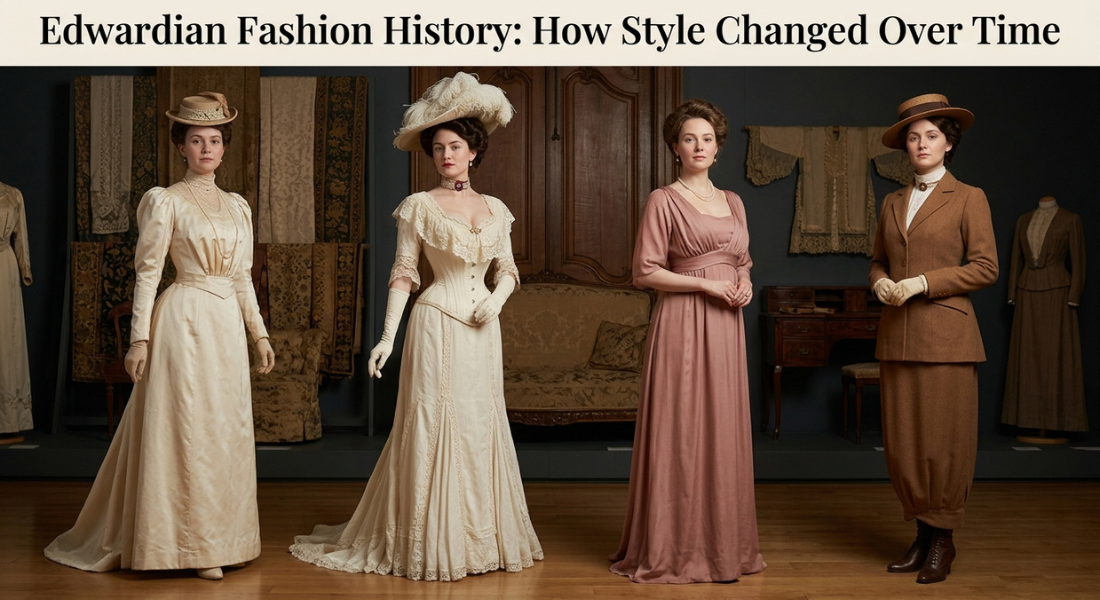
Edwardian Fashion History was not the story of one fixed look. It traces how late Victorian dress developed into early Edwardian forms and changed through the middle of the decade.
By the years before the First World War, fashion had moved towards more elongated and practical proportions. This article follows that development chronologically and explains the forces behind it.
Edwardian fashion developed from late Victorian foundations rather than beginning suddenly in 1901.
The early 1900s were associated with a pronounced pigeon breasted or S bend direction.
Dress reform and commercial availability helped alternative approaches spread.
Around 1905 to 1908 competing design ideas increasingly encouraged experimentation.
By 1909 to 1914, elongated, straighter and less restrictive directions became more visible.
The First World War provides a useful broader endpoint for the pre war fashion transition.

Edwardian fashion developed from late 19th century dress rather than appearing suddenly when Edward VII became king in 1901. The 1890s provided its immediate foundations, while the fashion period commonly called Edwardian extended beyond the exact dates of the king's reign.
By the late 1890s women's dress was already changing. Alternative approaches questioned highly restrictive clothing while evolving corsetry and skirt structures altered the relationship between the body and fashionable dress.
The Victoria and Albert Museum links this wider development to dress reform including growing criticism of restrictive Victorian silhouettes. Its historical material also records how less restrictive styles and commercial availability helped prepare the way for early 20th century changes.
Edwardian Fashion covers the wider clothing, silhouettes, garments and styles of the period. This article focuses specifically on their historical development and changing direction. This is part of our complete Edwardian Fashion guide → see the full guide here.
1901 is a useful historical marker because it began Edward VII's reign but fashion did not reset on that date. Garments from around 1900 and 1901 could combine late Victorian conventions with emerging Edwardian developments.
This overlap matters because clothing usually changes through gradual adoption. Designers, dressmakers, retailers and customers continued working with established methods while new proportions and ideals gained acceptance.
The first Edwardian stage developed from those late 1890s foundations into a more recognisable early century fashion direction.
The pronounced S bend or pouter pigeon form became an important stage in this process but it was part of a changing sequence rather than the definition of the whole era.
The early silhouette reflected contemporary ideas about fashionable body shape and presentation. Corsetry and dressmaking techniques helped create a deliberately shaped appearance that differed from the preceding decade while retaining strong nineteenth century foundations.
A Metropolitan Museum of Art dress dated 1902 to 4 provides direct evidence of this period. The museum describes its pigeon breasted silhouette as a fashionable early 20th century ideal showing that the pronounced form was established rather than merely a later historical interpretation.
The years around 1900 to 1905 were not stylistically frozen. Proportions, construction and fashionable presentation continued to develop as designers experimented within the established system.
Surviving garments make this gradual process visible. A dated object from 1902 to 4 can document the early pigeon breasted direction while later examples show that alternative proportions were already emerging before the most obvious pre war changes.
Around the middle of the decade Edwardian fashion entered a more experimental phase. Earlier conventions remained influential but competing ideas increasingly encouraged variation in proportion, construction and movement.
This was not a single replacement of one style by another. Instead several developments overlapped allowing new approaches to gain visibility while established forms continued to appear in fashionable dress.
Dress reform contributed to a longer movement towards less restrictive clothing. The Victoria and Albert Museum traces the Dress Reform Movement from around 1850 until the First World War and explains how concerns about restrictive silhouettes encouraged alternative approaches.
By the late 19th and early 20th centuries these ideas had begun influencing mainstream fashion. The change was gradual but it helped establish movement and practicality as increasingly relevant considerations in fashionable dress.
Changing ideas could spread more widely when retailers made new styles commercially available. This reduced the distance between experimental dress, reform minded clothing and the fashions available to ordinary customers.
The V&A identifies London's Liberty as an important example. Its dress department opened in 1884 stocked less formal styles helping looser approaches reach a wider market. Commercial availability therefore helped historical change move beyond isolated designers or reformers.
The later direction resulted from several forces working together design experimentation, changing ideas about the body, practical requirements and international influences.
The important point is the interaction between these forces rather than one designer or event causing the transformation.
Paul Poiret became an important agent in this transition. His work did not appear in isolation but it offered a particularly clear alternative to rigidly controlled silhouettes.
The Metropolitan Museum of Art describes Poiret's 1908 to 11 designs as pivotal in the movement towards less restrictive dress.
His early designs used upright, columnar and high waisted ideas helping establish a direction that became increasingly influential before the First World War.
Fashion development also drew on artistic and historical references. Arts and Crafts encouraged natural motifs and supported dress reform while Art Nouveau contributed another visual language.
Historical revivals including Directoire inspired forms offered designers alternative proportions. The V&A notes that Arts and Crafts intersected with dress reform and helped encourage less restrictive approaches.
These influences demonstrate that fashion change was connected to wider artistic and cultural movements rather than occurring entirely within dressmaking.

Social change affected fashion when it altered what people needed from clothing. Women's activities, leisure, mobility and commercial culture all created pressure for dress that could accommodate different circumstances.
These forces did not produce one simple result. Instead they contributed to a gradual weakening of some earlier conventions and encouraged designers and consumers to consider movement, practicality and alternative silhouettes alongside established fashionable ideals.
Women's expanding participation in education, employment, leisure and public activities increased the importance of clothing that could accommodate movement and varied routines. It would be misleading to describe fashion as simply “liberating” women.
Clothing changes reflected a combination of changing social expectations, practical requirements and existing reform movements. Fashion responded to these developments while also continuing to express contemporary ideas about femininity and appearance.
Cycling, motoring, travel and other active pursuits created practical pressures that established formal highly controlled dress could not always meet comfortably. These activities did not replace fashionable dress but they encouraged adaptations in construction and proportion.
As mobility became more visible in modern life the idea that fashionable clothing should permit greater movement became increasingly compatible with mainstream design.
The later period was marked by increasing experimentation and a gradual movement away from the strongest early decade conventions. Elongated and straighter directions became more visible as designers explored alternatives to the earlier silhouette.
The change was uneven. Older forms continued to coexist with newer ones making the later Edwardian period best understood as a transitional stage rather than a completely uniform style.
No single event removed the early silhouette from fashion. Its dominance weakened as several pressures accumulated: dress reform, changing body ideals, practical requirements, artistic influences and experimentation by designers.
This is why the historical shift appears gradual in surviving evidence. Fashion could retain familiar conventions while introducing new proportions allowing consumers to adopt change without an immediate break from established dress practices.
Dated museum objects provide particularly useful evidence. The Metropolitan Museum records a Callot Soeurs evening dress from 1909 to 10 with a raised waist and columnar body identifying it with the Directoire Revival around 1910.
The same period includes Poiret's early work. The Met dates one important evening dress to 1910 and describes his 1908 to 11 designs as pivotal in the movement towards less restrictive silhouettes. Together these objects show that alternative proportions were firmly visible by the end of the decade.
The years immediately before the First World War were transitional rather than a completely separate fashion system. Established Edwardian conventions continued but increasingly modern approaches to proportion, movement and construction pointed towards the fashion direction of the 1910s.
This makes the period useful for understanding continuity. The new decade did not begin with an instant visual reset; developments already underway became more pronounced as the pre war years progressed.
Between about 1910 and 1914, straighter and more elongated approaches became increasingly prominent. Poiret's 1908 to 11 work is significant because the Met identifies it as part of the transition towards less restrictive dress.
The Victoria and Albert Museum also notes that by the outbreak of war in 1914 fashionable women's silhouettes had become considerably more practical. These developments show a direction of change rather than a single moment when Edwardian fashion suddenly ended.
Edward VII died in 1910 but his death does not provide a complete fashion endpoint. Clothing continued developing after the end of his reign making the broader pre war period important when tracing the evolution of early 20th century dress.
1914 provides a useful historical boundary because the First World War altered social and material conditions surrounding clothing. Fashion did not change overnight, but the wartime context marked a major shift in the environment in which dress developed.

The historical sequence runs from late Victorian foundations to early Edwardian formation, through mid decade experimentation and increasingly practical elongated directions before reaching the transitional fashion environment of the years immediately before the First World War.
The significance lies in the sequence itself. Edwardian fashion developed through overlapping changes rather than following a single predetermined path.
Edwardian fashion retained important nineteenth century conventions while developing features associated with modern twentieth century dress.
Its historical importance therefore lies in the overlap. Established corsetry, construction methods and ideals could coexist with dress reform, new design ideas, commercial expansion and more practical approaches.
Rather than searching for one definitive Edwardian look it is more useful to see the period as a bridge between established Victorian conventions and the changing fashion system of the 1910s.
Edwardian fashion history is best understood as a process of gradual transformation. Late Victorian foundations shaped the early Edwardian period while dress reform, commercial fashion, social change and design experimentation encouraged new directions.
By the years before the First World War more elongated and practical approaches were increasingly visible. Political dates provide useful markers but fashion continued changing across those boundaries.
Edwardian fashion is commonly dated from 1901 when Edward VII became king though the transition began during the late Victorian period.
Edward VII died in 1910 but Edwardian fashion is often extended to around 1914 before the First World War changed dress.
It moved from late Victorian influences and dramatic silhouettes towards more elongated practical styles by the 1910s.
Changing lifestyles, dress reform, mobility and new design ideas encouraged more practical clothing.
Late Victorian dress, dress reform, Arts and Crafts, Art Nouveau, commercial fashion and changing social roles influenced the period.
No Silhouettes construction and fashionable ideals changed significantly from the early 1900s to the 1910s.


Reader Discussion
Leave a Reply