- by Daily Talkin Staff
- July 8, 2026
-

-
-
Loading
Loading
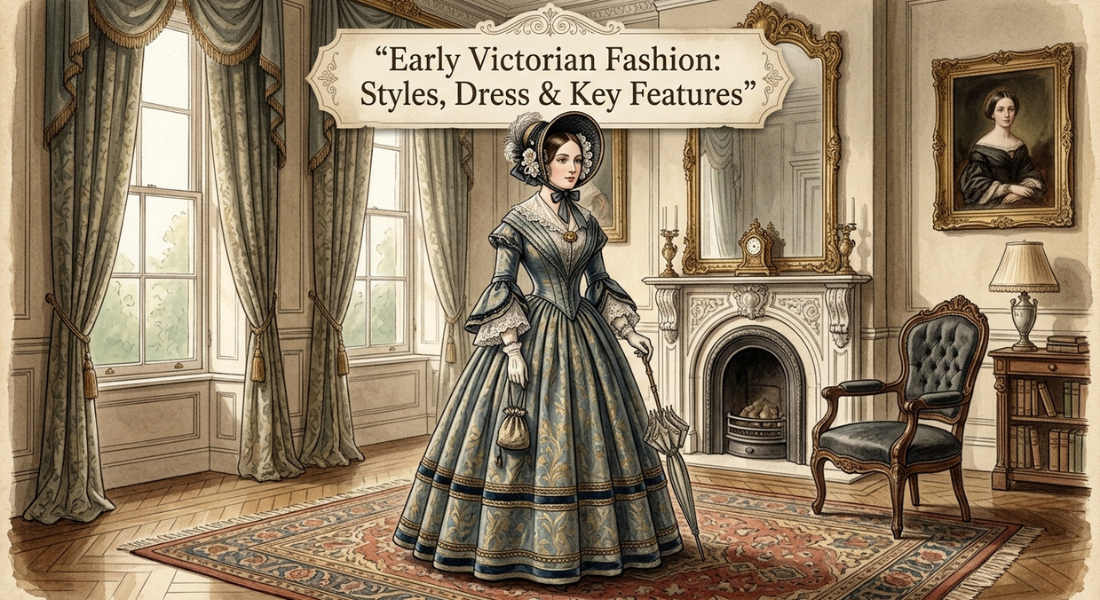
What makes a dress unmistakably Early Victorian rather than simply “Victorian”? Early Victorian Fashion refers to clothing from the opening decades of Queen Victoria’s reign especially the late 1830s through the 1850s.
Its defining clues include a fitted upper body, marked waist, evolving sleeves and necklines, and increasingly broad skirts.
Early Victorian Fashion sits within the wider history of Victorian Fashion but its early decades have distinctive proportions and styling. For the complete period wide history see our Victorian Fashion: History, Clothing & Styles guide.
Early Victorian dress covers the late 1830s through the 1850s for this article's practical scope.
Its strongest visual clue is the relationship between a fitted bodice, defined waist and increasingly broad skirt.
Necklines and sleeves changed considerably according to date and occasion.
Daywear was generally more covered while evening dress allowed greater neckline exposure and decoration.
The cage crinoline emerged particularly in 1856 so it should not be projected across the whole early period.
Social position, resources and occupation affected how closely people could follow fashionable dress.

Early Victorian Fashion describes the clothing associated with the late 1830s through the 1850s, marked by a fitted upper body, defined waist and increasingly full skirt. It was a transitional phase rather than one unchanging costume.
The period begins around Queen Victoria’s accession in 1837. For practical identification this article uses the late 1830s through the 1850s as its working scopeb although historians can draw boundaries differently.
The clearest visual feature is the relationship between the upper and lower body. The bodice fitted closely, the waist was clearly marked, and the skirt expanded outward rather than falling straight from the torso.
That shape changed considerably within the period. The 1830s retained some transitional qualities, the 1840s became more controlled, and the 1850s pushed skirt volume further outward. The result was an evolving silhouette rather than a single standard look.
This also helps distinguish early dress from the later bustle silhouette. Bustle fashion shifted fullness towards the back and first appeared in recognisable Victorian form in the late 1860s so it should not be projected backwards onto the early period.
The visual progression is easiest to recognise through proportion. The 1830s retained wider more transitional shapes the 1840s brought a more restrained and elongated appearance; and the 1850s saw skirts expand substantially.
Rather than treating each decade as a separate fashion system look at the direction of change: sleeves became more controlled, the waist remained strongly defined, and skirt volume steadily increased.
The Early Victorian silhouette combined a close fitting bodice and defined waist with a skirt that widened progressively towards the hem. The shoulders and sleeves were visually controlled creating a clear contrast with the expanding lower half.
The upper body was deliberately shaped rather than loose. A fitted bodice established the waistline while the skirt created width around the lower body.
This relationship matters more than any isolated garment. A surviving bodice viewed without its original skirt or supporting layers can give a misleading impression of how the complete outfit looked.
During the 1840s dresses could appear elongated and restrained with shaped sleeves and a controlled waist. The Metropolitan Museum describes mid 1840s examples with elongated waists, V shaped bust treatments and closely shaped sleeves.
By the 1850s, the lower half became increasingly expansive. This movement towards greater skirt volume created the visual bridge between earlier full skirts and the later mid century silhouette.
Early Victorian necklines varied according to occasion. Daywear generally favoured more covered treatments while evening and formal clothing could expose more of the upper chest and shoulders.
The V&A records low, almost off the shoulder necklines for evening and formal wear around 1837 to 1849, contrasted with higher necklines, collars and small shawls for daytime.
Sleeves also provide a useful dating clue. The exaggerated sleeve shapes associated with earlier Romantic fashion gave way to more controlled forms during the 1840s including closely shaped sleeves that followed the arm more closely.
An early dress worked as a coordinated system rather than a single outer garment. The fitted bodice established the upper body shape while the skirt and underlying layers created the desired width and fall.
The precise arrangement varied according to date, occasion and the wearer's means. Fashionable examples could involve carefully coordinated layers while less affluent clothing could achieve similar visual principles with simpler materials and construction.
This is why historical dress should be assessed as an ensemble. The outer fabric alone cannot always explain the silhouette visible in a portrait or surviving garment.
Museum examples from the period show how construction could be built into the bodice itself. The Metropolitan Museum for example notes boning stitched into the lining of an early 1840s dress demonstrating how structural control extended beyond separate undergarments.
The result was a deliberate balance: controlled through the torso, structured around the waist and increasingly expansive below it.
The most useful relationship is between the bodice, waistline, skirt and supporting layers. Together these elements reveal the intended silhouette far better than any individual decorative feature.
A bodice might survive without its original skirt, or a skirt might be photographed without the layers that originally supported it. Judging such pieces in isolation can therefore produce an inaccurate date.
For identification first consider the overall proportions. Then examine the waist placement, sleeve shape, neckline and amount of skirt volume. This approach treats Victorian dress parts as components of one visual system rather than as a glossary of unrelated garments.

Early Victorian women's clothing followed the same broad silhouette but changed noticeably according to occasion. Daywear tended towards greater coverage while evening and formal dress allowed more elaborate treatment.
Day clothing generally placed greater emphasis on practical coverage, controlled necklines and sleeves suitable for public presentation. Fabric and decoration could still be refined without producing the exposure associated with evening dress.
Evening clothing offered greater freedom in neckline and decoration. The Metropolitan Museum's collection includes British evening and morning dresses from the 1840s showing how occasion was reflected in distinct garments.
Social occasions could also increase the visual refinement of an outfit. Better materials, intricate surface treatment and carefully shaped details helped distinguish formal presentation from ordinary daytime clothing.
Day dress generally presented a more covered and restrained appearance particularly around the neckline. Evening dress could reveal more of the shoulders and upper chest and use richer decorative treatment.
The difference was not simply a matter of showing more skin. Occasion influenced the entire presentation, including fabric choice, surface decoration, sleeve treatment and the degree of visual refinement.
A useful historical clue is therefore context. A low neckline on its own does not define the whole period; its meaning changes depending on whether the garment was intended for evening or daytime wear.
Early Victorian men's dress favoured a neat, structured and coordinated appearance. Coats, waistcoats, trousers and neckwear were combined to create a controlled silhouette rather than a deliberately exaggerated one.
The emphasis was on proportion and coordination. A waistcoat helped organise the centre of the outfit while the coat and trousers established a clean overall line.
Shirts and neckwear completed the presentation with white cotton or linen remaining important components of respectable male dress. The National Archives notes that white cotton or linen shirts were a staple of gentlemen's wardrobes during the nineteenth century.
Hats could complete the appearance but they should be understood as part of the coordinated outfit rather than treated as a separate fashion story.
Fashion illustrations tend to preserve the clothing of people who could afford fashionable dress so they do not represent every social group equally.
Middle class clothing could follow fashionable proportions while adapting materials, decoration and construction to household budgets. Access to dressmakers and suitable fabrics also affected how closely an outfit followed current styles.
Working class clothing was more strongly shaped by occupation, durability and available resources. Practical requirements could take precedence over the elaborate presentation seen in fashionable portraits.
The National Archives describes clothing as a marker of social respectability and shows how fashion operated within strong class expectations.
Early Victorian dress can often be recognised through the combination of fabric weight, surface texture, colour and restrained decoration. These clues work alongside silhouette rather than replacing it.
Silk could create a polished appearance for fashionable dress while wool and cotton suited different garments and circumstances. The Metropolitan Museum's surviving examples include silk, cotton, wool and mixed fabric dresses from the period.
Surface treatment also mattered. Pleating, piping, tucks, fringe, tassels and controlled fabric manipulation could add visual interest without changing the fundamental silhouette.
Availability mattered too. A fashionable appearance did not require every wearer to use the same materials. Social position, location and access to dressmaking affected what could realistically be produced and maintained.
Start with the silhouette then examine the sleeve shape, neckline, waist placement and skirt volume. Finally consider the degree and type of decoration.
No single clue should determine the date. A neckline can vary according to occasion, while decorative techniques may persist across neighbouring periods.
The strongest identification comes from several features agreeing with one another. A defined waist combined with a fitted bodice, controlled sleeves and a broadly expanding skirt is more useful than one isolated trim or fabric.
This layered approach is especially valuable when examining paintings, fashion plates or incomplete surviving garments.

The transition becomes particularly visible during the 1850s, when skirt volume increased and new structural solutions appeared. This was not an abrupt replacement of one costume but a gradual change in proportions.
Earlier skirts already had considerable width but increasing volume eventually placed greater demands on the supporting layers beneath them.
The later 1850s therefore mark an important boundary within this article's scope. They show Early Victorian dress moving towards a more pronounced mid century shape.
The V&A identifies 1856 as the point when the cage crinoline emerged as a practical alternative to increasingly burdensome layers of petticoats. That development signals the direction of change without requiring the later Victorian silhouette to become part of this guide.
No The cage crinoline belongs particularly to the later 1850s so it should not be treated as the defining structure of every early Victorian outfit.
The V&A states that the cage crinoline emerged in 1856 as skirts continued to grow wider replacing some of the heavier layers previously used for support.
This distinction matters when dating clothing. An early 1840s dress should not automatically be reconstructed with the cage structure associated with the later 1850s.
Crinolines therefore represent an important late stage development within this article's period, not a universal feature of Early Victorian dress.
Early Victorian Fashion is best understood as a changing transitional phase rather than one fixed costume. The strongest recognition points are the fitted upper body, defined waist, evolving sleeves and necklines, and increasingly broad skirt.
Occasion and social position also altered the final appearance. Looking at these features together gives a much more reliable picture of early Victorian dress.
Early Victorian Fashion generally covers the late 1830s through the 1850s beginning around Queen Victoria’s accession in 1837.
They featured fitted bodices, defined waists and increasingly full skirts, with changing sleeves and necklines.
Daywear was generally more covered while evening dresses could feature lower, more open necklines and richer decoration.
Yes especially in the later 1850s. The cage crinoline emerged in 1856 and did not define the entire period.
Men wore coordinated coats, waistcoats, trousers, shirts and neckwear often completed with a hat.
Early styles featured developing full skirts and defined waists while later fashions introduced different proportions including bustle silhouettes.




Reader Discussion
Leave a Reply