- by Daily Talkin Staff
- July 8, 2026
-

-
-
Loading
Loading
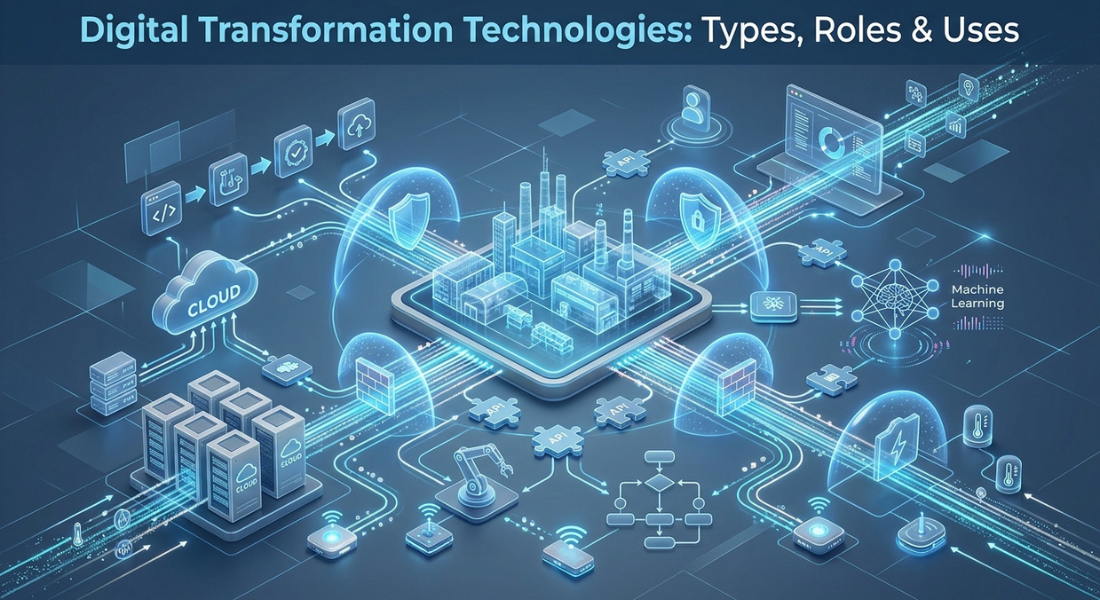
Digital Transformation Technologies can connect systems, automate routine work and turn scattered data into useful digital capabilities. But with so many technologies available, understanding what each one does and where it fits can be difficult.
Cloud computing, AI, data analytics, IoT, APIs, automation, cybersecurity, DevOps and digital twins serve different technical roles. This guide explains how these technologies work, where they are used and how they connect.
Cloud computing provides scalable computing, storage, networking and application capabilities.
Data analytics, AI, machine learning and generative AI turn digital information into analysis, predictions or generated content.
IoT connects physical devices while digital twins provide computational representations of real world systems.
Workflow automation and RPA execute defined tasks while AI can add data driven interpretation and pattern recognition.
DevOps and DevSecOps support software delivery while cybersecurity protects identities, applications, infrastructure, data and connected devices.
Blockchain, AR/VR and 3D printing provide more specialised capabilities for particular technical requirements.

Digital transformation technologies are the technical capabilities that support connected systems, digital services and data driven applications.
They include infrastructure, data technologies, artificial intelligence, connectivity, automation, software delivery, cybersecurity, platforms and emerging technologies.
The focus is on what each technology does technically rather than on the wider organisational change surrounding it. Cloud computing may provide infrastructure APIs may connect applications while AI may analyse information or generate content.
A technology is relevant because of the capability it provides, not simply because it is new or widely discussed. Cloud computing provides scalable resources, analytics processes information, IoT connects physical devices, and automation executes defined tasks.
This distinction matters because a technology's function is different from the organisational change that may surround its use. The technology supplies a technical capability; how an organisation applies that capability is a separate question.
A useful taxonomy separates these technologies into foundational infrastructure; data and intelligence, connected systems, automation and software delivery, security, platforms, and emerging technologies.
This structure also explains why technologies that appear unrelated can operate together. Cloud infrastructure can host applications, APIs can connect them, analytics can process their data, and cybersecurity can protect the technology stack.
Foundational technologies provide the technical environment in which other digital capabilities operate. Cloud computing supplies computing resources, while APIs, platforms and integration technologies allow applications, services and data to communicate.
Cloud computing provides on emand network access to a shared pool of configurable computing resources, including servers, storage, networks, applications and services. NIST identifies five essential characteristics, alongside three service models and four deployment models.
For digital technology environments, its role is primarily infrastructural. Cloud resources can support application hosting, data workloads, scalable computing and access to specialised services without requiring every capability to run on local hardware.
Application programming interfaces (APIs) provide defined ways for software systems and applications to communicate. They can allow an application to request data or functionality from another system without exposing its internal implementation.
Digital platforms operate at a broader level by bringing applications, services, users and data into a shared technical environment.
In this sense, digital transformation platforms and digital transformation software can provide integration and application capabilities while digitalization technologies may refer more broadly to technologies that convert or support digital processes and information.
Data technologies turn digital information into usable insight while AI technologies apply computational methods to identify patterns, make predictions, generate content or support decisions.
The distinction is important: storing information creates a digital resource but analytics and AI provide methods for interpreting or acting on that information.
Data analytics involves processing and interpreting data to identify patterns, trends, relationships and useful information. It can support dashboards, reporting, forecasting, anomaly detection and predictive analysis.
Big data environments extend this capability to datasets that may be large, fast moving or diverse. Analytics therefore differs from simple digital storage: a database can retain information while analytics applies computational methods to extract meaning from it.
Artificial intelligence refers to artificial systems capable of performing tasks involving capabilities such as perception, reasoning, learning, planning or decision making. NIST also describes AI systems as machine based systems that can make predictions, recommendations or decisions for defined objectives.
Machine learning is a major AI approach in which systems learn patterns from data rather than relying solely on explicitly programmed rules. Common applications include classification, prediction, recommendation, natural language processing and intelligent decision support.
Generative AI differs from conventional analytics because it can generate new synthetic content from learned patterns. NIST describes generative AI as a class of AI models capable of generating content such as text, images, audio and video.
Practical technology level applications include summarising documents, generating content, assisting with code and providing conversational interfaces. Predictive analytics and machine learning, by contrast, commonly focus on identifying patterns or estimating likely outcomes from existing data.
IoT connects physical devices to digital systems while digital twins provide computational representations of real world entities. Together they create a technical relationship between observations from physical environments and models used for monitoring, simulation or analysis.
The Internet of Things (IoT) consists of connected devices containing hardware, software, firmware and actuators that can interact and exchange data. NIST's definitions include devices such as sensors, controllers and connected equipment.
Smart sensors can capture measurements such as temperature, pressure, location, vibration or equipment status. Connected devices can then exchange this information with applications or data platforms for monitoring and analysis.
A digital twin is a computer model or digital representation of a physical system. NIST describes digital twins as models that can support forecasting, simulation, monitoring, optimisation and decision support.
The concept is broader than a static digital drawing. A useful digital twin can represent states, behaviours or transitions of a real world entity and use computational models to analyse possible conditions or future outcomes.
IoT can provide observations from physical systems while a digital twin can represent those systems computationally. The two therefore address different technical functions within the same connected environment.
For example sensors may provide equipment measurements while a digital twin represents the equipment's condition and behaviour. The resulting relationship can support monitoring, anomaly analysis, simulation or optimisation without treating IoT and digital twins as the same technology.

Automation technologies reduce the amount of manual computer interaction required to execute defined activities. Workflow automation, intelligent automation and RPA address different levels of task execution and decision support.
Workflow automation uses software to trigger predefined actions such as notifications, approvals, record updates or system tasks. Rules determine what happens when specified conditions are met.
Intelligent automation adds technologies such as AI, machine learning or natural language processing to automation environments. This can allow software to interpret information or make data based determinations before a defined automated action occurs.
Robotic Process Automation uses software robots to perform repetitive computer based tasks. IBM describes RPA as using automation technologies to handle activities such as extracting data, completing forms and moving files between applications.
RPA can interact with enterprise applications through APIs or user interfaces. It is particularly suited to structured repetitive actions where the required task sequence can be clearly defined.
RPA is primarily process driven: a software robot follows defined instructions to perform a task. AI is data driven and can analyse information, recognise patterns or produce predictions and recommendations.
The technologies can complement each other. AI can interpret information that would be difficult for a fixed rules engine to handle while RPA can execute the resulting defined action. IBM similarly distinguishes RPA's rule based execution from AI's data driven capabilities.
DevOps supports the technical delivery of software by connecting development and IT operations practices through automation, collaboration and feedback. It is therefore an enabling software delivery capability rather than a standalone business transformation framework.
DevOps brings software development and operations activities closer together through automated processes and continuous feedback.
NIST defines DevOps around automating processes between development and IT operations teams so software can be built, tested and released faster and more reliably.
Technically, this can involve automated builds, testing, deployment and monitoring. These capabilities help development teams move software changes through delivery environments with less manual intervention.
DevSecOps extends the development and operations model by integrating security activities throughout software delivery.
Rather than treating security as a separate activity after development, security controls and checks can become part of development, testing and deployment environments. NIST identifies DevSecOps as a distinct terminology area covering development, security and operations.
Cybersecurity provides protection across the connected technology environment. Cloud services, APIs, applications, IoT devices, data platforms and software delivery systems all introduce technical assets and access points that require appropriate security controls.
Cloud environments require controls for infrastructure, applications, identities and data. APIs also need protection because they expose interfaces through which systems exchange information and invoke functionality.
Connected devices create another security relationship. IoT hardware, firmware, communications and applications can all become part of a connected technology environment, so security needs to extend beyond a single application or network boundary.
Identity and access management controls who or what can access a resource and what actions that identity is permitted to perform. These capabilities become particularly relevant when applications, users and devices operate across distributed environments.
Zero trust removes implicit trust based solely on network location and emphasises authentication and authorisation for users and devices. NIST's Zero Trust Architecture focuses protection on resources rather than relying primarily on network perimeters.
Some technologies have specialised applications alongside foundational capabilities such as cloud, analytics and cybersecurity. Blockchain, AR/VR and 3D printing can contribute to particular technical requirements without applying universally across every digital environment.
Blockchain is a distributed digital ledger in which transaction records are grouped into blocks and cryptographically linked. NIST describes blockchain as providing a shared, tamper evident and tamper resistant ledger maintained across a community of participants.
Technology level applications can include shared transaction records, provenance tracking and multi party data exchange where participants need a common record without relying on a single repository.
Augmented reality (AR) adds digital information or objects to a user's view of the physical environment while virtual reality (VR) creates an immersive digital environment.
These technologies can support technical applications such as training simulations, visualisation, remote assistance, design review and interactive experiences. Their role depends heavily on the type of digital environment and interaction being created.
3D printing, or additive manufacturing converts digital designs into physical objects by depositing or solidifying material layer by layer.
It connects digital design systems with physical production and can support rapid prototyping, customised components and digital manufacturing workflows. Unlike cloud or analytics its primary capability is the digital to physical production link.
Blockchain, AR/VR and 3D printing generally address more specific technical requirements than foundational technologies such as cloud computing, data analytics or cybersecurity.
That does not make them less useful. It means their relevance depends more heavily on the technical problem being addressed, the systems involved and the type of digital capability required.
Digital technologies rarely operate as isolated components. Cloud infrastructure can host platforms and applications, APIs can connect systems, data technologies can process information, and AI or automation can use the resulting capabilities.
Cloud infrastructure provides computing, storage, networking and application services. Digital platforms can organise these resources into shared environments for applications, users and services.
APIs then provide defined communication paths between applications. This creates a technical relationship in which infrastructure supports applications, platforms organise services and integration technologies allow systems to exchange information.
IoT devices can generate observations from physical systems while connected applications can transmit that information to data platforms. Analytics can then process the resulting datasets to identify patterns or trends.
AI and machine learning can extend that capability by identifying patterns, generating predictions or producing recommendations. The technologies therefore form connected technical layers rather than separate lists of unrelated tools.
AI and machine learning can provide predictions, classifications or other outputs that inform an automated system. Workflow automation or RPA can then execute predefined actions based on those outputs.
The distinction remains important. Intelligence can help interpret or identify something while automation executes a defined response. Combining them can connect data driven analysis with software based task execution.
Cybersecurity operates across infrastructure, identity, applications, APIs, data, IoT and software delivery. It is therefore a cross layer capability rather than a feature confined to one technology category.
NIST's Cybersecurity Framework 2.0 provides a broad taxonomy for managing cybersecurity outcomes, with its core organised around Govern, Identify, Protect, Detect, Respond and Recover.

The technologies differ mainly by the technical capability they provide. Some supply infrastructure, some process information, others connect physical systems, automate tasks, deliver software or protect digital resources.
Cloud computing and digital platforms provide scalable technical foundations for applications, services and data. Cloud computing supplies configurable computing resources, while platforms can organise applications, services and data within a shared environment.
Their primary role is therefore foundational. They create the technical environment in which other digital capabilities can run rather than directly providing every analytical, automation or security function.
Data analytics focuses on understanding information, while AI and machine learning provide capabilities such as prediction, classification and pattern recognition. IoT focuses on connecting physical devices and collecting observations.
Digital twins represent real world entities computationally and can support modelling, monitoring and forecasting. These technologies overlap technically but their core functions remain distinct.
APIs connect applications and systems, while workflow automation and RPA execute defined software actions. DevOps focuses on the technical practices used to build, test and release software.
Together, these technologies address different parts of the digital technology environment: communication, task execution, integration and software delivery. Digital technology transformation can therefore involve several categories without making them interchangeable.
Cybersecurity provides protective capabilities across the technology stack, including identity, access and resource protection. Blockchain, AR/VR and 3D printing address more specialised technical requirements.
Digitalization technologies can therefore range from foundational infrastructure to specialised digital to physical capabilities. Rapid digital transformation may involve several of these technologies but the technologies themselves retain distinct technical functions.
Digital transformation is the broader organisational use of digital capabilities to change operations, experiences and value creation. This article focuses only on the technologies enabling those changes. See our complete Digital Transformation guide →.
Digital transformation technologies work as a connected ecosystem rather than as isolated tools. Cloud and platforms provide the foundation, while data, AI and IoT support intelligence and connectivity.
Automation, DevOps and cybersecurity help organisations operate, deliver and protect digital systems. Digital twins, blockchain, AR/VR and 3D printing provide specialised capabilities for specific technical needs.
Understanding how these technologies differ and work together makes it easier to identify their roles within a broader digital technology environment.
Cloud, AI/ML, data analytics, IoT, automation, RPA, APIs, digital platforms, cybersecurity, DevOps and digital twins are key technologies.
Yes Cloud computing provides scalable computing, storage, networking and application services for digital technologies.
They support prediction, classification, pattern recognition, recommendations and other data driven applications.
RPA follows defined rules and tasks, while AI analyses data, recognises patterns and produces intelligent outputs.
IoT connects physical devices and collects data while digital twins model real world entities for monitoring and analysis.
DevOps supports software delivery through automation, testing, deployment and continuous feedback.


Reader Discussion
Leave a Reply