- by Daily Talkin Staff
- July 8, 2026
-

-
-
Loading
Loading
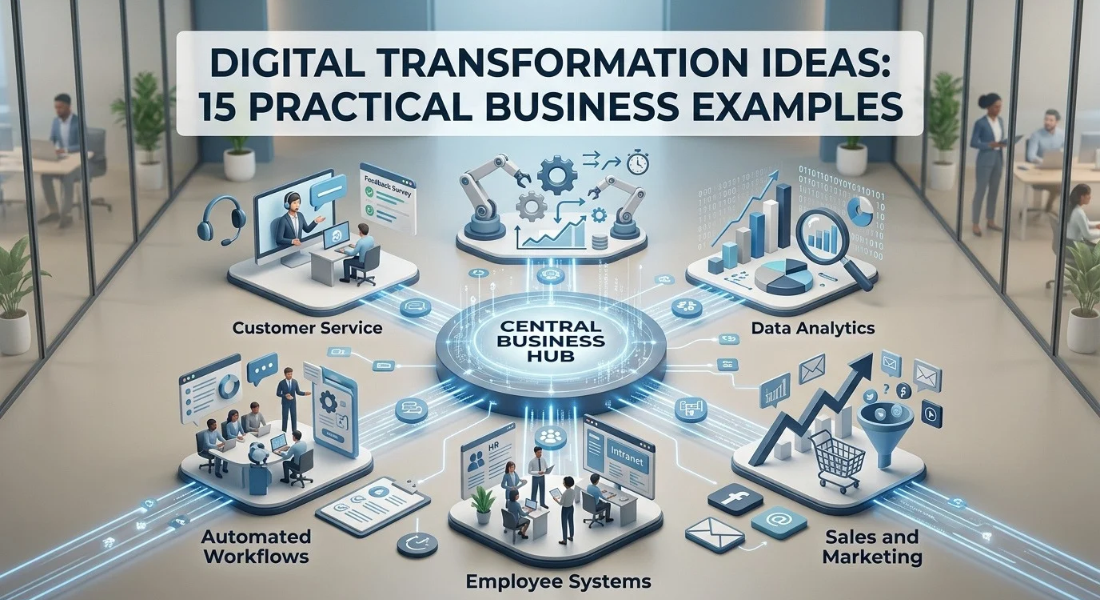
A recurring customer complaint, slow approval or disconnected report can signal a bigger business opportunity. Digital transformation ideas turn these everyday problems into practical initiatives that use digital capabilities to improve a specific activity, interaction or workflow.
From customer service and operations to data, employees, sales and marketing the right idea starts with a clear problem rather than a technology alone.
Digital transformation ideas should begin with a specific business problem or opportunity.
AI, automation, analytics and cloud computing are capabilities the initiative explains how they address a real need.
Customer ideas include AI assisted support, self service portals, personalisation and connected journeys.
Operations ideas include workflow automation, digital document management, automated approvals and process monitoring.
Data, employee, sales and marketing initiatives can target visibility, administrative friction, knowledge access and customer engagement.
A useful initial filter is Problem → Impact → Feasibility.
A digital transformation idea is a specific initiative that applies digital capabilities to change or improve a business activity, customer interaction, workflow or decision process.
The focus is the business opportunity, not simply adopting a technology such as AI, cloud computing or automation.
A digital tool or technology provides a capability an initiative applies that capability to solve a defined business problem.
For example choosing an AI platform is a technology decision. Using an AI assistant to answer routine customer enquiries is an initiative with a specific purpose and use case.
A useful idea starts with a recognisable problem or opportunity. This could be slow processing, poor customer access, repetitive work, fragmented information or limited visibility.
A simple pattern keeps the idea focused:
Business problem → Digital initiative → Example use case
This approach prevents a technology from becoming the objective by itself. The initiative should explain what changes and where the capability could be applied.
Stephanie L. Woerner and colleagues at MIT CISR describe digital business transformation through capabilities that can improve customer experience and operational efficiency reinforcing the value of connecting digital capabilities with specific business outcomes.
Digital transformation ideas sit within the wider field of organisational digital change but this article focuses only on practical initiative concepts. For the broader topic see our complete Digital Transformation guide → see the full guide here.
Customer facing initiatives can use digital capabilities to remove friction from journeys, provide faster access to information and make service interactions more convenient.
The strongest ideas focus on specific customer problems rather than adding digital channels simply because the technology is available.
AI assistants can handle common enquiries, provide conversational support and generate automated responses for straightforward requests. The aim is not to replace every service interaction but to make routine information easier to access.
For example an online retailer could use an AI assistant to answer order status, delivery and return questions before routing complex cases to human agents.
A customer self service portal gives people secure access to information and routine actions without requiring a service representative for every request. It can support account management, document access, bookings, requests and status tracking.
A service company, for example, could allow customers to book appointments, view invoices and monitor service requests through one portal.
Personalised experiences use relevant customer information to tailor website content, recommendations, communications or offers. The initiative should respond to a clear need for more relevant interactions rather than simply collecting more customer data.
An e commerce business could display product recommendations based on a customer's browsing and purchasing behaviour.
An omnichannel initiative connects relevant customer interactions across websites, mobile applications, email, chat, physical locations or other channels. The goal is continuity rather than simply having more channels.
For example a customer could begin an enquiry online and continue with a service agent without having to repeat the information already provided.
Operational ideas focus on repetitive work, handoffs, approvals, documents and processes that consume time or create avoidable errors.
These initiatives turn digital capabilities into practical workflow improvements while keeping the emphasis on the activity being changed rather than on the underlying software.
Workflow automation can handle recurring administrative actions such as data entry, notifications, routing and status updates. This is particularly useful where employees repeatedly move information between systems or perform predictable steps.
For example, a finance team could automatically route incoming invoices to the appropriate approver based on amount, department or other defined criteria.
Digital document management can provide centralised access to records, searchable information, controlled workflows and consistent handling of business documents.
The initiative is useful when employees spend unnecessary time locating or checking information stored across disconnected locations.
A professional services firm could replace scattered document storage with a searchable digital repository linked to relevant client workflows.
Digital request workflows can standardise how employees submit purchasing, leave, access or other routine requests. Automated routing can send each request to the appropriate person while keeping its status visible.
For example an employee could submit a purchasing request through a digital form that automatically routes it to the correct approver and sends status notifications.
Process monitoring gives teams visibility into where work is waiting, delayed, returned or repeatedly held up. It can make recurring bottlenecks easier to identify without requiring employees to manually compile status information.
An operations team for example could monitor order processing stages to identify where handoffs consistently cause delays.
Data focused initiatives help organisations turn scattered information into usable insight. Practical ideas include improving visibility through dashboards, bringing relevant information together and using analytics to identify patterns.
The initiative should solve a decision or information problem rather than becoming a generic analytics project.
Business intelligence dashboards can present relevant information for specific roles or functions. Sales teams might need pipeline visibility while finance or operations teams may need different information.
A sales team could use a dashboard to monitor pipeline activity, conversion rates and regional performance from connected business data.
Real time analytics can provide timely visibility when delayed information makes operational decisions harder. The useful initiative is not simply producing more reports but giving the right people access to information while activity is still changing.
For example a logistics business could monitor order and delivery information throughout the day to identify delays earlier.
Predictive analytics uses historical and current information to identify patterns associated with likely outcomes. It can support decisions where recognising an emerging pattern is more useful than reviewing past performance alone.
A manufacturer could analyse equipment data to identify patterns associated with potential maintenance needs before an issue disrupts production.
Employee focused initiatives can reduce administrative friction, improve access to information and make routine workplace processes easier to complete.
The most useful ideas redesign specific employee interactions or workflows instead of treating workplace technology adoption as transformation by itself.
Employee self service gives staff digital access to routine administrative activities such as updating personal information, accessing documents, checking benefits or submitting requests.
For example employees could manage personal details, access payroll documents and submit routine HR requests through one secure self service portal.
Digital onboarding can connect forms, training, account setup, equipment requests and onboarding information into a coordinated employee journey. This reduces the need for employees and managers to track every requirement separately.
A new employee could receive automatically assigned onboarding tasks for HR, IT and their manager with each participant seeing the information relevant to them.
Digital knowledge management provides a searchable internal source for policies, procedures, product information and organisational knowledge. It can be particularly useful when employees repeatedly ask colleagues for information that already exists elsewhere.
A customer support team could use a central knowledge base to locate approved answers and procedures while handling customer enquiries.
Sales and marketing initiatives can use customer information, automation and digital journeys to reduce manual work and create more relevant interactions.
The useful starting point is a specific problem, such as fragmented customer information slow follow up or disconnected digital engagement.
CRM automation can capture new leads, route them to the appropriate representative, create reminders and support follow up activities. The initiative becomes more useful when routing reflects a real business requirement.
For example new website enquiries could automatically be assigned to a sales representative based on product interest, territory or customer type.
Personalised digital marketing uses relevant customer behaviour or segmentation to tailor communications and recommendations. The focus should remain on making digital interactions more relevant rather than sending more messages.
A retailer could provide different product recommendations based on previous purchases and browsing behaviour.
A practical way to compare ideas is to consider the business problem, expected impact and feasibility together. An attractive idea should address a meaningful need, have a clear potential outcome and be realistic enough to justify further investigation.
Use this three part lens:
Problem: What specific friction, delay, cost or customer issue does it address?
Impact: What meaningful improvement could result?
Feasibility: Does the organisation have the data, people and technical conditions to explore it?
This is an initial filter not a transformation roadmap. Its purpose is to distinguish a potentially useful initiative from an interesting technology looking for a problem.
The most useful digital transformation ideas begin with a concrete business problem rather than a technology shopping list.
Across customer experience, workflows, data, employees, sales and marketing, the same pattern applies identify the friction, connect it to an appropriate digital capability and define a practical use case that shows what could change.
Examples include workflow automation, customer self service, digital document management, CRM automation and business dashboards.
An online service portal that lets customers book appointments view invoices and track requests is one practical example.
Identify a recurring problem, choose a suitable digital initiative and define a practical use case for it.
Examples include AI assisted support, self service portals, personalised interactions and connected customer journeys.
Examples include workflow automation, digital document management, automated approvals and process monitoring.
AI and cloud computing are technologies. They become transformation ideas when applied to a specific business need.


Reader Discussion
Leave a Reply