- by Daily Talkin Staff
- July 8, 2026
-

-
-
Loading
Loading
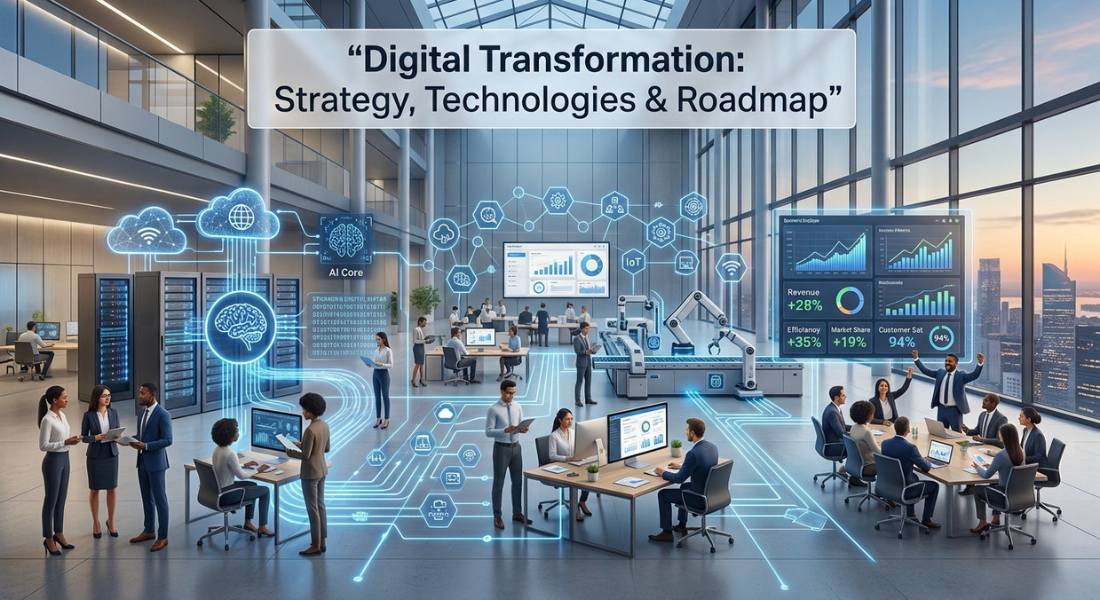
Digital transformation is organisational and business change enabled by digital technologies to improve how an organisation operates, serves customers, empowers employees, creates value, and competes.
It connects technology with people, processes, strategy, customer experience, data, and measurable business outcomes rather than simply converting information into digital form or buying new software.
This guide explains digital transformation strategy, technologies, implementation, processes, business models, benefits, challenges, measurement, costs, and practical examples.
Digital transformation combines technology with organisational, process, people, and business model change.
Successful transformation starts with business objectives rather than technology selection.
Cloud, AI, automation, analytics, APIs, IoT, and cybersecurity can enable transformation when matched to clear needs.
Leadership, workforce skills, data governance, security, and change management are critical to adoption.
Transformation success should be measured through business, customer, operational, and financial KPIs.
Digital transformation is an ongoing capability-building process, not a one time software implementation.

Digital transformation is the integration of digital technology into an organisation in ways that fundamentally improve or change its processes, products, operations, customer experiences, and business models.
The objective is not technology adoption alone but better business performance and the ability to adapt continuously. It is not simply digitising documents, moving workloads to the cloud, automating one task, or adding AI to an existing workflow.
Transformation requires organisations to reconsider how work is performed, how value is delivered, and how people and technology work together.
Concept | What Changes? | Main Purpose | Example |
Digitization | Analog information | Convert information into digital form | Scanning paper records |
Digitalization | Existing processes | Improve how work is performed | Digital approval workflows |
Digital transformation | Operations, value creation or business models | Fundamentally improve the organisation | Creating a digital first service model |
Digital transformation can change business processes, products and services, operations, customer experience, employee experience, business models, and organisational capabilities. IBM identifies business and operating models, processes, products, employee experience, and customer experience as major transformation domains.
The central relationship can be expressed as:
Technology → People → Processes → Business Model → Customer Experience → Measurable Outcomes
Technology provides capabilities but people determine adoption, processes determine how work changes, and leadership connects those changes to business value.
Digital transformation works as a structured business change process rather than a one time technology implementation. Organisations should begin with business objectives, customer needs, operational problems, and current capabilities before selecting technologies or platforms.
A practical sequence is to assess the current state, define goals, identify opportunities, prioritise projects, pilot solutions, implement and integrate them, enable employees, measure results, scale successful initiatives, and continuously optimise the operating model.
Start by examining legacy systems, existing processes, data maturity, customer journeys, employee workflows, technology gaps, cybersecurity risks, and organisational capabilities. A realistic baseline prevents technology investments from solving the wrong problem.
Transformation priorities should connect to business objectives, customer needs, operational problems, revenue opportunities, efficiency opportunities, and strategic priorities. Each initiative should have a clear reason for existing.
Prioritise projects according to business impact, feasibility, cost, risk, customer value, and time to value. A high impact initiative with manageable complexity can often produce evidence that supports wider investment.
Pilot projects can test assumptions before wider deployment. Implementation then requires system integration, workforce adoption, change management, measurement, and governance.
Successful initiatives can be scaled while performance data should be used to refine processes, technology, training, and future transformation priorities.
Successful transformation depends on more than technology. Strategy, technology, processes, people, leadership, data, governance, cybersecurity, and organisational culture must work together around defined business outcomes.
Technology adoption without these foundations can create disconnected systems, poor data, employee resistance, security exposure, and limited ROI. McKinsey research has repeatedly identified leadership, capability building, workforce empowerment, tools, and communication as important transformation success factors.
Executive sponsorship provides direction and accountability while CIOs, Chief Digital Officers, IT leaders, business unit leaders, and cross functional teams translate strategy into action.
Employees also need relevant skills, training, communication, and opportunities to influence new ways of working. Change management is therefore a core transformation capability rather than an optional communication exercise.
Common foundations include cloud computing, artificial intelligence, generative AI, data analytics, automation and RPA, APIs, IoT, cybersecurity, legacy system modernisation, and data governance.
Technology should follow business requirements. AWS for example structures cloud transformation capabilities around business, people, governance, platform, security, and operations.
Transformation governance establishes decision rights, priorities, ownership, risk controls, and investment discipline. Data governance helps maintain quality, access controls, privacy, and consistent definitions.
Cybersecurity and AI governance should be built into transformation programmes from the beginning. Vendor and platform evaluation should consider integration, resilience, security, compliance, cost, portability, and long term strategic fit.
Useful KPIs include revenue growth, digital revenue, customer retention, customer satisfaction, conversion rate, process cycle time, automation rate, employee productivity, operating cost, technology adoption, time to market, and ROI.
The most useful measures connect technology activity to business results. IBM specifically recommends tracking KPIs to determine whether transformation produces meaningful improvements.

A digital transformation strategy connects digital initiatives with business objectives, customer needs, organisational capabilities, technology priorities, and long term competitive goals. It determines what should change, why it matters, which capabilities are required, and how results will be measured.
For a complete breakdown of digital transformation strategy see our full guide on Digital Transformation Strategy →
Digital transformation involves using digital technologies to fundamentally improve or change business operations, processes, customer experiences, products, services, and value creation. It extends beyond simply adopting new software.
For a complete explanation of what digital transformation is see our full guide on What Is Digital Transformation →
Digital transformation is organisational change enabled by digital technologies with the objective of improving how an organisation operates and creates value.
It differs from simple technology adoption because processes, capabilities, and outcomes also change. For a complete breakdown of the digital transformation definition see our full guide on Digital Transformation Definition →
Common transformation technologies include cloud computing, artificial intelligence, generative AI, machine learning, IoT, automation and RPA, APIs, data analytics, digital twins, DevOps, DevSecOps, and cybersecurity. Technology selection should follow business requirements rather than trends.
For a complete breakdown of digital transformation technologies see our full guide on Digital Transformation Technologies →
Digital business transformation uses digital capabilities to change how an organisation operates, serves customers, competes, and creates value. It can affect business models, processes, products, customer experience, and organisational capabilities.
For a complete breakdown of digital business transformation see our full guide on Digital Business Transformation →
Successful transformation combines clear objectives, executive leadership, suitable technology, workforce adoption, process redesign, strong data foundations, change management, governance, and measurable outcomes.
Success should be judged by business and customer results rather than technology deployment alone. For a complete breakdown of successful digital transformation see our full guide on Successful Digital Transformation →
Digital transformation can reshape business operations, customer experience, employee workflows, products, services, data practices, and business models. Its scope depends on the organisation's objectives, maturity, competitive environment, and transformation priorities.
For a complete breakdown of digital transformation in business see our full guide on Digital Transformation in Business →
Digital process transformation redesigns workflows using automation, AI, cloud platforms, APIs, analytics, and integrated systems. The goal is to remove inefficient work rather than simply automate inefficient processes.
For a complete breakdown of digital process transformation see our full guide on Digital Process Transformation →
Organisations pursue transformation because of changing customer expectations, competitive pressure, operational inefficiency, new digital business models, data driven decision making, resilience, innovation, and growth opportunities.
For a complete breakdown of why digital transformation matters, see our full guide on Why Digital Transformation →
Digital transformation services can include strategy consulting, cloud migration, application modernisation, data and analytics, cybersecurity, automation, systems integration, customer experience transformation, and change management.
For a complete breakdown of digital transformation services see our full guide on Digital Transformation Services →
A digital transformation project is a defined initiative that uses technology and process change to solve a business problem or create a measurable capability. It requires objectives, scope, stakeholders, implementation plans, adoption measures, risk controls, and KPIs.
For a complete breakdown of digital transformation projects see our full guide on Digital Transformation Project →
An effective approach begins with business objectives and current state assessment, followed by opportunity identification, prioritisation, piloting, implementation, adoption, measurement, and optimisation. Transformation works best as an iterative process rather than a single technology rollout.
For a complete breakdown of digital transformation approaches see our full guide on Digital Transformation Approach →
Enterprise digital transformation coordinates change across multiple functions rather than optimising one isolated department.
It requires enterprise architecture, shared data, cross functional processes, governance, security, legacy modernisation, workforce capabilities, and strategic alignment.
For a complete breakdown of enterprise digital transformation see our full guide on Digital Transformation Enterprise →
Transformation value can come from revenue growth, cost reduction, productivity, customer satisfaction, retention, faster time to market, resilience, and new digital revenue streams. Value should be connected to business KPIs rather than technology adoption metrics alone.
For a complete breakdown of digital transformation value see our full guide on Digital Transformation Value →
Potential transformation ideas include workflow automation, AI assisted operations, cloud modernisation, self service customer experiences, data driven decision making, digital products, predictive analytics, and connected operations.
The best opportunity depends on measurable business needs. For a complete breakdown of digital transformation ideas see our full guide on Digital Transformation Ideas →
Business model transformation changes how an organisation creates, delivers, and captures value through digital capabilities. Examples include digital products, platforms, subscriptions, ecosystems, direct to customer models, data enabled services, and new revenue streams.
For a complete breakdown of digital transformation business models, see our full guide on Digital Transformation Business Model →
Digital transformation looks different across industries but the underlying principle remains the same: digital capabilities are used to improve business performance, customer experiences, operations, or value creation.
Financial institutions use digital banking, mobile applications, automated workflows, data driven services, and digital payments to improve access and customer experiences.
Mobile deposits are one example of how technology can change an established banking process rather than merely digitise an existing document workflow.
Healthcare transformation can include digital patient experiences, electronic data systems, telehealth, digital services, connected devices, analytics, and operational automation.
The transformation opportunity extends beyond the technology itself to how clinicians, patients, administrators, and data interact across the care journey.
Manufacturers can use IoT sensors, automation, predictive maintenance, analytics, robotics, and connected operations to improve production visibility and equipment performance.
These capabilities can turn operational data into earlier warnings, more informed maintenance decisions, and better resource planning.
Retail transformation can involve omnichannel experiences, personalisation, digital commerce, customer data, mobile services, and automated support.
The goal is to connect customer interactions and operational capabilities rather than treating each digital channel as a separate system.
The transferable lesson is that successful transformation begins with a meaningful business or customer problem. Technology then becomes an enabler of redesigned processes, new capabilities, better experiences, and measurable outcomes.
Transformation programmes commonly fail when organisations treat them as technology projects instead of organisational change programmes.
Old applications can restrict integration, scalability, security, and speed. Modernisation may therefore be necessary before new digital capabilities can operate effectively.
Employees may resist unfamiliar workflows or lack the skills needed for new systems. Training, communication, participation, and capability building can reduce adoption barriers.
Without executive ownership and clear priorities, departments can pursue disconnected projects. Transformation needs shared objectives, decision rights, funding, and accountability.
Poor quality or fragmented data can undermine analytics, AI, automation, and customer experiences. Integration and governance should therefore be treated as transformation foundations.
More connected systems can expand the attack surface and create privacy, compliance, operational, and third party risks. Security controls should be designed alongside new capabilities.
A transformation without measurable outcomes can become an expensive technology programme. KPIs should be established before implementation so value can be assessed consistently.
Buying a platform does not automatically improve performance. Processes, roles, incentives, workflows, and customer journeys often need redesign around the new capability.
There is no universal price for digital transformation because organisations differ substantially in size, maturity, technology debt, objectives, and transformation scope.
Major cost factors include organisation size, existing infrastructure, legacy modernisation, cloud migration, software and platform costs, data modernisation, cybersecurity, integration, consulting, employee training, and ongoing maintenance.
Digital transformation is a portfolio of initiatives rather than a standardised product purchase. A focused workflow project and a multi year enterprise modernisation programme can therefore have dramatically different investment requirements.
Evaluate investment against expected business value, strategic importance, risk, time to value, and ROI. AWS similarly frames transformation around connecting technology and organisational capabilities to tangible business outcomes.
Digital transformation is an ongoing organisational transformation connecting technology, strategy, processes, people, data, customer experience, and measurable business outcomes.
The strongest programmes start with business objectives, identify high value opportunities, prioritise practical initiatives, prepare employees, manage risk, and measure results continuously.
The key is not to adopt the most technology. It is to use the right digital capabilities to create meaningful, measurable improvement and build an organisation that can keep adapting.
Digital transformation uses digital technology to improve how an organisation operates, serves customers, and creates value.
The four common pillars are technology, people, processes, and strategy or organisational capabilities.
Examples include AI, cloud modernisation, automated workflows, digital products, and connected operations.
Common technologies include AI, generative AI, cloud computing, IoT, RPA, analytics, APIs, digital twins, and cybersecurity.
Digitization converts information to digital form while digital transformation changes processes, operations, experiences, or business models.
Measure outcomes such as revenue, customer satisfaction, productivity, cost, adoption, time to market, and ROI.


Reader Discussion
Leave a Reply