- by Daily Talkin Staff
- July 8, 2026
-

-
-
Loading
Loading
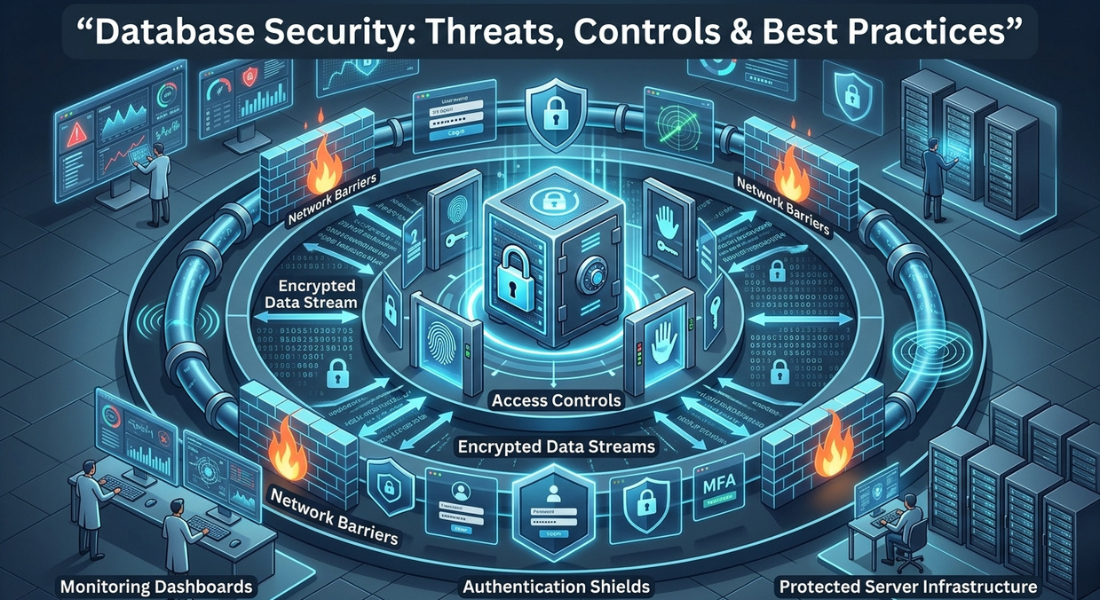
A compromised account or vulnerable application can expose sensitive records. Database security is the controls and practices used to prevent unauthorised access, misuse, alteration, disclosure, and disruption.
This guide covers threats, controls, priorities, a checklist, and questions. Database security is one specialised area within the broader database topic, focusing specifically on protecting stored information and controlling access to it.
This is part of our complete Database guide → see the full guide here.
Protect confidentiality, integrity, and availability.
Treat credentials, permissions, applications, and networks as security boundaries.
Combine authentication, least privilege, encryption, hardening, monitoring, and auditing.
Review controls after changes and identified vulnerabilities.
Use a checklist to make security reviews consistent.

Database security protects data and the identities, applications, systems, and connections that can reach it. It prevents unauthorised disclosure or changes while keeping legitimate access available, making permissions, configuration, connections, and monitoring part of the security boundary.
Confidentiality prevents unauthorised disclosure. Integrity prevents unauthorised or improper alteration. Availability keeps legitimate users able to access required information.
Together these objectives provide a practical test for database protection is information private, trustworthy, and accessible when needed?
Weak controls can expose personal information, alter records, compromise credentials, or disrupt operations. Consequences may include regulatory action, investigation costs, and lost trust.
Weaknesses can exist in identities, permissions, configuration, applications and queries, network connections, stored data, or administrative processes. An overprivileged account, unsafe query, or open network path can undermine protection.
The useful question is which weakness each threat exploits and which control reduces it. Common risks include compromised credentials, unsafe queries, excessive privileges, insecure configuration, insider misuse, and exposed services.
Verizon’s 2025 DBIR found credential abuse in 22% of reviewed breaches and vulnerability exploitation in 20%.
Stolen credentials, weak passwords, compromised accounts, excessive permissions, and unauthorised administrative access can provide a valid route into protected information.
Depending on the privileges obtained, an attacker may read, modify, delete, or export records. Impact therefore depends heavily on access rights.
Unsafe application input can alter the structure or intent of a database query, potentially exposing or changing records.
OWASP SQL Injection Prevention Cheat Sheet recommends prepared statements with parameterised queries as a primary defence supported by appropriate input validation and secure application practices.
Weak configuration can expose unnecessary services, ports, or access paths. Excessive privileges increase what an account can misuse, while insider or compromised accounts can abuse legitimate access. These risks show why secure configuration and least privilege should reinforce each other.
Authentication and authorisation answer different questions who is requesting access, and what may that identity do? Strong authentication reduces unauthorised entry precise authorisation limits what an authenticated identity can access or change.
Authentication verifies the identity of a person, application, service, or other entity requesting access. Strong credentials, unique accounts, appropriate MFA where supported, and secure service identities reduce compromise risk.
Shared accounts should be avoided because they weaken accountability and make sensitive actions harder to attribute.
Authorisation determines what an authenticated identity is permitted to access or change. Permissions can distinguish read, write, administrative, and restricted access.
Successful authentication should never imply unrestricted control over records or security sensitive functions.
Least privilege gives each account only the permissions required for its legitimate role. If an account is compromised or misused the potential blast radius is smaller.
Role based access control (RBAC) can organise permissions around job functions and make unnecessary access easier to identify and remove.
Encryption protects database information while stored and while moving between connected systems. It can reduce exposure if storage or communications are accessed improperly but it does not replace authentication, authorisation, configuration, or monitoring.
Encryption at rest protects persistent information such as database files and storage volumes. If an unauthorised party reaches the underlying storage encrypted content is harder to use without the required key. It does not stop an authorised account from reading data through legitimate database access.
Encryption in transit protects information travelling between applications, database clients, servers, and related components. TLS is a common mechanism for supported database connections.
Without protected connections, credentials or sensitive records can be exposed while moving across networks even when stored data is encrypted.
Encryption depends on protecting the keys that unlock encrypted information. Key access should be tightly controlled, responsibilities separated, and rotation applied according to risk and technical requirements.
Poor key handling can undermine otherwise strong encryption so key access needs its own safeguards.
Hardening reduces exposure through secure defaults, limited administrative access, timely updates, reduced exposure, and controlled network paths. It should be reviewed after significant changes rather than treated as a one time setup task.
Hardening can include secure configuration, disabling unnecessary services and features, restricting administrative access, using secure defaults, and removing unnecessary exposure.
Configuration reviews should verify that only required functions and connections remain available reducing the number of paths an attacker could exploit.
Outdated database software may contain known security weaknesses. Timely security updates reduce exposure while vulnerability assessments help identify weaknesses requiring attention.
Changes should be tested appropriately before deployment so security improvements do not create avoidable operational problems.
Network segmentation can separate database systems from public facing services and unrelated networks. Restricted ports, firewall controls, private connectivity, and limited direct internet exposure reduce reachable attack paths.
A database firewall can add another layer while database network security should permit only necessary systems and connections.
Monitoring shows what is happening; auditing preserves records that support investigation and accountability. Together they help identify suspicious access, validate controls, and provide evidence when an event needs investigation.
Effective monitoring is therefore more than collecting logs and hoping someone reviews them later.
Useful monitoring can flag unusual login attempts, privilege changes, unexpected queries, abnormal data access, large exports, and sensitive administrative actions.
The value comes from recognising behaviour that differs from an expected pattern or violates permissions. Alerts should be actionable rather than overwhelming teams with noise.
Database auditing records security relevant actions so an organisation can establish who performed an activity, what happened, and when. Audit trails support investigations, accountability, access reviews, and control testing. Logs need suitable protection, retention, and review.
Relevant events can be correlated with other security signals to identify patterns that a single database log may miss. Organisations may feed events into a SIEM for broader detection and response workflows. The aim is to turn useful activity data into timely security decisions.

Security management turns technical controls into repeatable expectations. A security policy should define access, privileged access, authentication and encryption requirements, monitoring, incidents, and reviews.
A practical policy can define acceptable access, account responsibilities, privileged access, authentication requirements, encryption expectations, monitoring, incident handling, and periodic review.
It should establish ownership so access, configuration, logging, and security exceptions have accountable decision makers.
Security protects sensitive information from unauthorised access, alteration, or disclosure. Privacy addresses how personal information is collected, used, accessed, retained, and disclosed.
Strong database controls support privacy but they do not by themselves determine whether a particular use of personal data is appropriate or lawful.
Standards and compliance requirements can establish expectations for access control, authentication, auditing, protection, and review. NIST CSF 2.0 is organised around six Functions Govern, Identify, Protect, Detect, Respond, and Recover.
Compliance can guide control design but passing an assessment does not guarantee a secure database.
The strongest approach is layered rather than dependent on one tool limit access, strengthen authentication, reduce privileges, protect information, harden the environment, and monitor activity. Review controls as users, applications, infrastructure, and vulnerabilities change.
Restrict access to necessary users and systems. Strengthen authentication, apply least privilege, encrypt sensitive information, harden and patch database systems, and monitor security relevant activity.
Protect administrative credentials and security configurations as carefully as the data itself.
Review controls periodically and after meaningful changes, such as new applications, users, permissions, infrastructure, database versions, or identified vulnerabilities.
Confirm that access remains necessary, configurations remain secure, logging works, and known weaknesses receive appropriate treatment.
Test access reviews, vulnerability assessments, configuration settings, permission boundaries, logging, and security alerts. Where appropriate penetration testing can validate realistic attack paths.
Testing should produce actionable findings and follow up rather than becoming a compliance exercise.

A concise checklist turns security expectations into repeatable checks covering access, protection, and monitoring. It helps spot gaps routine administration can overlook and supports periodic security reviews.
Unique accounts for users and services
Strong authentication and appropriate MFA
Least privilege permissions and RBAC
Restricted administrative access
Regular access and privilege reviews
Encryption at rest and in transit
Secure database configuration
Timely security patching
Restricted network paths and ports
Protected credentials, secrets, and encryption keys
Audit logging where required
Suspicious activity monitoring
Privilege change detection
Regular log review and alert handling
Periodic security control testing
Effective database security depends on layered controls that work together to protect information. Strong authentication, limited permissions, encryption, secure configurations, and monitoring help reduce security risks.
Regular security reviews are equally important as users, applications, infrastructure, and vulnerabilities change. Keeping these controls updated helps maintain reliable database protection over time.
Database security protects database information from unauthorised access, disclosure, alteration, misuse, and disruption.
Common threats include unauthorised access, compromised credentials, SQL injection, excessive privileges, insider misuse, and misconfiguration.
Use strong authentication, least privilege, encryption, secure configuration, patching, network controls, monitoring, and regular security reviews.
Authentication verifies identity while authorisation determines what that identity can access or change.
Encryption protects stored and transmitted data, reducing exposure if storage or communications are accessed improperly.
Least privilege gives accounts only the permissions required for their legitimate tasks, limiting potential security risks.


Reader Discussion
Leave a Reply