- by Daily Talkin Staff
- July 8, 2026
-

-
-
Loading
Loading
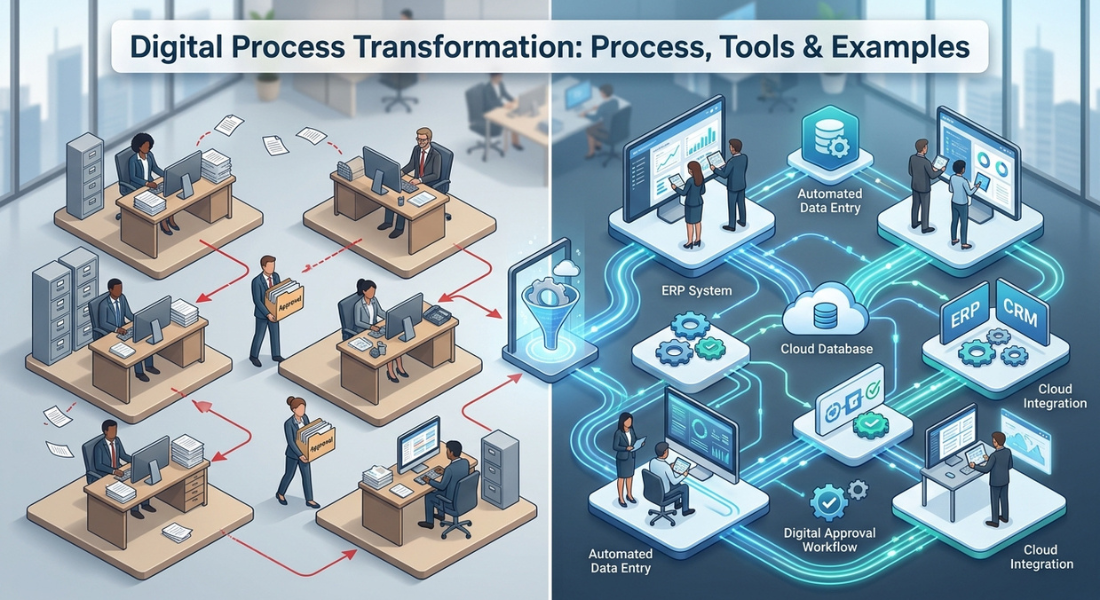
A business can automate dozens of tasks and still leave the underlying workflow slow, fragmented or unnecessarily manual. Digital Process Transformation addresses this by examining how the process itself is designed, not just which tasks can be automated.
Digital process transformation redesigns a specific business process using digital capabilities, connected systems and changed ways of working. This article explains process redesign, technology roles and practical workflow examples.
Digital process transformation redesigns a specific business workflow rather than simply digitising information.
Process redesign can remove unnecessary approvals, handoffs, duplicate entry and poorly defined decisions.
Automation is a component of transformation not a substitute for examining the process itself.
APIs and integrated systems can connect information and actions across workflow stages.
AI, analytics and RPA have different roles within a transformed process.
Effective workflows account for both routine cases and exceptions requiring human judgement.

Digital process transformation means changing how a specific business process works from beginning to end.
Instead of simply replacing paper, adding software or automating one task, it examines the complete workflow and redesigns its sequence, decisions, information flows and system interactions.
The focus is the process itself. A transformed process may remove unnecessary approvals, connect previously separate systems, route routine cases automatically and reserve human judgement for exceptions.
This is closely related to business process reengineering (BPR) which IBM describes as fundamentally rethinking and redesigning core processes rather than making only incremental adjustments.
A transformed workflow can change the order in which activities happen, who receives each task, where decisions occur and how information moves between stages.
Responsibilities may shift between people and systems while connected applications can remove manual transfers. The object being changed is therefore the workflow itself, not simply the document format or software used for one task.
Process redesign separates transformation from straightforward technology implementation. Before adding automation, a business can examine whether every approval, handoff, data entry step or routing rule still serves a useful purpose.
IBM's description of BPR similarly emphasises eliminating redundancies and redesigning end to end processes rather than preserving inefficient structures simply because technology can execute them.
Improving one task can make a local activity faster without changing what happens before or after it. The surrounding workflow may still contain duplicate entry, unnecessary waiting or disconnected decisions.
Process transformation examines the connected sequence instead. It considers dependencies, information, decisions, responsibilities and system interactions across the complete process.
Digital process transformation sits within the broader field of Digital Transformation which covers organisation wide technology enabled change. This article focuses only on transforming individual business processes. See our complete Digital Transformation guide → see the full guide here.
The terms overlap but they describe different degrees of change. Digitisation converts analogue information into digital form digitalisation uses digital capabilities to improve existing work, and automation executes defined tasks or workflow actions.
Process transformation goes further when the workflow itself needs to change. The distinction matters because adding technology to an unchanged process can preserve the very friction that redesign was meant to remove.
Digitisation converts information from a physical or analogue format into digital form. Scanning paper invoices into electronic records is a straightforward example.
The underlying process may remain unchanged: employees can still check the same information, request the same approvals and move records between the same teams. Digitisation changes the information format not necessarily the workflow logic.
Digitalisation applies digital capabilities to improve an existing way of working. For example an online approval form may replace an email request while keeping the same approval sequence.
Process transformation asks a broader process question: should those approval stages, handoffs and decisions exist in their current form at all? The workflow can therefore be redesigned rather than simply digitised.
No Automation executes tasks or coordinates predefined workflow steps while transformation can change the process those tasks belong to. Automating five unnecessary approvals may make the sequence faster without making it sensible.
Transformation first examines the logic of the process then determines which activities should be automated, connected, removed or retained for human review.
Processes are strong candidates when friction occurs across several connected activities rather than inside one isolated task. Repeated data entry, unnecessary handoffs, disconnected applications and slow decisions can signal that the workflow itself needs examination.
The aim is not to automate every manual activity. It is to identify where the process can operate differently through better sequencing, clearer decisions, connected information and appropriate digital execution.
Common process level warning signs include repeated manual entry, duplicated work, excessive approvals and frequent transfers between teams. Other signals include disconnected systems, inconsistent information and slow exception handling.
When employees repeatedly compensate for gaps with spreadsheets, email or manual reconciliation the workflow may need redesign rather than another isolated tool.
A workflow that moves between HR, finance, CRM, ERP or other applications can become fragmented when systems do not exchange information effectively.
Employees may copy records between applications, check information manually or wait for another team to complete a transfer. Connecting systems can remove these interruptions but the process may also need redesign so that ownership and information flow remain clear.
Redesign is appropriate when the existing sequence contains unnecessary steps, duplicate approvals, avoidable handoffs or poorly defined decision points.
Automation should follow process logic that has been examined. Otherwise technology can preserve inefficient work while making it execute more quickly and consistently.
Process redesign changes the structure of work rather than simply changing the tools used to perform it. The redesigned version may contain fewer stages, different routing rules, integrated information and clearer points for human intervention.
Microsoft describes business process management as a cyclical discipline covering planning, design, modelling, implementation, monitoring and optimisation reinforcing the idea that process change requires structured examination rather than one off automation.
Teams can examine each activity and ask whether it adds information, control or value to the workflow. Duplicate approvals can sometimes be consolidated while repeated data entry can be removed when systems share the required information.
Routing can also change. Instead of sending every case through the same sequence the workflow can direct routine cases automatically while sending unusual cases to the appropriate specialist.
A transformed process can distinguish routine cases from those that require judgement. Rules can handle predictable conditions while more complex cases are routed to an employee with the appropriate responsibility.
This creates a human in the loop workflow rather than assuming every decision should be automated. Exception paths become part of the process design instead of being treated as failures outside the normal workflow.
Connected data can reduce the need for employees to repeatedly collect, enter or verify the same information. A customer record, employee profile or invoice detail can move with the workflow between connected stages.
The process consequence is greater continuity: fewer interruptions, clearer ownership and less manual reconciliation. Oracle describes BPM technology in terms of creating, executing and optimising processes, including coordination across applications and people.

Technology supports transformation when it performs a defined process role. Workflow automation can coordinate activities, APIs can move information between systems, analytics can expose process behaviour, and AI or RPA can support specific decisions or repetitive interactions.
The technology should therefore follow the redesigned workflow. A useful process design explains why a capability is needed and where it changes execution rather than treating technology selection as the starting point.
Workflow automation can route tasks, trigger actions, enforce business rules and coordinate human activities across several stages.
This differs from automating an isolated repetitive action. Process orchestration considers what happens before and after each task which conditions determine the next step and which role should receive the work.
APIs allow applications to exchange data and trigger actions without requiring employees to manually transfer information between systems.
For example a customer request captured in one application can pass relevant information to a service platform while preserving the original record. The process becomes a connected sequence rather than a chain of manually coordinated systems.
Analytics can reveal where a workflow slows down or repeatedly deviates from its expected path. AI can support classification, prediction or decision assistance where suitable data and rules exist.
RPA can handle repetitive rule based interactions with applications. Its value increases when it operates within a redesigned workflow rather than simply reproducing unnecessary manual steps.
The clearest examples show a before and after change in workflow logic. The technology matters, but the defining change is how information, decisions and responsibilities move through the process.
The following examples illustrate process level transformation without treating them as broad organisation wide transformation programmes.
A traditional onboarding workflow may depend on paper forms, email exchanges and repeated HR data entry. Information can be requested several times because employee records, payroll and other systems are disconnected.
A redesigned workflow can capture information once, route it automatically, update connected records and trigger notifications for required tasks. HR can then see completion status without manually checking every stage.
An inefficient invoice process may involve email attachments, spreadsheets, manual matching and separate approval requests. Employees transfer information between finance systems while exceptions are handled outside the main workflow.
A transformed process can connect invoice intake, matching, validation and approval routing. Routine invoices follow predefined rules while mismatches or unusual amounts are routed to an appropriate reviewer.
A customer request can be captured once, categorised and routed to the team responsible for resolution. Customer information can be connected to the request so employees do not repeatedly ask for details already held elsewhere.
Routine requests can follow defined workflows while complex cases remain with human agents. The result is a clearer path from request through resolution with fewer unnecessary handoffs.

Process transformation can fail even when the technology operates correctly. The common problem is a mismatch between the new digital capability and the actual workflow being performed.
Three process specific issues deserve particular attention: automating an unchanged process, lacking ownership across the complete workflow and designing only for routine cases.
Automation can reproduce unnecessary approvals, duplicate entry and avoidable handoffs at greater speed.
The technology may therefore improve execution without improving the process. This is why process examination should come before automation: remove or redesign unnecessary work first then automate the workflow that remains.
A workflow can cross several departments even when each team owns only its own tasks. Without someone responsible for the complete process local improvements may create problems elsewhere in the sequence.
End to end ownership helps identify dependencies between stages and makes it easier to decide where routing, information flow and responsibilities should change.
A workflow designed only for routine cases can break when an unusual request requires judgement, additional information or specialist review.
Effective redesign defines how exceptions are identified and routed. Human intervention remains part of the process where judgement matters rather than forcing every case through identical automated rules.
Digital process transformation changes how a specific business process works not simply the technology used inside it. The strongest designs remove unnecessary steps, connect information, clarify decisions and apply automation where it fits the redesigned workflow.
The result is a process built around better flow and appropriate human involvement rather than a faster version of inefficient work.
Digital process transformation redesigns a specific business process using digital capabilities, connected systems, automation and improved workflow logic.
Automation executes tasks while transformation redesigns the process itself. Automation can be one part of a broader process transformation.
Employee onboarding can use digital forms, automated routing, connected records and completion tracking instead of paper forms and emails.
Workflow automation, APIs, integrated platforms, analytics, AI and RPA can connect processes, analyse workflows and automate repetitive tasks.
Redesign first when a process has unnecessary steps, duplicate entry, excessive approvals, disconnected systems or avoidable handoffs.
Common problems include unclear process ownership, fragmented workflows, poorly handled exceptions and automating an inefficient process unchanged.


Reader Discussion
Leave a Reply