- by Daily Talkin Staff
- July 8, 2026
-

-
-
Loading
Loading
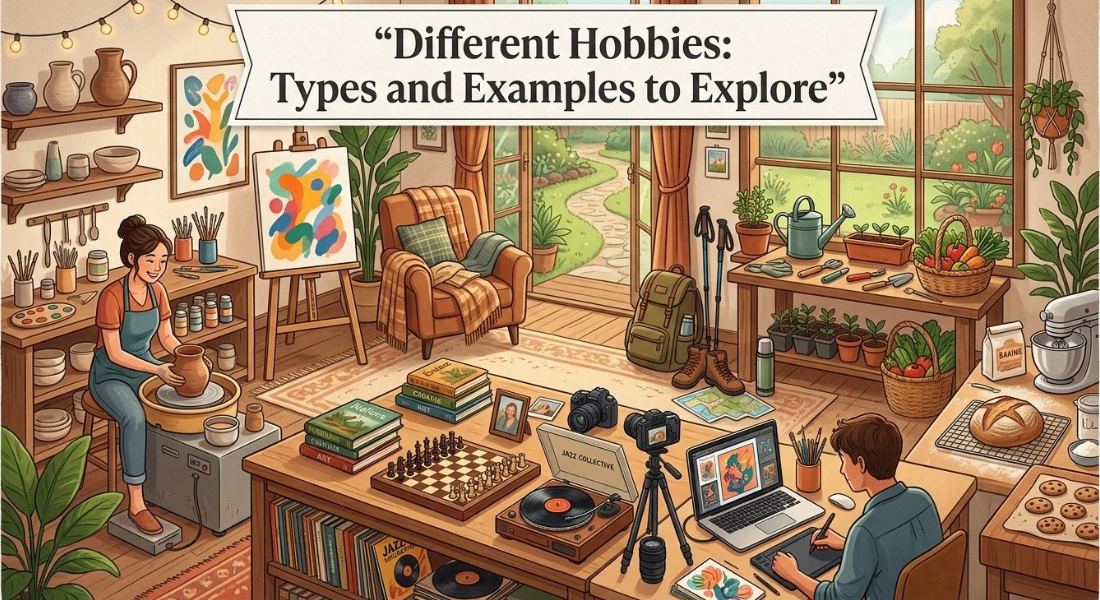
Not every hobby looks like painting, reading, or playing sports. Different hobbies span creative, active, learning, social, collecting, food, game, and digital activities. This guide organises varied examples by activity type so you can quickly see how broad the hobby landscape really is.
Hobbies are a broad topic covering activities, benefits, types, and ways to explore them. This article focuses specifically on different hobby options and examples. This is part of our complete guide on Hobbies → see the full guide here.
Different hobbies can be grouped by their main activity style.
Creative hobbies include painting, pottery, sewing, photography, and woodworking.
Active and outdoor options include hiking, cycling, gardening, fishing, and kayaking.
Learning and game hobbies include languages, reading, coding, chess, and puzzles.
Social, collecting, food, digital, and unusual hobbies add further variety.

Different hobbies can be grouped by the main activity involved making or expressing, moving or exploring, learning, playing, connecting with others, collecting, preparing food, or creating digitally. Some activities fit more than one group depending on how you practise them.
This classification makes a long list easier to understand. Painting and pottery centre on making while hiking and cycling involve movement or exploration. Reading and languages are learning focused whereas chess and puzzles centre on play and problem solving.
Social activities involve shared participation while collecting focuses on finding, organising, and preserving objects. Food hobbies involve preparing or experimenting with ingredients, and digital hobbies use technology as part of the creative process.
Creative hobbies involve producing, designing, arranging, or transforming something. Examples include painting, drawing, pottery, sewing, embroidery, woodworking, candle making, jewellery making, miniature painting, photography, and floral arranging.
The variety is wide: some are mainly visual, some involve hands on construction, and others combine design with practical making. Photography can also overlap with digital, outdoor, or social activities.
Active and outdoor hobbies include walking, hiking, cycling, swimming, dancing, gardening, fishing, birdwatching, kayaking, climbing, and skating.
Some centre on everyday movement while others involve exploring outdoor environments or working with nature. Gardening for example is both a practical activity and an outdoor hobby while birdwatching focuses more on observation.
Learning and thinking hobbies centre on reading, investigation, study, concentration, problem solving, or developing knowledge. They range from language learning and genealogy to coding, astronomy, chess, puzzles, research, and specialist subjects.
These activities can be highly structured or completely self directed. Someone might study a language through lessons, research family history through records, or explore astronomy by observing the night sky.
Others are based around solving or building. Chess, crosswords, Sudoku, model building, and strategy games offer very different experiences while sharing an emphasis on focused participation.
Examples include learning languages, reading, genealogy, astronomy, history research, creative writing, coding, online learning, studying music theory, and researching a specialist subject.
The difference lies mainly in what you explore. Reading can centre on fiction or history while genealogy investigates family records and astronomy focuses on objects and events in space.
Game based hobbies include chess, board games, card games, jigsaw puzzles, crosswords, Sudoku, role playing games, strategy games, model building, and tabletop gaming.
Some are mainly solitary such as completing a jigsaw or crossword. Others naturally involve several participants, including chess clubs, board game sessions, tabletop campaigns, and role playing games.

Social and shared hobbies are activities that naturally involve groups, communities, clubs, partners, or recurring gatherings. Examples range from book clubs and choirs to volunteering, amateur theatre, photography groups, and hobby meetups.
The activity itself can determine how social the hobby feels. A person can practise photography alone, for example, or join a photography group where members meet, share projects, and explore locations together.
This category also includes hobbies built around recurring events. Running clubs, craft circles, community gardening, and tabletop groups all turn an individual interest into a shared activity.
Examples include book clubs, dance groups, community gardening, volunteering, amateur theatre, choir groups, running clubs, photography groups, craft circles, and tabletop gaming groups.
These hobbies vary considerably in format. Some involve scheduled meetings while others depend on shared projects, performances, discussions, or organised activities.
Shared interest hobbies can include cooking with friends, hosting game nights, collaborative photography, group hiking, music groups, film clubs, trivia, and hobby meetups.
They do not have to be formally organised. A regular film night or weekend cooking session can become a hobby simply through repeated participation around a shared interest.
Some hobbies are built around collecting objects, preparing food, or turning everyday activities into creative projects. These include coins, books, records, baking, fermentation, cake decorating, floral arranging, food photography, and recipe development.
These options are easy to overlook because they do not always resemble conventional art, sport, or academic activities. Yet collecting and food based hobbies can involve ongoing projects, specialised interests, experimentation, and careful curation.
Collecting hobbies include coins, stamps, books, vinyl records, antiques, postcards, sports memorabilia, trading cards, minerals, vintage clothing, art prints, and themed collections.
The focus may be on finding particular items, organising an existing collection, researching their background, or preserving objects around a specific theme.
Food hobbies include baking, sourdough, cooking, cake decorating, recipe development, coffee preparation, fermentation, gardening to table projects, kombucha making, and food photography.
They can range from experimenting with recipes to documenting finished dishes. Some are mainly culinary while others combine food with photography, gardening, or creative presentation.
Digital and less common hobbies extend beyond traditional arts and sports. Examples include digital illustration, animation, blogging, game development, mapmaking, cosplay, dollhouse restoration, geocaching, plane spotting, urban sketching, and specialised collecting.
These activities show how varied leisure interests can become. Some combine physical materials with digital tools while others focus on niche subjects, creative worlds, observation, or detailed restoration.
Digital hobbies include digital illustration, video editing, photo editing, blogging, animation, game development, 3D modelling, music production, website creation, digital scrapbooking, and creative design.
The common thread is the use of digital tools as part of creating, editing, publishing, or producing something. The finished activity can be artistic, technical, written, visual, or interactive.
Less conventional examples include mapmaking, cosplay, dollhouse restoration, miniature painting, geocaching, plane spotting, urban sketching, historical reenactment, and specialised collecting.
These hobbies demonstrate that an activity does not need to be mainstream to become a sustained interest. Niche subjects can also combine several categories at once.

The clearest difference between hobby types is what participants mainly do create, move, learn, play, interact, collect, prepare, or produce digitally. This classification helps distinguish activities without ranking one type above another.
Hobby type | Example activities | Main activity style |
Creative | Painting, pottery, sewing | Making or expressing |
Active | Cycling, swimming, hiking | Moving or exploring |
Learning | Reading, languages, coding | Studying or developing knowledge |
Games | Chess, puzzles, board games | Playing or solving |
Social | Clubs, volunteering, group classes | Participating with others |
Collecting | Coins, books, records | Finding and curating |
Food | Baking, cooking, fermentation | Preparing or experimenting |
Digital | Editing, animation, blogging | Creating with technology |
Different hobbies extend far beyond familiar choices such as reading, painting, or sports. They can involve making, moving, learning, playing, connecting, collecting, preparing, or creating digitally. Seeing these categories together makes the variety easier to understand and highlights how many different forms a hobby can take.
The main types covered here are creative, active and outdoor, learning, games, social, collecting, food and home based, and digital hobbies.
Examples include painting, hiking, reading, chess, gardening, baking, photography, collecting, coding, tabletop gaming, and digital design.
Creative options include drawing, painting, pottery, sewing, photography, candle making, jewellery making, embroidery, woodworking, and miniature painting.
Examples include hiking, cycling, swimming, dancing, gardening, fishing, kayaking, birdwatching, climbing, walking, and skating.
Less obvious options include mapmaking, cosplay, dollhouse restoration, geocaching, plane spotting, urban sketching, historical reenactment, and specialised collecting.
Yes. Some activities overlap naturally. Photography for example can be creative, digital, outdoor, or social depending on how it is practised.





Reader Discussion
Leave a Reply