- by Daily Talkin Staff
- July 8, 2026
-

-
-
Loading
Loading
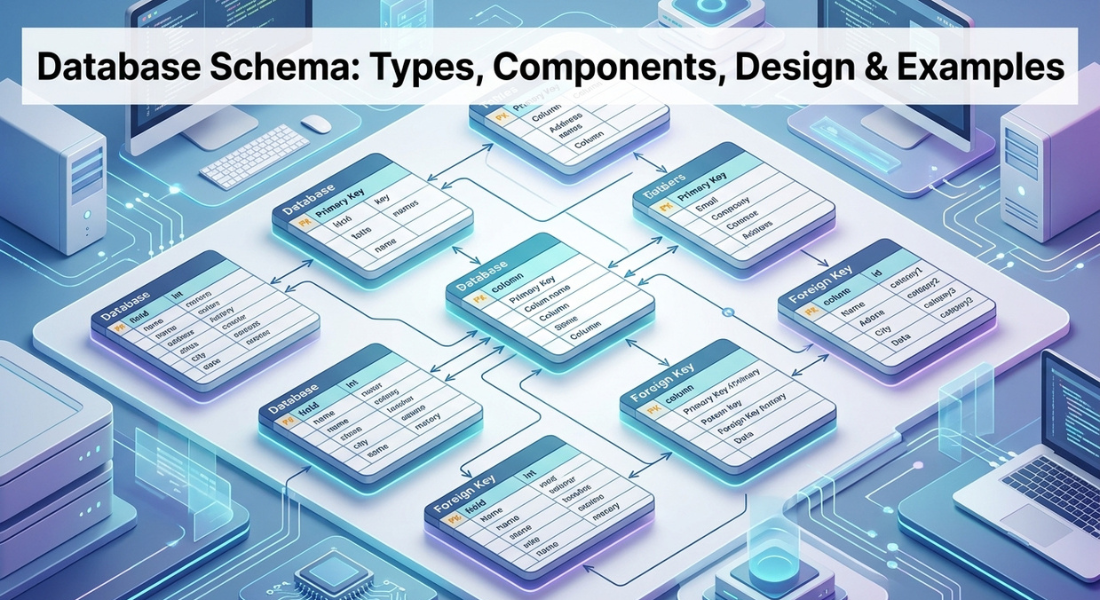
An online order needs customer, product and order information to connect correctly. A database schema defines how this information is organised, related and constrained. It provides the structural foundation for storing and managing data.
Understanding a database schema helps explain how different data elements work together. This guide covers schema components, levels, models, practical examples, design considerations and related schema concepts.
A database schema defines how information is structured, related and constrained.
Tables, columns, data types, keys, relationships and constraints form its core structural elements.
Conceptual, logical and physical schemas describe different abstraction levels.
Relational, entity relationship, star, snowflake and hierarchical approaches represent different structural patterns.
A schema defines structure, while a database instance contains the actual values at a particular time.
SQL can translate schema decisions into implemented database objects.

A database schema defines the expected structure and organisation of information stored in a database. It specifies elements such as tables, columns, data types, relationships, keys and constraints while the actual records can change independently over time.
Think of the schema as the agreed structure behind stored information. It establishes which entities exist which attributes describe them and how those entities connect.
The structure provides a consistent framework for applications and users without being the changing data itself.
A schema is comparatively stable while a database instance represents the values present at a particular moment. For example an Orders table can keep the same columns and relationships while thousands of new orders are inserted, updated or removed.
IBM distinguishes these two ideas by describing a database instance as a snapshot of data at a given time whereas the schema describes the structure those values follow.
Depending on the database system, a schema can define tables, columns, data types, primary keys, foreign keys, relationships and constraints. It can also encompass other database objects, such as views, procedures and functions where the system treats them as schema scoped objects.
Database schemas are one part of the broader database landscape, which covers how databases store, manage and use information across different systems and workloads. This is part of our complete guide on Database → see the full guide here.
The main components are structural elements that specify what information exists, how values are represented, how records connect and which rules they must follow. Together they turn an abstract information requirement into a defined structure that a database system can implement consistently.
A table represents a defined entity or collection of related records while columns describe the attributes stored for each record. For example, a Customers table might contain customer_id, name and email columns.
Each column also has a data type, such as integer, text, date or decimal. The type establishes what kind of value the column is designed to accept and helps keep stored values structurally consistent.
A primary key provides a way to uniquely identify each record in a table. A foreign key references a key in another table allowing the schema to express a relationship between related records.
A common example is a one to many relationship: one customer can have many orders while each order belongs to one customer. The keys make that relationship explicit rather than relying on duplicated customer information.
Constraints enforce structural rules. NOT NULL requires a value, UNIQUE prevents duplicate values within the defined scope, and CHECK restricts values according to a condition. Referential constraints also help ensure that referenced records remain valid.
Some systems treat views procedures and functions as objects associated with a schema. Microsoft SQL Server, for example, describes schemas as namespaces or containers for objects including tables, views, procedures and functions.
These terms describe related but different levels of database structure. A data model provides the approach for representing information a schema gives that approach a concrete structural definition, a database contains the organised information, and an instance describes the values existing at a particular time.
A data model is the conceptual approach used to represent and organise data. Relational, hierarchical and other modelling approaches provide ways to describe how information should be structured and related.
A schema is the concrete structural definition created using that model. For example a relational model can be implemented through specific tables, columns, keys and constraints that form the implemented schema. IBM describes schemas as translating a data model into rules that a database follows.
A database is the broader environment containing stored information and its associated structures. The schema defines a particular organisation within that environment.
The distinction matters because saying “the database” can refer to the overall stored information and structures while “the schema” refers specifically to the defined arrangement of objects, fields, relationships and rules.
Some systems also use “schema” as a namespace or container for database objects. In SQL Server for example schemas provide named containers for objects such as tables and views.
A database instance is the collection of actual data values represented by the schema at a particular point in time. Those values can change as records are inserted, updated or deleted.
The schema may continue defining the same Customers, Orders and Products structure while the instance changes every minute. This is why structure and data should not be treated as interchangeable concepts.
The three commonly discussed levels are conceptual, logical and physical. They describe the same underlying information at different degrees of abstraction moving from business meaning toward implementation detail. IBM identifies these three schema levels when explaining how database structures can be represented.
The conceptual schema provides the highest level view. It identifies major entities, important relationships and business requirements without concentrating on database specific implementation details.
For an online store, it might identify customers, orders and products as core entities and show that customers place orders containing products. At this stage the focus is on meaning and structure rather than column definitions or storage choices.
The logical schema makes the structure more precise. It can define attributes, relationships, keys and integrity rules while remaining largely independent of the specific storage technology used.
For example the conceptual idea of an order becomes a defined Orders structure with an identifier and a customer relationship. Related entities receive more precise attributes and connections creating a model that is ready for implementation.
The physical schema describes how the logical structure is translated into features specific to the chosen database system. It can reflect implementation details such as database specific object definitions and storage related structures.
The physical level therefore sits closest to the actual implementation. Its purpose is to describe how the defined structure exists within a particular database environment rather than changing the underlying business meaning.

“Schema type” can mean different things depending on the context. Some classifications describe abstraction levels, while others describe modelling patterns. The most useful structural models here are relational, entity relationship, star, snowflake and hierarchical approaches.
A relational schema organises information into tables containing rows and columns, with keys and relationships connecting related tables. This makes entities and their attributes explicit in a table based structure.
An entity relationship model represents entities, attributes and relationships before they are translated into an implemented relational structure. It is particularly useful for thinking through what the data represents and how different entities should connect.
A star schema places a central fact structure around related dimension structures producing a shape that resembles a star. It is commonly associated with analytical data organisation because the relationships are relatively straightforward to navigate.
A snowflake schema extends the idea by splitting some dimensions into additional related structures. This creates a more branching arrangement and can represent dimension relationships with greater structural detail.
A hierarchical schema organises information through parent child relationships creating a tree like structure. Each child typically belongs beneath a defined parent making the model suitable for naturally nested information.
This differs from relational structures where records can connect through keys across multiple tables rather than following one tree. Hierarchical organisation is therefore most intuitive when the underlying information naturally forms levels or branches.
Consider an online store with four core structures:
Customers → Orders → Order Items → Products.
Each table represents a distinct entity while keys connect those entities so the complete order can be understood without placing every detail into one oversized table.
The Customers table stores customer specific information while Orders records individual purchases. Products contains information about items the store sells.
Order Items connects orders with products and can store details such as quantity or the price captured for that order. Separating these entities prevents repeated customer and product information from being embedded in every order row.
Each table can have a primary key such as customer_id, order_id, order_item_id or product_id. Foreign keys then connect the related structures.
One customer can have multiple orders creating a one to many relationship. Likewise one order can contain multiple order items while each order item points to a product. The structure makes these relationships explicit.
A simple schema diagram for this example can be read from left to right:
Customers
│
│ 1 to many
▼
Orders
│
│ 1 to many
▼
Order Items
│
│ many to one
▼
Products
Start with a customer and follow the relationship to that customer's orders. From an order follow its order items to see which products were included. This gives a non specialist reader a direct path through the structure.
A useful schema starts with what the application needs to represent rather than with arbitrary tables. The goal is to create structures that accurately express required entities, relationships and rules while remaining understandable enough for developers and database users to work with confidently.
First identify the information the application must represent. An online store needs customers, orders and products because those entities have distinct meanings and relationships.
Define those relationships before finalising tables. Asking whether one customer can have many orders for example helps determine how the structures should connect rather than forcing the relationship into an unsuitable table design.
Columns should describe meaningful attributes rather than vague or overloaded values. A customer email, order date and product price each have different purposes and therefore need appropriately defined types.
Identifiers should also be stable and unambiguous. Clear naming conventions make relationships easier to understand especially when several tables contain similarly named concepts.
Constraints turn business requirements into enforceable structural rules. Use appropriate uniqueness, required value, validation and referential rules so the structure does not merely describe valid data but helps enforce it.
Before implementation, review the design for unnecessary duplication, ambiguous relationships and invalid connections. The aim is a structure that accurately represents the required information without introducing avoidable confusion.

SQL provides a way to express an implemented structure while information schema views provide metadata about database objects. Schemaless and schema on read approaches take a different route by allowing more flexibility in when and how structure is enforced.
A conceptual structure can become an implemented table through SQL. For example:
CREATE TABLE Customers (
customer_id INTEGER PRIMARY KEY
email VARCHAR(255) NOT NULL
);
This statement defines a Customers table with an integer primary key and a required email value. It demonstrates how structural decisions about columns, data types and keys can be expressed directly in SQL.
For database systems that support schema namespaces, SQL can also create a schema and place objects within it. Microsoft documents CREATE SCHEMA as one way to create a schema in SQL Server.
The information schema is a standardised metadata oriented collection of views describing database objects. PostgreSQL documents it as a set of views containing information about objects defined in the current database.
A system schema or system catalog is different: it is usually specific to the database implementation and can expose implementation specific metadata. PostgreSQL explicitly distinguishes its information schema from system catalogs which are tied to PostgreSQL specific details.
A schemaless approach allows data to be stored with a more flexible structure instead of requiring every record to conform to one rigid predefined schema. This does not necessarily mean that the data has no structure; structure may simply be enforced differently.
Schema on write applies structural rules before or as data is stored. Schema on read applies or interprets structure when data is retrieved. The distinction is mainly about when structural expectations are enforced.
A database schema defines structure rather than the changing records stored within that structure. It establishes entities, fields, data types, keys, relationships and constraints while conceptual, logical and physical levels describe the structure at different degrees of abstraction.
A clear schema gives developers and database users a shared understanding of how information fits together, making implementation and maintenance easier.
A database schema defines how data is organised, including tables, columns, relationships, keys, data types and constraints.
Key components include tables, columns, data types, primary keys, foreign keys, relationships and constraints.
The three levels are conceptual, logical and physical, representing business meaning, detailed structure and implementation.
A schema defines the structure and rules while an instance is the actual data stored at a specific time.
A data model provides the approach for organising data while a schema defines its specific structure.
Yes Some database systems support multiple schemas for organising and separating database objects.





Reader Discussion
Leave a Reply