- by Daily Talkin Staff
- July 8, 2026
-

-
-
Loading
Loading
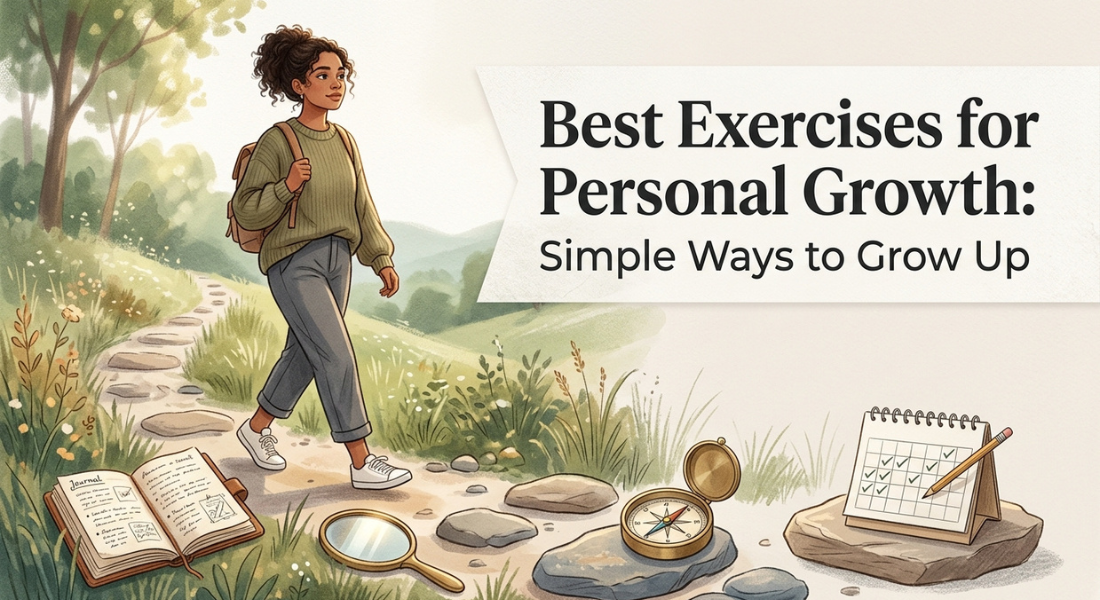
You may want to improve yourself but still wonder where to start. The best exercises for personal growth can turn self reflection into a practical step, helping you understand your habits, thoughts and behaviour.
These exercises are simple, purposeful and easy to practise consistently. Below are eight exercises covering self awareness, strengths, mindset, confidence, emotions, priorities and meaningful action
Choose an exercise according to the area you most want to develop.
Use reflective journalling to identify patterns in your behaviour and reactions.
Try reframing for more balanced thinking and affirmations for constructive self talk.
Use emotion tracking and priority exercises when reactions or competing demands are getting in the way.
Gratitude can support positive reflection, but its effects should not be overstated.
Turn one useful insight into a small, repeatable behaviour rather than attempting too many exercises at once.

Personal growth exercises are practical activities that help you examine your behaviour, develop your perspective and practise meaningful change.
Effective exercises have a clear purpose such as recognising patterns, identifying strengths, challenging unhelpful thoughts or clarifying priorities.
The best exercise is not necessarily the most complex. A short reflection that leads to one practical action can be more useful than a lengthy activity with no clear next step.
A useful exercise addresses a real need is easy to repeat and leads to a practical action. It should create insight, challenge unhelpful thinking, practise a behaviour or clarify priorities.
Choose an exercise based on your current need. Use journalling for self awareness, reframing for negative thinking, affirmations for self talk and prioritisation for competing demands.
Personal Development is the broader process of intentional improvement while these exercises focus on putting personal growth into practice.
These exercises focus specifically on putting personal growth into practice. For a broader overview see our complete guide to Personal Development → see the full guide here.
Reflective journalling helps you understand why you behave, react or make decisions in particular ways. Choose one recent situation and write what happened, how you responded, and what you were thinking or feeling.
Then identify what influenced your response, such as an assumption, fear, habit or pressure. Finish by asking what you would repeat or change next time.
For example if you repeatedly postpone difficult conversations journalling may reveal an assumption that disagreement will damage the relationship.
Use specific prompts such as: What happened? How did I respond? What emotion was strongest? What assumption influenced me? What went well? What would I change next time?
A short session once or twice a week can help identify recurring patterns. Focus on one situation at a time and turn repeated insights into one practical behaviour.
A strengths and values exercise helps when you know you want to grow but are unsure which qualities or priorities deserve your attention. It combines two questions: What am I capable of doing well, and what matters enough to influence my choices?
Start by recalling situations where you handled difficulty effectively, helped someone, solved a problem or produced a result you were proud of. Note the capability behind each example.
Then consider the values reflected in the choices you respect most. These might include honesty, learning, independence, reliability, creativity, kindness or courage.
The aim is not to create a perfect personality profile. It is to identify patterns that can make your everyday choices more intentional.
Look for repeated evidence rather than relying only on personality labels. Think about compliments you have received, problems people ask you to solve and situations where you remain effective under pressure.
For instance repeatedly helping people understand complicated information may point to communication or teaching ability. Handling unexpected problems calmly may indicate adaptability or practical problem solving.
Choose a small number of values that genuinely influence your decisions then compare them with how you spend your time and attention. If learning is important but you rarely make time to learn the gap itself is useful information.
You can then decide whether to change your behaviour or reconsider how important that value actually is.
Positive reframing is a practical positive thinking exercise that changes how you interpret a situation without pretending that everything is good. The goal is a more balanced view not forced optimism.
Start with a thought that appears after a setback or difficult event. For example: “I made a mistake in the meeting so I am terrible at communicating.” Separate the facts from the interpretation.
The fact may be that you struggled to explain one point. The conclusion that you are permanently bad at communication is an interpretation.
Now create a more accurate alternative: “I struggled with that explanation but I can identify what confused the discussion and practise it before the next meeting.” This approach keeps the difficulty visible while creating room for learning and action.
Use three stages: identify the automatic interpretation separate facts from assumptions then write a balanced alternative.
For example “I failed” might become “That attempt did not produce the result I wanted, and I now know one part of the approach that needs changing.” The second statement does not deny the setback it makes it more useful.
Reframing can be particularly useful after criticism, mistakes, rejection, setbacks or uncertain situations where your first interpretation becomes unnecessarily absolute.
It is less about replacing every negative thought with a positive one and more about checking whether your conclusion is supported by the available evidence.
Affirmation exercises can be used as a focused self talk practice, particularly when you want to reinforce a realistic capability or behaviour. They should not be treated as a guaranteed shortcut to confidence.
Begin with something you can reasonably support through action. Instead of writing “I am perfect at everything,” choose a statement such as, “I can prepare carefully and improve through practice.”
The strongest statements connect confidence with behaviour, effort or values. They remind you of something you can actually demonstrate rather than asking you to believe something that feels completely disconnected from experience.
You can also adapt the wording to a specific situation, such as speaking in a meeting, starting a difficult task or responding calmly to criticism.
A useful affirmation should feel credible enough to practise. Statements based on effort, learning and capability are usually more actionable than exaggerated claims.
For example “I can handle an unfamiliar task by breaking it into smaller steps” gives you something concrete to reinforce. It also points towards a behaviour rather than relying on positive words alone.
Attach one short statement to a routine you already perform such as making your morning drink or preparing for work.
Then pair the statement with a small action. If the affirmation concerns confidence in communication follow it by preparing one question before an important conversation. The behaviour gives the statement practical meaning.

An emotion and mood awareness exercise helps you notice what is happening internally before reacting automatically. The aim is not to eliminate difficult emotions but to understand the situation, response and possible next action.
Choose one recent moment when your emotional response was noticeable. Record the situation, identify the emotion, note any physical response and consider what happened immediately before it.
For example a delayed reply might trigger frustration followed by repeated checking of your phone. Looking at the sequence can reveal that uncertainty rather than the delay itself was driving the reaction.
Once you understand the pattern choose a response that fits the situation. Sometimes that may mean taking a short break, moving your body, talking to someone or returning to the issue later.
Use a simple sequence:
situation → emotion → trigger → response → alternative response.
Keep the description factual. Instead of judging yourself for feeling angry or anxious identify what happened and what you did next. This makes the exercise observational rather than self critical.
Over time repeated entries can show whether particular situations, assumptions or environments consistently produce the same response.
Choose an activity that matches what you actually need. A short walk or other movement may suit restlessness while social connection may help when isolation is the issue.
Other options include spending time outdoors, doing something enjoyable or taking a brief restorative break. These are mood boosting activities not guaranteed treatments so choose what is practical rather than assuming one activity works for everyone.
A personal priorities exercise is useful when too many demands compete for your time, energy and attention. Rather than trying to improve everything simultaneously identify what genuinely deserves attention now.
List your current commitments and the improvements you would like to make. Include everyday responsibilities as well as activities you keep saying you want to pursue.
Next look at where your resources are actually going. A priority that receives little time may not be a true priority in practice. Equally some demands may be necessary but temporary rather than central to your longer term direction.
Choose one immediate priority and decide what can be reduced, postponed or protected around it. The purpose is not to organise your entire life; it is to make one choice clearer.
Write down the activities currently consuming your time and energy then mark which ones genuinely require attention now.
Look for conflicts. If you want to practise a personal growth hobby but regularly spend that time on lower value commitments the problem may be competing priorities rather than lack of motivation.
Avoid giving every priority equal weight. Decide what needs protected attention what can remain flexible and what can temporarily receive less time.
A balanced approach may mean choosing one main area for growth while maintaining essential responsibilities. This is often more realistic than trying to make progress in every area simultaneously.
A gratitude and positive experience reflection asks you to examine something you genuinely appreciate rather than simply producing a list of pleasant things. The exercise can include a helpful person, a meaningful experience, a small success or an ordinary moment you valued.
Write down what happened and then explain why it mattered. Consider what the experience gave you, what someone did that you appreciated or what you learned from it.
Research on gratitude provides useful evidence but it does not justify promising guaranteed happiness. A 2025 meta analysis covering 145 papers, 163 samples and 24,804 participants across 28 countries found a small overall increase in well being from gratitude interventions with Hedges’ g = 0.19.
That makes gratitude worth treating as one optional reflective exercise rather than a universal solution.
Instead of writing “I am grateful for my friends” add why the experience mattered. You might describe a conversation that helped you through a difficult decision and explain what you valued about that support.
The extra reflection gives the exercise more personal meaning and makes it easier to recognise patterns in what you appreciate.
Use it during a short regular reflection particularly when you want to notice positive experiences or recognise progress that has been easy to overlook.
It can be useful at the end of a week or after a demanding period. Keep the practice optional and specific rather than treating gratitude as something you must perform to feel positive.
Reflection becomes more useful when it changes what you do. After completing any of the exercises above choose one insight and turn it into a small behaviour you can repeat.
Suppose journalling shows that you avoid difficult conversations because you rehearse every possible negative outcome. Your next step might be to prepare three points before one conversation instead of repeatedly thinking about it.
A useful way to make the behaviour concrete is to specify when and where it will happen. Research on implementation intentions has found that “if then” planning can help bridge the gap between intentions and action.
A review describes the approach as linking a specific situation with a planned response. The exercise therefore ends with behaviour not another round of reflection.
Take one insight and write a specific response to it. For example “If I notice myself avoiding an important conversation then I will spend ten minutes preparing the main points and arrange a time to speak.”
The action should be small enough to perform and specific enough that you will know whether you actually did it.
Start with one behaviour and review what happened after several attempts. If the action is too demanding reduce it rather than abandoning the entire practice.
Consistency matters more than collecting a large number of personal growth activities. A small behaviour that survives a busy week is more useful than an ambitious routine that lasts two days.

The best starting point depends on the problem you want to work on. If you need greater self awareness begin with reflective journalling. If you are unsure about your strengths or values use the strengths and values exercise.
For negative thinking try positive reframing. For constructive self talk use affirmations. If emotional reactions are the main difficulty track the situation and response. Use the priorities exercise when competing demands are taking over your attention.
Gratitude reflection suits someone who wants to pay more deliberate attention to meaningful positive experiences. If you already know what needs to change but struggle to act turn one insight into a weekly behaviour.
This makes exercise selection practical rather than arbitrary.
Choose one primary exercise first. Give it enough time to see whether it produces useful insight or behaviour before adding another. If two areas are closely connected you can combine them later.
For example journalling may reveal a thinking pattern that you then address through reframing. There is no need to begin with a large personal growth programme.
Many exercises can take only a few minutes while deeper reflection may work better as a weekly session. The right frequency depends on the activity and what you are trying to learn from it.
A short exercise repeated consistently is often easier to maintain than a demanding routine. If an activity repeatedly feels impractical, shorten it or reduce its frequency.
Personal growth does not require complicated routines or constant self analysis. The most useful exercise is one that matches your current needs and leads to a practical change you can maintain.
Start with one exercise practise it consistently and use what you learn to guide your next step. Over time, small actions can build greater self awareness, confidence and meaningful personal growth.
There is no single best exercise. Choose one that matches your needs such as journalling for self awareness or reframing for mindset.
Journalling and strengths and values reflection can help you understand your behaviours, values and recurring patterns.
Positive reframing helps you separate facts from assumptions and develop a more balanced perspective.
Realistic affirmations may support positive self talk especially when combined with practical action.
Choose one short exercise and make it part of an existing daily routine. Consistency matters more than duration.
It is usually better to start with one exercise that meets your main need then add others when it feels manageable.




Reader Discussion
Leave a Reply