- by Daily Talkin Staff
- July 8, 2026
-

-
-
Loading
Loading
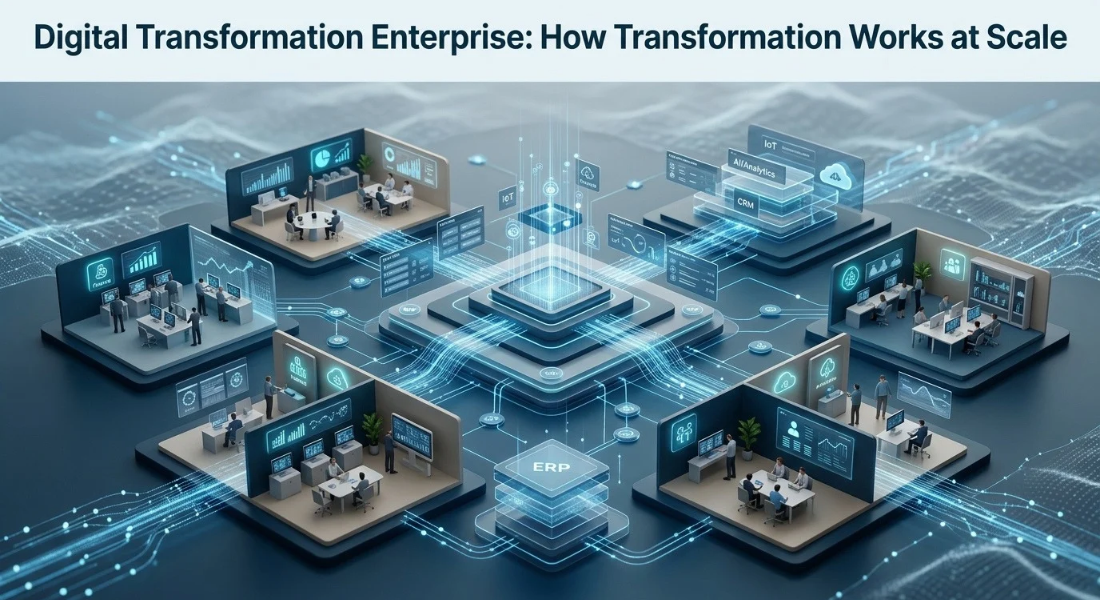
A large organisation can modernise one department while leaving its wider technology estate disconnected. Digital Transformation Enterprise is coordinated digital change across interconnected functions, systems, data and people.
This article explains what makes transformation enterprise level, how dependencies interact, and how governance and execution work across organisational boundaries.
Enterprise transformation is defined by cross organisational scope and interdependence, not company size alone.
Shared platforms, data, applications and architecture create dependencies between transformation initiatives.
Enterprise governance needs to standardise areas where consistency creates value while preserving justified business unit flexibility.
Enterprise architecture connects business capabilities, applications, data and technology across organisational boundaries.
Portfolio coordination should consider dependencies, shared capabilities, decision rights and enterprise level outcomes.
Progress should be assessed by improved enterprise capability and coordination, not project delivery alone.

Enterprise transformation becomes enterprise level when digital change crosses organisational boundaries and must coordinate multiple business units, functions, systems, data environments, operating processes and decision makers.
It is therefore defined by interdependence and scope not simply by the amount of technology involved.
Enterprise scale is better understood through the breadth and interdependence of change than employee count alone. A transformation may span several business units, countries, functions, customer journeys and technology estates.
The OECD defines large firms in its business statistics as those with 250 or more employees but firm size alone does not determine transformation complexity.
An isolated digital initiative normally addresses a defined capability, process or system. An enterprise programme coordinates initiatives when they affect shared capabilities, multiple functions or common technology and data environments.
The distinction matters because a successful individual project can still create enterprise problems if it introduces another platform, data definition or interface that conflicts with systems elsewhere.
The broader Digital Transformation pillar covers the overall concept, strategy, technologies, implementation and outcomes.
This article focuses specifically on what changes when transformation operates across a complex enterprise. See our complete Digital Transformation guide → for the broader topic overall.
An individual digital initiative usually has a defined functional boundary while enterprise transformation coordinates multiple initiatives connected through shared systems, data, platforms, processes and decision rights.
The enterprise view therefore manages relationships between changes rather than treating each project as independent.
Enterprise transformation | Individual digital initiative |
Cross organisational scope | Defined functional scope |
Multiple connected initiatives | Usually one primary initiative |
Shared enterprise dependencies | Fewer dependencies |
Enterprise level governance | Project or programme governance |
Multiple systems and functions | Specific systems or processes |
Longer coordinated horizon | Defined project lifecycle |
Shared decision making | More limited decision making |
An enterprise transformation can contain individual digital initiatives but the initiatives operate within a wider structure. The distinction is particularly important where several projects depend on the same platform, data source, identity service or integration layer.
Treating enterprise transformation as a collection of unrelated projects can create duplicated platforms, fragmented data and conflicting technical decisions. One business unit may solve its local problem while increasing integration work for another.
The result is not necessarily project failure. Each initiative may meet its immediate objectives while the enterprise accumulates incompatible capabilities, duplicated costs and additional coordination requirements.
An enterprise specific view can be understood through interconnected layers: operating model, applications and platforms, data, processes, people and governance. The important point is not the layers individually but how decisions in one layer affect capabilities elsewhere.
Enterprise application transformation concerns how shared applications and platforms support multiple parts of the organisation. Architectural decisions should consider integration, interoperability, reuse and whether a capability can serve more than one business unit.
Shared platforms can reduce repeated development when they are designed for reuse. MIT CISR's recent research describes strong enterprise IT leadership, modularity and reuse as important dimensions of enterprise IT operating models.
Enterprise data transformation concerns coordination rather than simply analytics. It includes who owns important data, how it is accessed, how quality is maintained,and how systems exchange it and where it can be reused.
A customer, product or transaction record may be used by several applications. If each function maintains a different definition or source downstream transformation initiatives inherit reconciliation and integration problems.
The operating model determines who makes technology decisions, who owns shared capabilities and how IT and business units collaborate.
MIT CISR defines an enterprise IT operating model through accountabilities, processes, platforms, metrics and behaviours, including the roles of IT and business units.
This makes organisational design part of the enterprise architecture problem. Decision rights need to support both shared capabilities and legitimate business unit requirements.
Enterprise transformation dependencies matter because initiatives rarely operate independently. A change to one capability can create prerequisites, constraints or downstream effects for applications, data, processes, security controls, operating models and employee workflows elsewhere.
Dependency mapping shows why sequencing cannot be based only on which project appears most attractive.
For example:
Legacy modernisation → application integration → data availability → process redesign → workforce adoption
The arrows represent potential relationships rather than a universal sequence. A specific enterprise may have several paths running simultaneously with one shared capability serving multiple initiatives.
Identity services, shared data, integration layers, enterprise platforms, security controls and common processes can connect projects that appear unrelated.
A customer experience initiative for example may depend on identity management and customer data owned elsewhere. If those shared capabilities are not ready the customer facing initiative may need temporary workarounds or a revised sequence.
The World Economic Forum describes this problem at industrial scale, noting that large networks can involve dozens or hundreds of sites using different legacy systems, standards and approaches.
Enterprise transformation needs clear decisions about what should be shared and what should remain locally controlled.
Standardisation can improve interoperability and reuse while business unit autonomy can preserve flexibility where customers, markets, regulations or operating requirements genuinely differ.
Consistency generally has greater value where capabilities are shared. Suitable candidates can include common data definitions, security controls, interoperability requirements, architectural principles, selected platforms and governance standards.
The objective is not to make every process identical. It is to prevent unnecessary differences from creating duplicated capabilities or blocking integration between business units.
Business units may need flexibility for customer facing capabilities, local workflows and market specific requirements. A global organisation serving different regulatory environments may not be able to operate every process identically.
The decision should therefore consider the source of enterprise value. If standardisation improves reuse or control central coordination may help. If local variation reflects a genuine business requirement decentralised decision making may be more appropriate.
Enterprise architecture connects business capabilities with applications, data and technology. It gives leaders a structural view of how local decisions affect interoperability, reuse and longer term enterprise choices.
MIT CISR's operating model research similarly frames enterprise IT around the relationship between enterprise leadership, business units, platforms and reuse.
Its 2025 research analysed 39 interviews across 30 companies and used a survey of 152 enterprises to develop its operating model framework.
Enterprise scale transformation increases the difficulty of existing technology and organisational problems because more systems, owners, interfaces and decision makers become connected.
The challenge is therefore coordination across the estate rather than simply solving individual technical problems.
Legacy complexity becomes harder when old systems serve multiple business units or exchange data with other platforms. Duplicated applications, incompatible interfaces and limited integration options can constrain the sequence of modernisation.
McKinsey identifies fragmented processes and complex legacy technology as obstacles to scaling digital automation particularly where multiple technologies perform similar tasks.
Departments can optimise locally while creating enterprise level duplication. One unit may prioritise speed, another cost control, and another regulatory requirements producing competing investment decisions.
The issue is not simply that teams work separately. It is that separate ownership can produce different technology standards, data definitions or capability choices that later need to be reconciled.
Enterprise integration increases the number of interfaces and relationships that need oversight. Shared platforms can also create wider security, privacy and compliance implications because a control or architectural decision may affect several business units.
Governance therefore needs clear decision rights. Without them teams can either wait for excessive central approval or make local decisions that create downstream constraints.

Enterprise coordination is a portfolio activity rather than another generic transformation roadmap.
Leaders first establish the enterprise baseline, identify shared capabilities and dependencies, group connected initiatives, assign decision rights, sequence work and continually reassess cross initiative effects.
Start by mapping major business capabilities, applications, data environments, shared platforms, dependencies and active transformation initiatives.
This creates a common reference point before priorities are changed. Without it leaders may approve new initiatives without seeing that several projects already depend on the same legacy system, integration layer or data capability.
Enterprise prioritisation should consider business value alongside dependency chains, risk and feasibility. A project with high local value may need to wait if another initiative must first deliver a shared capability.
This approach also identifies opportunities to group initiatives around reusable platforms, data capabilities or common services rather than funding several parallel solutions.
Once dependencies are understood, initiatives can be sequenced around prerequisites and shared capabilities. Decision rights should identify which issues stay within a programme and which require enterprise level intervention.
MIT CISR's research describes the enterprise IT operating model as the mechanism through which accountabilities, processes, platforms, metrics and behaviours are organised across IT and business units.
The portfolio should then be reassessed as dependencies change, new requirements appear or business conditions shift.
Enterprise scale scenarios become clearer when several functions or business units depend on the same capabilities. The following examples are deliberately illustrative: their purpose is to show why the transformation cannot be treated as one isolated technology project.
A large organisation modernises a core application used by finance, operations and customer facing teams. The replacement cannot simply be deployed as a standalone system because existing applications still depend on its data and interfaces.
The transformation therefore has to coordinate migration, integration, shared data and business unit requirements while the legacy environment continues operating.
Imagine an organisation with fragmented customer and operational data across regions. Each region may have developed useful local systems but enterprise reporting and shared services require compatible data structures and integration.
The enterprise problem is therefore not simply choosing a new data platform. It involves ownership, integration, access, quality and the relationship between the platform and the applications that consume it.
Several business units may need different customer experiences while sharing identity, security, data and platform capabilities.
Each unit can retain appropriate control over its customer journey while common enterprise capabilities prevent unnecessary duplication. This illustrates why enterprise transformation often combines shared foundations with local execution.

Enterprise progress should be assessed through the health of the overall transformation system not only through individual project completion.
Useful indicators include dependency resolution, shared capability reuse business unit alignment, integration progress and movement towards a coherent target state.
A completed deployment does not automatically mean that enterprise capability has improved. A platform may be technically live but poorly adopted across the functions that were expected to use it.
Assessment should therefore ask whether the capability works across its intended organisational boundary and whether dependent initiatives can use it as planned.
Track whether prerequisite capabilities become available when downstream initiatives need them. Also monitor whether changes in one programme introduce unexpected constraints elsewhere.
This makes dependencies visible as operational conditions rather than treating them as static items in an initial project plan.
Enterprise leaders can examine whether shared platforms, data and capabilities are being reused where appropriate. At the same time they should check whether business units retain flexibility where local requirements justify it.
MIT CISR's research distinguishes between local decision making with limited reuse and stronger enterprise IT leadership that creates reusable platforms, modules and data.
The final question is whether separate initiatives are moving towards a coherent enterprise capability. Progress should be reviewed as conditions change rather than assuming the original portfolio remains correct indefinitely.
This keeps assessment focused on enterprise coordination without reducing transformation to a list of project level metrics.
Enterprise digital transformation is fundamentally a coordination problem at organisational scale. Its difficulty comes from aligning business units, applications, data, platforms, dependencies, decision rights and operating structures.
The practical test is whether separate initiatives can work together as parts of a coherent enterprise capability rather than becoming disconnected projects that solve local problems in isolation.
Digital transformation enterprise refers to coordinated digital and organisational change across interconnected functions, business units, systems, data environments, processes and organisational capabilities.
The defining feature is cross organisational scope and interdependence. Company size or the number of technologies involved does not alone determine whether transformation is enterprise level.
It is an initiative that contributes to an enterprise level capability particularly when it depends on or changes shared platforms, data, applications, processes or organisational capabilities.
Initiatives often rely on shared applications, data, platforms, architecture or organisational capabilities. A change in one area can therefore create prerequisites or constraints elsewhere.
Enterprise architecture connects business capabilities with applications, data and technology. It helps leaders manage interoperability, reuse and structural decisions across organisational boundaries.
Neither model applies universally. Shared capabilities and governance may require enterprise coordination while business units may retain flexibility where customers, markets or local requirements differ.


Reader Discussion
Leave a Reply