- by Daily Talkin Staff
- July 8, 2026
-

-
-
Loading
Loading
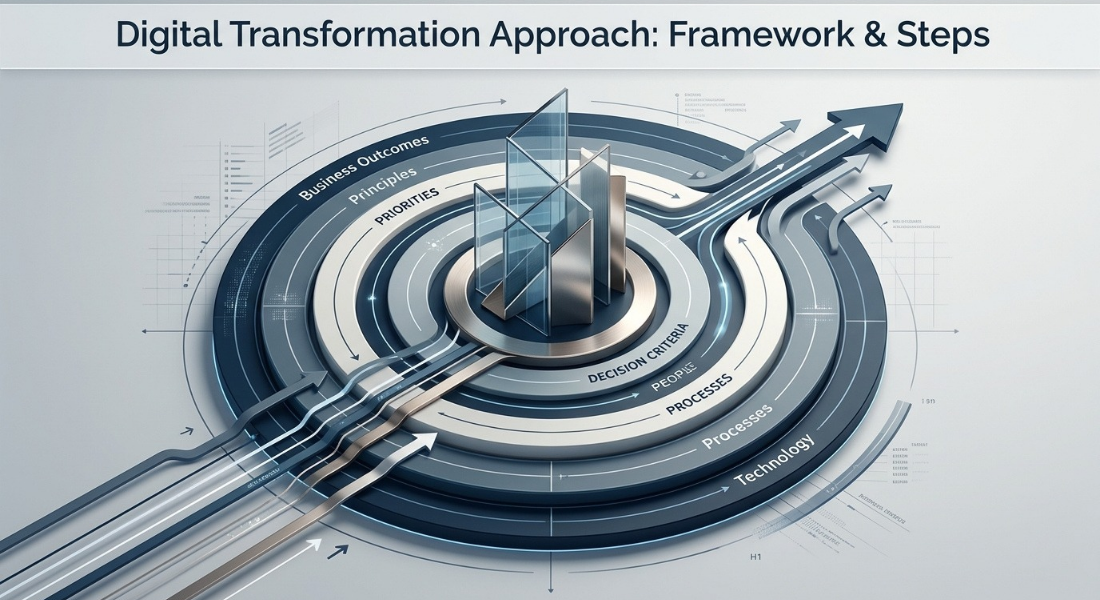
An organisation can have strong technology and still lack a coherent digital transformation approach. The approach provides a structured way to decide how transformation should be framed, organised and prioritised.
This article explains the core principles, components and decision criteria behind an effective approach, along with how planning and a transformation framework fit into the overall structure.
A digital transformation approach defines how an organisation structures and prioritises transformation decisions.
An approach differs from strategy, framework and process because each serves a different role.
Strong principles connect transformation to outcomes, meaningful business areas, value, feasibility and readiness.
Core components include objectives, principles, scope, priorities, decision criteria and ownership.
Planning should connect objectives to priorities and initiatives without becoming a separate project management exercise.

A digital transformation approach is the structured way an organisation decides how to frame, organise and prioritise transformation. It establishes the reasoning behind transformation decisions rather than describing the transformation itself.
The distinction matters because transformation can involve many related decisions. An approach provides a consistent basis for deciding which changes belong together, what deserves attention and how different initiatives should support shared objectives.
McKinsey similarly emphasises focusing transformation on specific business domains that can generate meaningful value rather than treating individual technology use cases as isolated efforts.
Digital transformation covers the broader relationship between technology, people, processes, strategy, outcomes and organisational change. This cluster focuses only on how to structure the approach. This is part of our complete Digital Transformation guide → see the full guide here.
A coherent approach normally connects several elements:
desired outcomes
guiding principles
scope and focus
decision criteria
transformation priorities
organisational alignment
a framework for coordinating related initiatives
Together these elements create a consistent basis for transformation decisions.
Without an explicit approach, organisations can accumulate disconnected initiatives, competing priorities and technology led decisions.
A clear approach gives Business Leaders, Technology Leaders and cross functional teams a shared logic for deciding what should be pursued what should wait and how separate initiatives relate to the same transformation objectives.
These terms overlap but they describe different layers of transformation thinking. The approach explains how transformation is tackled while strategy establishes direction a framework provides structure and a process defines ordered activities.
A Digital Transformation Approach describes how transformation is tackled. It establishes the principles, scope and decision logic used to organise the work.
A Digital Transformation Strategy describes what direction and priorities the organisation chooses. The strategy therefore establishes the intended direction while the approach provides the reasoning and structure used to tackle that transformation.
A Digital Transformation Framework provides an organising structure or model for transformation. It can group concepts, decision areas or stages into a usable structure.
The approach determines how that framework should be selected and applied to the organisation's circumstances. A framework can therefore support an approach without being identical to it.
A Digital Transformation Process describes an ordered set of activities. It answers questions about what happens and in what sequence.
An approach sits behind those activities. It establishes the reasoning, principles and decision criteria that determine how the process should be structured for a particular organisation.
What Principles Should Guide a Digital Transformation Approach?
The strongest principles keep transformation decisions connected to organisational value, meaningful areas of change and practical constraints. They also leave enough flexibility to adapt when evidence or organisational conditions change.
Transformation should begin with a clearly understood organisational outcome rather than with a technology looking for an application. This means asking what needs to change and why before considering Artificial Intelligence, Cloud Computing, Automation or Data Analytics.
McKinsey's guidance similarly states that digital and AI transformations should start with the business problem to be solved. The technology becomes a means of supporting the intended outcome not the reason for defining the transformation.
An approach should identify a meaningful transformation domain rather than scatter attention across unrelated use cases. A transformation domain might centre on a customer journey, business process or functional area with clear ownership and outcomes.
McKinsey describes the useful scope as large enough to matter but small enough to transform without excessive dependence on unrelated parts of the organisation.
A practical decision should balance three factors:
Value + feasibility + readiness
Value asks whether the change addresses something worthwhile. Feasibility considers whether the organisation can realistically pursue it. Organisational Readiness considers whether the necessary capabilities, ownership and alignment exist.
Using all three prevents attractive opportunities from being selected solely because they promise high value.
An approach should provide structure without becoming a rigid formula. New evidence can change assumptions about scope, feasibility or value.
Organisational learning can also reveal that a priority needs to be narrowed, expanded or reconsidered. Adaptability therefore belongs in the approach itself rather than being treated as an exception to it.
The core components are the building blocks that connect transformation objectives with consistent decision making. They translate broad intent into a controlled set of priorities while keeping ownership and criteria visible.
Objectives establish what the organisation is trying to accomplish through transformation. Transformation Principles establish how decisions should be made consistently while pursuing those objectives.
For example an organisation might require transformation decisions to remain connected to measurable business value or to a clearly defined transformation domain.
The two components work together: objectives establish the destination while principles influence the choices made along the way.
Scope defines where the approach applies. Priorities determine which areas deserve attention first while Transformation Initiatives represent the related pieces of change within those boundaries.
This prevents broad objectives from becoming an uncontrolled collection of projects. The aim is to create a deliberate relationship between the transformation objective, the areas selected for attention and the initiatives that support them.
Explicit decision criteria help teams assess opportunities consistently rather than relying on individual preferences. Ownership is equally important. Business Leaders, Technology Leaders and cross functional teams need clarity about who is accountable for decisions and outcomes.
McKinsey's glossary describes domain ownership as senior business accountability for outcomes within a transformation domain.

The appropriate approach depends on the organisation's starting point, the scope of change, the value being sought and the decisions that must be coordinated. There is no single structure that fits every transformation context.
An organisation's scale, existing capabilities, technology constraints and desired change all influence the appropriate approach.
A company with established digital capabilities may need a different decision structure from one dealing with significant capability gaps or fragmented systems. The approach should reflect these conditions rather than assume an ideal starting point.
A focused transformation area may require a relatively contained decision structure while cross functional or enterprise wide change requires stronger alignment between related domains.
Scope should therefore be large enough to address the intended outcome but controlled enough for teams to maintain clear ownership and decision coherence.
The intended value can influence how transformation decisions are structured. An organisation seeking operational improvement may focus its approach around business processes and efficiency.
A customer experience objective may require attention to an end to end customer journey while a new capability objective may require a different combination of organisational and technology considerations.
Artificial Intelligence, Cloud Computing and Automation can create useful opportunities but their availability should not determine the transformation approach.
Starting with a technology can reverse the normal decision logic the organisation first selects a capability and then searches for a problem. A sound approach starts with the desired outcome and determines whether a technology can contribute to it.
Digital Transformation Planning should translate the chosen approach into a coherent logic for deciding what receives attention and how related initiatives connect. It is planning logic not a substitute for the organisation's broader approach.
The relationship can be kept simple:
Objectives → priority areas → initiatives
Objectives establish what matters. Priority areas identify where attention should be concentrated. Transformation Initiatives then connect specific areas of change to those priorities.
This keeps planning anchored to the approach rather than allowing individual initiatives to define the transformation agenda independently.
Planning should establish dependencies, priorities and decision points before committing to particular technology choices.
For example an organisation may first need to decide which business area warrants transformation and what outcome defines success before assessing whether APIs, Automation or another technology should support that area.
Planning becomes useful when it reflects the principles and decision criteria already established. If the approach prioritises business value, the planning logic should preserve that emphasis.
If it defines transformation around specific domains planning should maintain those boundaries instead of becoming an unrelated project management exercise.
A useful framework acts as a decision architecture. It connects direction, principles, criteria, priorities and review points without turning into a detailed implementation roadmap.
First establish the organisational change the approach is intended to support and the boundaries within which decisions will be made.
This gives later decisions a reference point. Without defined direction priorities can shift according to whichever initiative or technology receives attention at a particular moment.
Principles and decision criteria determine which opportunities deserve attention and which should be excluded.
For example an opportunity may need to demonstrate meaningful business value, fit the defined scope and remain feasible given current organisational capabilities. The criteria make these judgements more consistent.
Related Transformation Initiatives should reinforce shared objectives rather than operate as disconnected projects.
A coherent portfolio makes relationships between priorities visible. It also helps Executive Leadership and cross functional teams recognise where separate initiatives depend on, support or compete with one another.
An adaptable framework allows assumptions and priorities to be reconsidered as evidence changes.
Review points do not mean constantly redesigning the approach. They provide deliberate opportunities to test whether the original direction, scope and decision logic still fit the organisation's circumstances.

Most approach related mistakes come from weak decision logic rather than a lack of available technology. Three problems are particularly easy to identify.
Choosing a technology first can make the transformation agenda revolve around what the technology can do rather than what the organisation needs to change.
This is especially relevant when emerging technologies create pressure to demonstrate adoption before a meaningful business problem has been defined.
An approach needs explicit prioritisation logic. Without it every initiative can appear urgent and resources become distributed across too many competing areas.
McKinsey's research highlights the importance of concentrating transformation efforts on a limited number of meaningful business domains rather than spreading resources across an uncoordinated collection of initiatives.
A framework should support the organisation's circumstances rather than become a rigid formula. The same structure may not suit different organisational scales, capabilities, scopes or transformation objectives.
The framework is useful only when its decision logic remains relevant to the context in which it is applied.
A digital transformation approach is the decision framework for how an organisation structures and prioritises transformation, not a synonym for strategy, technology adoption or implementation.
The strongest approaches connect clear principles with defined components, decision criteria and planning logic while remaining adaptable as circumstances change. The central test is simple: does the approach keep transformation decisions coherent, purposeful and connected?
A digital transformation approach is the structured way an organisation frames, organises and prioritises transformation decisions using defined principles, scope, criteria and planning logic.
An approach explains how transformation is tackled while strategy establishes the direction and priorities the organisation chooses.
Core principles include starting with outcomes, focusing on meaningful business areas, balancing value with feasibility and readiness, and keeping the approach adaptable.
It should include objectives, transformation principles, scope, priorities, decision criteria, ownership and planning logic that connects related initiatives.
Consider the organisation's starting point, scope of change, intended value, organisational readiness and the decisions that need to be coordinated.
No A framework supplies an organising structure while an approach determines how that structure is selected and applied to the organisation's circumstances.


Reader Discussion
Leave a Reply