- by Daily Talkin Staff
- July 8, 2026
-

-
-
Loading
Loading
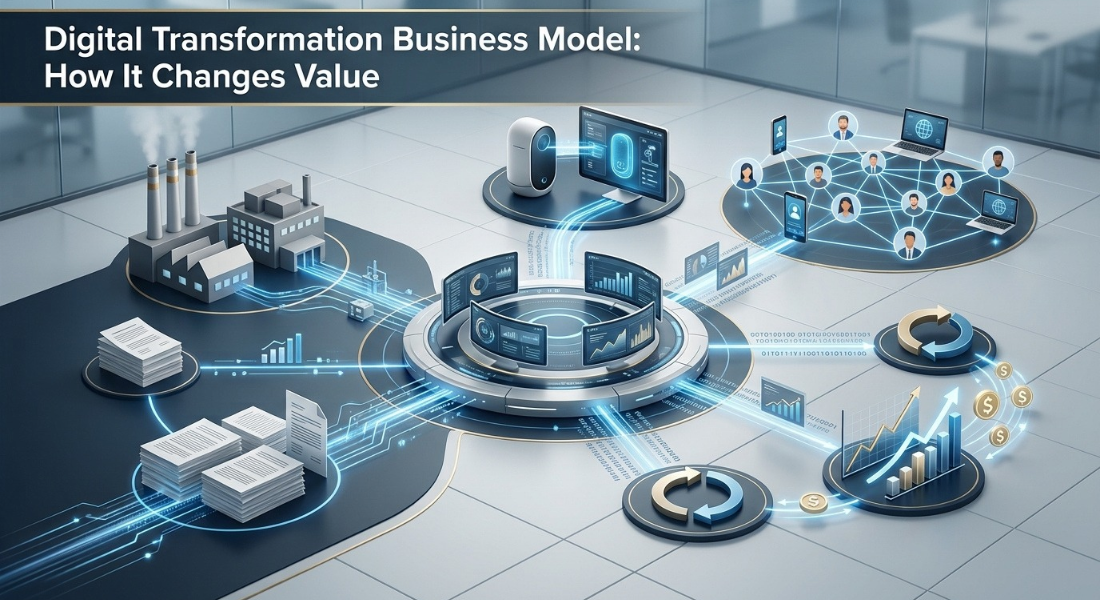
A business can add digital capabilities without changing the logic that makes it valuable. A Digital Transformation Business Model changes how an organisation creates, delivers, and captures value.
This article explains the key business model components, common transformation patterns, practical examples, and how to assess whether digital change has genuinely reshaped the model.
A digital business model explains how an organisation creates, delivers and captures value using digital capabilities.
Transformation can affect value propositions, customers, channels, relationships, activities, resources, partners and value capture.
Product to service, subscription, platform, ecosystem, data enabled and outcome based models are common transformation patterns.
Adding a digital channel does not automatically mean the business model has changed.
The strongest diagnostic looks for connected changes across several business model components.
Value creation, delivery and capture should remain aligned after the model changes.

A business model consists of connected choices about the value offered, customers served, relationships maintained, activities performed, resources used, partners involved, delivery channels, and value captured.
Digital transformation can change one or several of these elements together. The important point is that business model change is not limited to revenue.
A new digital service may require different customers, channels, capabilities, partners and activities before the organisation can capture value from it.
A useful architecture is:
Value proposition → customers → relationships and channels → activities and resources → partners → value creation and delivery → value capture
A change in one part can therefore affect the others. Research on digital business-model innovation similarly identifies changes to value proposition, value creation, delivery and capture as central to business model change.
Digital transformation covers the wider shift across technology, people, processes and business capabilities. This cluster focuses specifically on business model change within that wider subject. See our complete Digital Transformation guide → see the full guide here.
Digital capabilities can shift an offer from a physical product or one off transaction towards a connected product, ongoing digital service, personalised service or outcome based proposition.
The progression can be simple product → service → outcome. The customer may no longer pay mainly for ownership of an asset, but for continuing access, performance or a defined result.
Digital models can expand the customers a business can reach and change how those customers access the offer. Websites, platforms, self service channels and connected services can create more continuous interactions.
The relationship can therefore move from a single purchase to ongoing engagement while multi sided models can connect customers with suppliers, providers or other users.
The clearest way to understand business model transformation is to separate three connected questions How is value created?, How is it delivered?, and How is value captured?
Digital transformation can alter all three. A business might use customer data to improve the proposition, deliver it through a digital channel, and capture value through a subscription rather than a one time sale.
This alignment matters. Research on business model innovation shows that changes in value creation and value capture need to remain connected rather than being treated as separate decisions.
Digital capabilities can change which resources and activities generate customer value. Data, connected products, user participation, digital services and partner networks can become part of the value creation process.
The OECD notes that data, user participation, network effects and user generated content are commonly observed in highly digitalised business models.
Delivery can move towards digital channels, platforms, self service or continuous service relationships. This can change when, where and how customers receive value.
Value capture can also shift towards subscriptions, usage based pricing, platform commissions, service contracts or other recurring mechanisms. The revenue mechanism matters, but it is only one part of the transformed model.
A traditional model does not need to disappear completely. Digital transformation can modify selected components or change the underlying logic connecting several components.
Traditional model | Digitally transformed model |
One time product sale | Subscription or recurring service |
Physical distribution | Digital or self service delivery |
Product focused relationship | Continuous customer relationship |
Linear value chain | Platform or ecosystem |
Manual service | Digitally enabled service |
Limited customer information | Data informed value delivery |
These are patterns rather than mandatory stages. A manufacturer might retain physical products while adding a connected service whereas another organisation might redesign its entire proposition around digital access.
The OECD Oslo Manual describes comprehensive business model innovation in existing firms as including expansion into new products or markets, replacement of previous activities with new ones, or changing the model supporting an existing product.
Adding an online channel may change distribution without changing the underlying model. By contrast, moving from selling equipment to equipment as a service can alter the proposition, customer relationship, activities, risks and value capture.
The difference is whether digital change modifies one touchpoint or the logic connecting several business model components.

Several recurring patterns show how digital capabilities can reshape business model logic:
Product to service: a physical product becomes part of an ongoing service.
Subscription: customers pay regularly for continuing access or provision.
Platform: the business facilitates interactions between different participant groups.
Ecosystem: partners contribute complementary capabilities around a shared proposition.
Data enabled: data improves an existing offer or supports a new service.
Outcome based: customers pay around an agreed result rather than simply receiving a product.
These patterns can overlap. A connected equipment company for example could combine a product to service model with subscriptions, data enabled services and outcome based pricing.
The OECD describes digital models in which products deliver services over time and notes that subscriptions or pay as you use arrangements can support more continuous value capture.
A platform model fits situations where value depends on interactions between distinct participant groups, such as buyers and sellers. An ecosystem model goes further by combining complementary organisations around a wider proposition.
For context OECD research found that among European OECD small businesses selling online 29% of small firms and 24% of medium sized firms obtained at least 20% of their online sales through e commerce marketplaces.
The clearest examples show a change in business logic rather than simply the introduction of a digital tool. The following patterns demonstrate how several business model components can move together.
A manufacturer that once sold equipment as a standalone product can add monitoring, maintenance and continuing service around that equipment.
The proposition changes from ownership alone towards ongoing performance. Customer relationships become continuous, activities include service delivery, and value capture can move towards recurring contracts.
A business can replace or supplement individual purchases with recurring access to a product or service. This changes the timing and structure of the customer relationship.
Instead of completing the relationship at purchase the organisation has an ongoing obligation to deliver useful service. The model therefore connects continuing value delivery with recurring value capture.
A business that previously provided most of the value itself can instead coordinate customers, suppliers, service providers or complementary businesses.
Digital platforms can reduce the need for every participant to operate independently by facilitating interactions between them. The business model consequently depends more heavily on participation, matching, relationships and network value.
A focused diagnostic can reveal whether digital transformation has changed the business model or merely added a digital channel.
Ask five questions:
Has the value proposition changed?
Has the target customer or customer relationship changed?
Has the delivery mechanism changed?
Have activities, resources or partners changed?
Has the value capture mechanism changed?
The more connected components that change the stronger the evidence of business model transformation. A new app alone tells you little if the same proposition, customers, activities, relationships and revenue mechanism remain intact.
The OECD's framework also recognises that firms can change the model supporting existing products including shifts towards digital models with new processes and service characteristics.
The final test is alignment: does the new way of creating and delivering value support the way the organisation captures value? If those elements no longer fit, the model may need further redesign.

No Adding an app website or online channel may simply change how customers access an existing offer.
If the value proposition, customer relationship, activities and value capture remain substantially unchanged, the organisation may have improved a channel or process rather than redesigned its business model.
A digital transformation business model is best understood through the changes it makes to value proposition, customers, relationships, activities, delivery and value capture.
Digital capabilities become business model innovation when these elements are meaningfully reshaped or connected in a new way.
The most useful test is alignment the customer proposition, value creation logic and value capture mechanism should support the same underlying model.
It uses digital capabilities to change how a business creates, delivers and captures value.
It can change the value proposition, customers, delivery, partnerships and value capture.
Examples include subscription, platform, ecosystem, product to service and data enabled models.
A digital business model defines value logic while digital transformation is the broader organisational change that can reshape it.
Yes Digital capabilities can extend, replace or redesign parts of an existing business model.
No A business can change other model components while keeping its existing value capture mechanism.


Reader Discussion
Leave a Reply