- by Daily Talkin Staff
- July 8, 2026
-

-
-
Loading
Loading
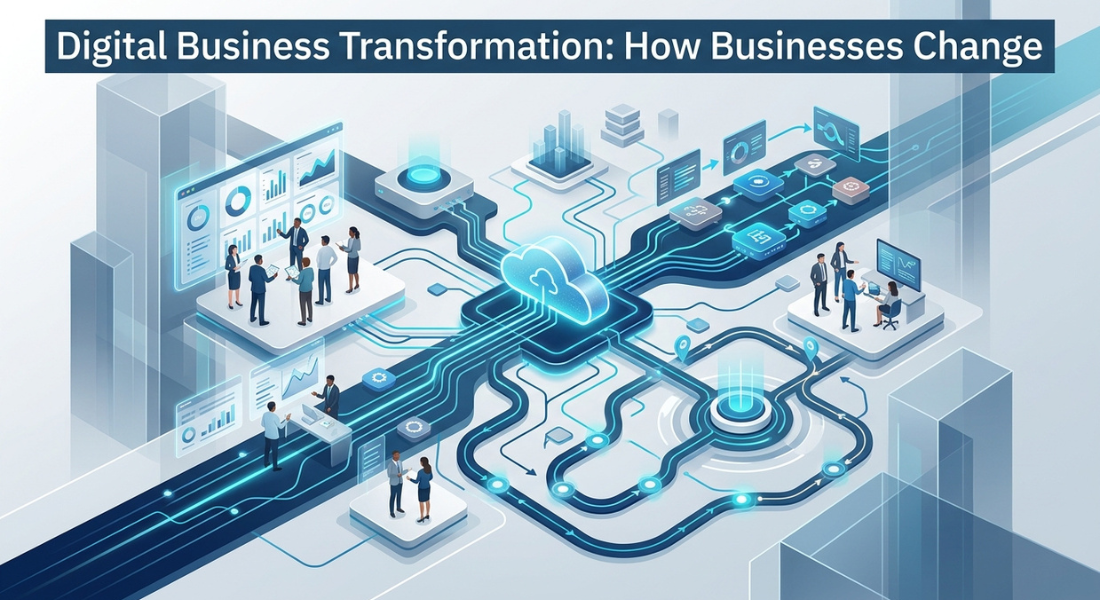
A company can invest in the latest technology and still operate much the same way. Digital Business Transformation begins when technology changes how the business actually works, not simply which tools it uses.
Digital Business Transformation happens when digital capabilities reshape business processes, customer value, operating models, ways of working and value creation. It goes beyond adding technology to an existing operation.
Digital Business Transformation changes how a business operates, creates value and serves customers through digital capabilities.
Technology adoption becomes transformation when it changes an underlying business capability rather than simply adding a new tool.
The deepest changes can affect processes, customer/value delivery, operating models, ways of working and business models.
Data, analytics, automation, AI, APIs and connected platforms matter because of the business changes they enable.
A transformative initiative should leave the organisation with a changed capability and a measurable business outcome.

Digital Business Transformation changes how a business operates creates value or serves customers not simply which tools it uses. Technology becomes transformative when it changes processes, decisions, customer value or business capabilities.
Digitalisation usually improves an existing activity. For example replacing paper invoices with digital invoices makes the process faster but may not change how the business operates.
Automatically matching invoices with orders, routing exceptions and redesigning responsibilities represents deeper business transformation.
The key difference is improvement versus fundamental change. Technology enables the transformation, but the changed business capability or value delivery makes it transformative.
Digital capability creates business change through a simple chain:
Digital capability → changed activity → changed business capability → changed value delivery → business outcome
Technology such as AI, APIs, analytics or cloud platforms only creates transformation when it changes how the organisation works. This may include workflows, decision making, customer interactions, organisational responsibilities or value delivery.
A simple test is “What does the business do differently now?” If the technology provides the same information, decisions and customer experience as before its transformative effect may be limited.
MIT CISR describes digital business transformation as using digital capabilities to transform the business, including changes to customer experience, operational efficiency, decision rights and ways of working.
Business processes change when digital capabilities alter workflows, information flow, responsibilities or decision points. The aim is to redesign how work is performed rather than simply digitise an existing process.
A traditional process may rely on manual data entry, multiple departments and periodic approvals. A transformed process can connect information, automate routine decisions, route exceptions and provide current data to the right employee or system.
For example a service request could move from employee led data entry to customer self service, automatic validation and workflow routing with employees involved only when human judgement is needed.
The key difference is process redesign rather than automation alone. Simply putting an inefficient workflow into software may make it faster without fundamentally changing the business capability.
Transformation changes customer and value delivery when digital capabilities connect customer interactions, information and business processes around the complete customer journey.
Instead of separate sales, service and support experiences, connected systems can help customers discover products, complete transactions and receive support through a more coordinated journey.
The change must extend beyond the front end. A new website or app is not necessarily transformative if employees still use disconnected systems, re enter information or manually coordinate fulfilment.
Digital transformation can also shift the business from product centred delivery towards broader customer needs by connecting products, services, data and interactions. MIT CISR identifies customer experience and operational efficiency as important dimensions of digital business transformation.
The key is connecting customer facing channels with the processes, information and capabilities behind them. This creates a changed way of delivering value rather than simply adding another digital channel.
Digital Business Transformation can change the operating model by connecting capabilities that previously worked as separate departmental activities.
Shared data, integrated workflows, APIs and digital platforms can help teams coordinate around customer journeys, business services or operational outcomes rather than isolated departmental tasks.
For example sales, service and operations can work from consistent information instead of manually reconciling separate systems. This can reduce handoffs, improve coordination and change where decisions and responsibilities sit.
The technology enables the connection, but the transformation comes from changing how teams cooperate, share information and deliver work across organisational boundaries.
Organisational ways of working change when digital capabilities alter responsibilities, decision rights, collaboration and required skills. For example automation can reduce repetitive tasks while increasing the need for exception handling and judgement.
Analytics can support evidence based decisions while digital services can require business and technology teams to work more closely together.
Digital transformation can also change the role of technology teams from system delivery towards jointly developing and improving business capabilities.
MIT CISR identifies changes in decision rights and ways of working as part of digital business transformation. The key is to align roles, skills and accountability with the new digital capabilities rather than simply introducing new technology.
Digital transformation becomes business model transformation when digital capabilities change how an organisation creates, delivers or captures value.
For example a business may move from selling a physical product once to offering a connected service or subscription. Selling the same product through an online channel, however, does not necessarily change the business model.
Three questions help identify the change:
What value is created?: Does the business solve a different customer need?
How is value delivered?: Do digital channels, platforms or connected services change the customer relationship?
How is value captured?: Does revenue shift towards subscriptions, usage based services or digital offerings?
The transformation occurs when the underlying value logic and economic model change, rather than simply adding a digital sales or service channel.
Data and analytics become transformative when they change how decisions are made, rather than simply producing more reports.
Timely operational data can help employees respond to problems as they occur while customer and commercial data can support decisions about behaviour, pricing, services and products.
This moves information closer to the point of action. Instead of relying on periodic reports, employees can use relevant evidence within their workflows, while managers can identify patterns across functions.
MIT CISR identifies data as a strategic asset for future ready firms and highlights its role in evidence based decision making. The key difference is using data to change action. Data creates business value when it affects what the organisation decides or does.

Digital technologies enable business change by providing capabilities that make new or improved ways of working possible. The key question is not which technology a company owns but what business change it enables.
Automation can redesign workflows, AI and analytics can support prediction and decision making, while cloud platforms, APIs, ERP and SaaS can connect information and capabilities across functions.
Automation can remove repetitive tasks and redirect exceptions to employees who need to apply judgement. This can reduce manual work while increasing capacity for analysis, problem solving and customer service.
AI and analytics can support prediction, classification, recommendations and personalisation when embedded into business workflows. Their transformative value comes when insights change what employees or systems do next.
Cloud platforms, APIs, ERP and SaaS can connect systems, information and workflows across functions. This can reduce manual reconciliation, duplicated activities and fragmented customer information.
The technology itself is not the transformation. Business change occurs when these capabilities alter how the organisation works, decides, coordinates or delivers value.
Transformation objectives should describe business change, not simply technology deployment. “Implement a new platform” is an activity, while “reduce service request processing time” describes a measurable change.
Useful objectives can include faster service, lower operational friction, stronger customer retention, greater scalability, improved responsiveness or new revenue mechanisms.
A clear objective should connect the business problem, desired change and expected value. For example, if customers wait too long for service the objective could be to create a connected workflow that reduces unnecessary handoffs and improves resolution time.
Business objectives should therefore guide technology selection. The desired outcome determines which digital capability is appropriate.
A digitally transformed business is not defined by having the newest technology. It has connected processes, accessible information, integrated customer journeys and adaptable digital capabilities built into its normal operations.
Employees can access relevant information without repeatedly reconciling disconnected systems while processes can move across departmental boundaries. Customers can experience connected interactions without repeatedly providing the same information.
Management can also use timely data to make decisions closer to where activity occurs. Reusable capabilities, such as shared identity, customer data, workflow or analytics services can support multiple business activities.
The key distinction is between a collection of digital projects and an organisation with reusable digital capabilities embedded in how it operates.
A digital initiative is genuinely transformative when it produces an embedded change in the way the business operates, creates value or serves customers. The initiative should leave the organisation with a changed capability rather than only a newly deployed technology.
Ask whether a process works differently whether employees have different responsibilities whether customers receive different value whether decision making has changed or whether the business model has changed.
The change should also become part of normal operations. A temporary pilot can demonstrate potential but transformation requires the new capability to influence the actual business.
This provides a useful distinction between technology implementation and business transformation. The first describes what was deployed. The second describes what became different.
Use these five questions to test an initiative:
What changed? Identify the business activity or capability that works differently.
Who works differently? Identify changed responsibilities, decisions or collaboration.
What customer value changed? Identify what became easier, faster or different for customers.
What capability was created? Identify the reusable business capability left behind.
What outcome should change? Connect the transformation to an operational, customer or commercial result.
If the answers describe only software installation the business change may be too shallow.
Digital business transformation can take several forms but the common feature is a change in the underlying business capability. Consider a service business where customers previously submitted requests by email.
Employees manually entered information into several systems, checked eligibility and passed the request between departments. A connected workflow can capture information once, validate it automatically and route exceptions to the right employee.
Another example involves customer relationships. A company may have separate sales, service and support channels that do not share relevant information. Connecting those activities can create a more continuous customer journey.
A third example involves operations. Data from different functions can be combined so that teams identify demand, capacity or operational problems earlier.
Finally a product business may add a connected digital service or recurring offering, changing how customers receive value and how the organisation captures revenue.
Imagine a business that manually reviews every routine service request. Employees check the same information, transfer records and escalate cases through several departments.
A redesigned digital process can validate standard requests automatically, connect the relevant records and send only exceptions to specialists.
The important transformation is not the software. It is the redesigned workflow different allocation of work and faster path from request to resolution.
Consider a product company that traditionally sells an item once and provides limited support afterwards. A connected service could monitor product usage, provide ongoing digital assistance and create a recurring relationship with the customer.
The company has then changed more than its communication channel. It has changed how value is delivered and potentially how revenue is captured.
Business outcomes follow from the changes created by the transformation. They can appear in operations, customer relationships, organisational capability and value creation.
Operational outcomes may include shorter cycle times, fewer manual interventions and greater responsiveness. Customer outcomes may include easier interactions, more consistent service and better continuity across channels.
Capability outcomes can be longer term. A business may become easier to scale, faster at launching new services or more capable of responding to changing demand.
Value outcomes can include new revenue mechanisms or stronger economics around an existing offering. These outcomes should be assessed against the original business objective rather than against the number of technologies deployed.
MIT CISR's research provides a useful illustration of this relationship. Its 2017 research used a survey of 413 organisations and more than 50 executive conversations it found that companies described as Future Ready reported margins 16 percentage points higher than their industry average in that research sample.
Operational improvement can appear through lower process friction, shorter cycle times, fewer unnecessary handoffs or more consistent execution. Customer outcomes can include faster service, better continuity across channels and less repetition during interactions.
Neither outcome is guaranteed simply because technology is introduced. The improvement depends on whether the underlying capability and customer journey have actually changed.
A transformed capability can make the business easier to scale or adapt. Reusable digital capabilities can support new services without rebuilding every underlying process.
Business model changes can also create new ways to capture value, such as recurring services or data enabled offerings.
The most meaningful outcome is therefore not the number of digital projects completed. It is the additional business capability the organisation can use to create and capture value.
Some digital initiatives fail to produce meaningful business change because the organisation changes the technology while leaving the underlying business logic intact. An old workflow may be moved into a new application without removing unnecessary approvals.
A digital channel may be launched without connecting it to fulfilment. Data may be collected without changing the decisions employees make. Another problem occurs when technology teams own the initiative without sufficient business ownership.
The system may work technically while failing to address the operational problem that motivated the project. Poor adoption can create a similar gap.
Employees may continue using old workarounds because the new process does not fit their responsibilities or because the organisation has not changed accountability around it. The result is a digital layer over an unchanged business.
A business can deploy a modern platform while preserving the same process, responsibilities and value delivery model. For example replacing paper approvals with electronic approvals may shorten handling time but leave unnecessary approval layers intact.
A deeper transformation asks why those approvals exist which decisions require human judgement, what information should be available automatically and how the workflow should operate from beginning to end.
The objective is not to digitise every existing step. It is to determine which steps should remain and which should change.

Digital Business Transformation belongs within the broader subject of digital transformation but this cluster has a narrower purpose: explaining how digital capabilities change the business itself.
The focus here is therefore the relationship between digital capability and business change. Processes, customer/value delivery, operating models, organisational ways of working, decisions and business models belong when they are examined through that relationship.
A technology catalogue, detailed implementation roadmap, technology buying guide or standalone explanation of individual platforms belongs outside this article's scope. Those subjects can distract from the central question of what actually changes inside the business.
Digital Business Transformation sits within the wider Digital Transformation subject, which covers the broader technology, strategy, implementation and organisational ecosystem. See our complete Digital Transformation guide →
The practical test is simple: if a topic does not explain either what changes in the business or how a digital capability enables that change it does not need to become a major part of this cluster.
Digital Business Transformation is not defined by how much technology a company deploys. It is defined by what becomes different because of those digital capabilities how work flows, how customers receive value, how decisions are made, how teams operate and how the business creates value.
The strongest transformation connects technology to an embedded business change and a measurable outcome. That is the difference between adding digital tools and changing the business itself.
Digital Business Transformation uses digital capabilities to change processes, customer value, operating models or business models.
Digitalisation improves existing activities digitally while transformation changes how the business operates or creates value.
It can change processes, customer experiences, operating models, decision making, ways of working and business models.
Technology enables new capabilities while transformation occurs when those capabilities create meaningful business change.
Examples include automated workflows, connected customer journeys, data driven operations and new digital services.
Check what changed, how people work differently, what customer value changed and which measurable business outcome is affected.


Reader Discussion
Leave a Reply